
- Graph Theory - Home
- Graph Theory - Introduction
- Graph Theory - History
- Graph Theory - Fundamentals
- Graph Theory - Applications
- Types of Graphs
- Graph Theory - Types of Graphs
- Graph Theory - Simple Graphs
- Graph Theory - Multi-graphs
- Graph Theory - Directed Graphs
- Graph Theory - Weighted Graphs
- Graph Theory - Bipartite Graphs
- Graph Theory - Complete Graphs
- Graph Theory - Subgraphs
- Graph Theory - Trees
- Graph Theory - Forests
- Graph Theory - Planar Graphs
- Graph Theory - Hypergraphs
- Graph Theory - Infinite Graphs
- Graph Theory - Random Graphs
- Graph Representation
- Graph Theory - Graph Representation
- Graph Theory - Adjacency Matrix
- Graph Theory - Adjacency List
- Graph Theory - Incidence Matrix
- Graph Theory - Edge List
- Graph Theory - Compact Representation
- Graph Theory - Incidence Structure
- Graph Theory - Matrix-Tree Theorem
- Graph Properties
- Graph Theory - Basic Properties
- Graph Theory - Coverings
- Graph Theory - Matchings
- Graph Theory - Independent Sets
- Graph Theory - Traversability
- Graph Theory Connectivity
- Graph Theory - Connectivity
- Graph Theory - Vertex Connectivity
- Graph Theory - Edge Connectivity
- Graph Theory - k-Connected Graphs
- Graph Theory - 2-Vertex-Connected Graphs
- Graph Theory - 2-Edge-Connected Graphs
- Graph Theory - Strongly Connected Graphs
- Graph Theory - Weakly Connected Graphs
- Graph Theory - Connectivity in Planar Graphs
- Graph Theory - Connectivity in Dynamic Graphs
- Special Graphs
- Graph Theory - Regular Graphs
- Graph Theory - Complete Bipartite Graphs
- Graph Theory - Chordal Graphs
- Graph Theory - Line Graphs
- Graph Theory - Complement Graphs
- Graph Theory - Graph Products
- Graph Theory - Petersen Graph
- Graph Theory - Cayley Graphs
- Graph Theory - De Bruijn Graphs
- Graph Algorithms
- Graph Theory - Graph Algorithms
- Graph Theory - Breadth-First Search
- Graph Theory - Depth-First Search (DFS)
- Graph Theory - Dijkstra's Algorithm
- Graph Theory - Bellman-Ford Algorithm
- Graph Theory - Floyd-Warshall Algorithm
- Graph Theory - Johnson's Algorithm
- Graph Theory - A* Search Algorithm
- Graph Theory - Kruskal's Algorithm
- Graph Theory - Prim's Algorithm
- Graph Theory - Borůvka's Algorithm
- Graph Theory - Ford-Fulkerson Algorithm
- Graph Theory - Edmonds-Karp Algorithm
- Graph Theory - Push-Relabel Algorithm
- Graph Theory - Dinic's Algorithm
- Graph Theory - Hopcroft-Karp Algorithm
- Graph Theory - Tarjan's Algorithm
- Graph Theory - Kosaraju's Algorithm
- Graph Theory - Karger's Algorithm
- Graph Coloring
- Graph Theory - Coloring
- Graph Theory - Edge Coloring
- Graph Theory - Total Coloring
- Graph Theory - Greedy Coloring
- Graph Theory - Four Color Theorem
- Graph Theory - Coloring Bipartite Graphs
- Graph Theory - List Coloring
- Advanced Topics of Graph Theory
- Graph Theory - Chromatic Number
- Graph Theory - Chromatic Polynomial
- Graph Theory - Graph Labeling
- Graph Theory - Planarity & Kuratowski's Theorem
- Graph Theory - Planarity Testing Algorithms
- Graph Theory - Graph Embedding
- Graph Theory - Graph Minors
- Graph Theory - Isomorphism
- Spectral Graph Theory
- Graph Theory - Graph Laplacians
- Graph Theory - Cheeger's Inequality
- Graph Theory - Graph Clustering
- Graph Theory - Graph Partitioning
- Graph Theory - Tree Decomposition
- Graph Theory - Treewidth
- Graph Theory - Branchwidth
- Graph Theory - Graph Drawings
- Graph Theory - Force-Directed Methods
- Graph Theory - Layered Graph Drawing
- Graph Theory - Orthogonal Graph Drawing
- Graph Theory - Examples
- Computational Complexity of Graph
- Graph Theory - Time Complexity
- Graph Theory - Space Complexity
- Graph Theory - NP-Complete Problems
- Graph Theory - Approximation Algorithms
- Graph Theory - Parallel & Distributed Algorithms
- Graph Theory - Algorithm Optimization
- Graphs in Computer Science
- Graph Theory - Data Structures for Graphs
- Graph Theory - Graph Implementations
- Graph Theory - Graph Databases
- Graph Theory - Query Languages
- Graph Algorithms in Machine Learning
- Graph Neural Networks
- Graph Theory - Link Prediction
- Graph-Based Clustering
- Graph Theory - PageRank Algorithm
- Graph Theory - HITS Algorithm
- Graph Theory - Social Network Analysis
- Graph Theory - Centrality Measures
- Graph Theory - Community Detection
- Graph Theory - Influence Maximization
- Graph Theory - Graph Compression
- Graph Theory Real-World Applications
- Graph Theory - Network Routing
- Graph Theory - Traffic Flow
- Graph Theory - Web Crawling Data Structures
- Graph Theory - Computer Vision
- Graph Theory - Recommendation Systems
- Graph Theory - Biological Networks
- Graph Theory - Social Networks
- Graph Theory - Smart Grids
- Graph Theory - Telecommunications
- Graph Theory - Knowledge Graphs
- Graph Theory - Game Theory
- Graph Theory - Urban Planning
- Graph Theory Useful Resources
- Graph Theory - Quick Guide
- Graph Theory - Useful Resources
- Graph Theory - Discussion
Graph Theory - Radius and Center
Radius of Graph
The radius of a graph is defined as the minimum eccentricity among all vertices. The eccentricity of a vertex is the greatest distance between that vertex and any other vertex in the graph.
The radius, therefore, represents the smallest maximum distance from any vertex to the farthest vertex in the graph.
Formally, the radius r of a graph G is given by −
r = min(ecc(v)) for all v in G
Where ecc(v) represents the eccentricity of vertex v.
Eccentricity
The eccentricity of a vertex v in a graph is the greatest distance from v to any other vertex in the graph. Eccentricity provides a measure of how far a vertex is from the farthest vertex. The concept of eccentricity is important because it helps in determining both the radius and center of a graph.
For example, in a tree graph, the eccentricity of a leaf node is equal to the length of the longest path from that leaf node to the farthest vertex.
Calculating the Radius
To compute the radius of a graph, follow these steps −
- For each vertex in the graph, calculate its eccentricity.
- Determine the vertex with the minimum eccentricity. This value is the radius.
Example: Simple Graph Radius
Consider the following graph with 5 vertices −
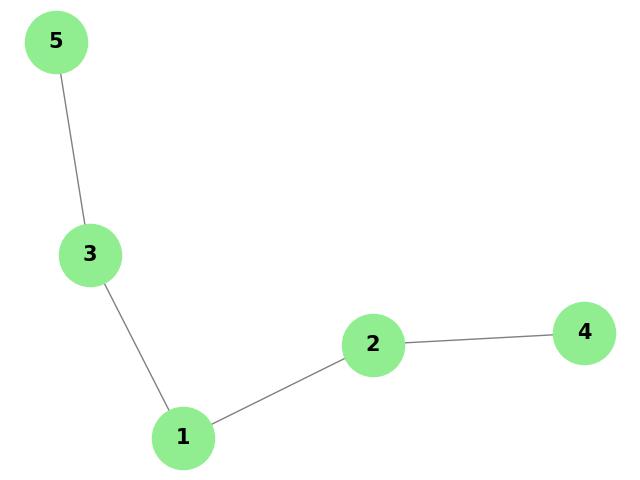
Let us calculate the eccentricity of each vertex −
Vertex 1:
- Distance to 2: 1 (direct edge)
- Distance to 3: 1 (direct edge)
- Distance to 4: 2 (through vertex 2)
- Distance to 5: 2 (through vertex 3)
- Maximum distance: 2 (between vertices 1 and 4 or 1 and 5)
Eccentricity of Vertex 1: 2
Vertex 2:
- Distance to 1: 1 (direct edge)
- Distance to 3: 2 (through vertex 1)
- Distance to 4: 1 (direct edge)
- Distance to 5: 3 (through vertices 1 and 3)
- Maximum distance: 3 (between vertices 2 and 5)
Eccentricity of Vertex 2: 3
Vertex 3:
- Distance to 1: 1 (direct edge)
- Distance to 2: 2 (through vertex 1)
- Distance to 4: 3 (through vertices 1 and 2)
- Distance to 5: 1 (direct edge)
- Maximum distance: 3 (between vertices 3 and 4)
Eccentricity of Vertex 3: 3
Vertex 4:
- Distance to 1: 2 (through vertex 2)
- Distance to 2: 1 (direct edge)
- Distance to 3: 3 (through vertices 2 and 1)
- Distance to 5: 4 (through vertices 2, 1, and 3)
- Maximum distance: 4 (between vertices 4 and 5)
Eccentricity of Vertex 4: 4
Vertex 5:
- Distance to 1: 2 (through vertex 3)
- Distance to 2: 3 (through vertices 3 and 1)
- Distance to 3: 1 (direct edge)
- Distance to 4: 4 (through vertices 3, 1, and 2)
- Maximum distance: 4 (between vertices 5 and 4)
Eccentricity of Vertex 5: 4
Therefore, the radius of the graph is 2, as the minimum eccentricity is 2 for vertex 1.
Radius in Trees
In a tree, the radius is the minimum distance from any vertex to the farthest vertex, and the center is the set of vertices that have the smallest eccentricity. A tree always has a center, and it is always either one or two vertices. The center can be identified by finding the central vertex or vertices of the tree.
For example, in a path graph (a simple tree), the center is the middle vertex (or two middle vertices if the number of vertices is even). The radius is the distance from the middle vertex to the farthest vertex.
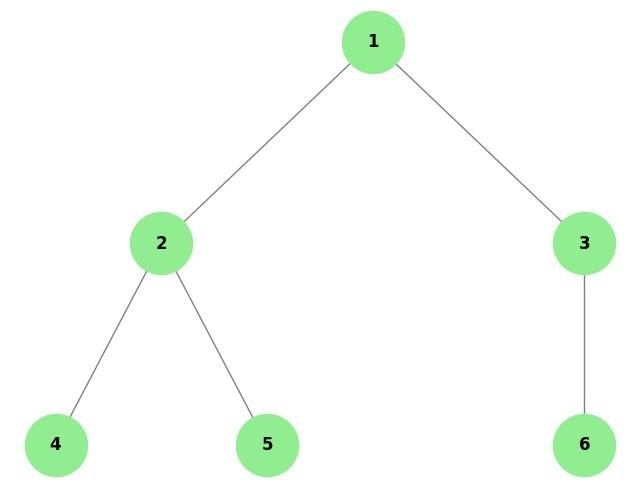
Eccentricity of each vertex −
- Vertex 1: 2
- Vertex 2: 3
- Vertex 3: 3
- Vertex 4: 4
- Vertex 5: 4
- Vertex 6: 4
Radius of the tree: 2
Center of the tree: [1]
Radius of Cyclic Graphs
In cyclic graphs, the radius is the minimum eccentricity, and the center is usually one or two vertices located at the center of the cycle.
The eccentricity in a cyclic graph is typically equal for all vertices, and the center can be identified by selecting the middle vertex (or two middle vertices for an even number of vertices).
Complete Graphs
In a complete graph, the radius and the center are easily determined. Since every vertex is connected to every other vertex, the eccentricity of all vertices is 1. Therefore, the radius is 1.
Grid Graphs
In grid graphs, the radius is the minimum distance from any vertex to the farthest vertex.
For an m x n grid graph, the radius is typically ⌊(m + n) / 2⌋ , where m is the number of rows, and n is the number of columns. This represents the minimum distance between vertices.
Diameter vs. Radius: Key Differences
The diameter of a graph is the longest shortest path between any two vertices, while the radius measures the smallest maximum distance from any vertex to others. The diameter is always greater than or equal to the radius.
For example, in a complete graph, the diameter is 1, while the radius is also 1, indicating all vertices are equally connected.
Center of Graph
The center of a graph is defined as the set of vertices that have the minimum eccentricity. These vertices are located in the most central position, with the smallest maximum distance to any other vertex in the graph.
Formally, the center C of a graph G is defined as −
C = { v ∈ G | ecc(v) = r }
Where r is the radius of the graph, and ecc(v) is the eccentricity of vertex v.
The center is closely related to the radius of a graph, as it contains the vertices whose eccentricity equals the radius.
Properties of the Center
Following are the properties of the center of a graph −
- Uniqueness of the Center: The center of a graph may consist of one or two vertices, but it is always well-defined and can be identified using eccentricity calculations.
- Relation to Radius: The center is always a vertex or vertices with eccentricity equal to the radius, representing the most centrally located points in the graph.
- Geodesic Distance: The center is essential in minimizing geodesic distances, ensuring the most efficient connections in terms of shortest paths.
Identifying the Center
To identify the center of a graph, we follow these steps −
- For each vertex, calculate its eccentricity.
- Determine the set of vertices whose eccentricity equals the radius. These vertices form the center of the graph.
Example: Simple Graph
Consider a graph with 6 vertices −
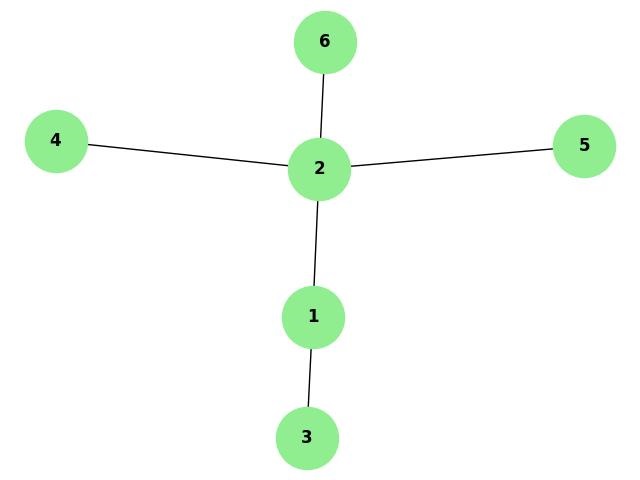
Let us calculate the eccentricity for each vertex −
Eccentricity of Vertex 1
Vertex 1 is connected to vertices 2 and 3. The distances are −
- Distance to Vertex 2: 1
- Distance to Vertex 3: 1
- Distance to Vertex 4: 2 (via Vertex 2)
- Distance to Vertex 5: 2 (via Vertex 2)
- Distance to Vertex 6: 2 (via Vertex 2)
Maximum distance (eccentricity) from Vertex 1 is 2.
Eccentricity of Vertex 2
Vertex 2 is connected to vertices 1, 4, 5, and 6. The distances are −
- Distance to Vertex 1: 1
- Distance to Vertex 3: 2 (via Vertex 1)
- Distance to Vertex 4: 1
- Distance to Vertex 5: 1
- Distance to Vertex 6: 1
Maximum distance (eccentricity) from Vertex 2 is 2.
Eccentricity of Vertex 3
Vertex 3 is connected to Vertex 1. The distances are −
- Distance to Vertex 1: 1
- Distance to Vertex 2: 2 (via Vertex 1)
- Distance to Vertex 4: 3 (via Vertex 1 and Vertex 2)
- Distance to Vertex 5: 3 (via Vertex 1 and Vertex 2)
- Distance to Vertex 6: 3 (via Vertex 1 and Vertex 2)
Maximum distance (eccentricity) from Vertex 3 is 3.
Eccentricity of Vertex 4
Vertex 4 is connected to Vertex 2. The distances are −
- Distance to Vertex 1: 2 (via Vertex 2)
- Distance to Vertex 2: 1
- Distance to Vertex 3: 3 (via Vertex 2 and Vertex 1)
- Distance to Vertex 5: 2 (via Vertex 2)
- Distance to Vertex 6: 2 (via Vertex 2)
Maximum distance (eccentricity) from Vertex 4 is 3.
Eccentricity of Vertex 5
Vertex 5 is connected to Vertex 2. The distances are −
- Distance to Vertex 1: 2 (via Vertex 2)
- Distance to Vertex 2: 1
- Distance to Vertex 3: 3 (via Vertex 2 and Vertex 1)
- Distance to Vertex 4: 2 (via Vertex 2)
- Distance to Vertex 6: 2 (via Vertex 2)
Maximum distance (eccentricity) from Vertex 5 is 3.
Eccentricity of Vertex 6
Vertex 6 is connected to Vertex 2. The distances are −
- Distance to Vertex 1: 2 (via Vertex 2)
- Distance to Vertex 2: 1
- Distance to Vertex 3: 3 (via Vertex 2 and Vertex 1)
- Distance to Vertex 4: 2 (via Vertex 2)
- Distance to Vertex 5: 2 (via Vertex 2)
Maximum distance (eccentricity) from Vertex 6 is 3.
From the above calculations, we see that both vertices 1 and 2 have the smallest eccentricity of 2. Since vertex 2 connects directly to more vertices, it is considered more central.
Thus, vertex 2 is chosen as the center, and the radius is 2.
Center in Trees
In a tree, the center is either one vertex or two vertices located at the middle of the longest path in the tree. This central location ensures that the maximum distance from the center to any other vertex is minimized.
Center in Cyclic Graphs
In cyclic graphs, the center is either one or two vertices located at the center of the cycle. The eccentricity of all vertices in a cycle is usually equal, so the center can be identified by selecting the middle vertex (or two middle vertices for an even number of vertices).
Example
Consider a cyclic graph with 6 vertices connected in a cycle −
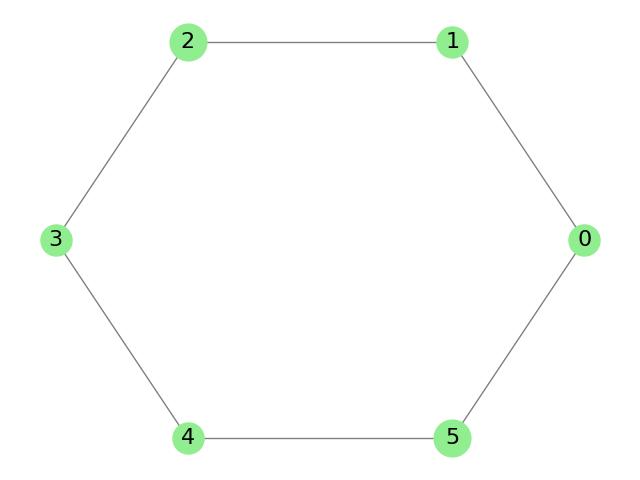
In this cyclic graph, all vertices have the same eccentricity because each vertex is the same distance from the farthest vertex in the cycle. The eccentricity of each vertex is 3, as it takes a maximum of 3 steps to reach any other vertex in the cycle.
Identifying the Center
Since the graph has an even number of vertices (6), the center is the pair of vertices that are equidistant from the ends of the cycle. In this case, the vertices at the center of the cycle are −
- Vertex 0
- Vertex 3
These vertices are the center of the cyclic graph because they are positioned at equal distances from the ends of the cycle.
