- Graph Theory - Home
- Graph Theory - Introduction
- Graph Theory - History
- Graph Theory - Fundamentals
- Graph Theory - Applications
- Types of Graphs
- Graph Theory - Types of Graphs
- Graph Theory - Simple Graphs
- Graph Theory - Multi-graphs
- Graph Theory - Directed Graphs
- Graph Theory - Weighted Graphs
- Graph Theory - Bipartite Graphs
- Graph Theory - Complete Graphs
- Graph Theory - Subgraphs
- Graph Theory - Trees
- Graph Theory - Forests
- Graph Theory - Planar Graphs
- Graph Theory - Hypergraphs
- Graph Theory - Infinite Graphs
- Graph Theory - Random Graphs
- Graph Representation
- Graph Theory - Graph Representation
- Graph Theory - Adjacency Matrix
- Graph Theory - Adjacency List
- Graph Theory - Incidence Matrix
- Graph Theory - Edge List
- Graph Theory - Compact Representation
- Graph Theory - Incidence Structure
- Graph Theory - Matrix-Tree Theorem
- Graph Properties
- Graph Theory - Basic Properties
- Graph Theory - Coverings
- Graph Theory - Matchings
- Graph Theory - Independent Sets
- Graph Theory - Traversability
- Graph Theory Connectivity
- Graph Theory - Connectivity
- Graph Theory - Vertex Connectivity
- Graph Theory - Edge Connectivity
- Graph Theory - k-Connected Graphs
- Graph Theory - 2-Vertex-Connected Graphs
- Graph Theory - 2-Edge-Connected Graphs
- Graph Theory - Strongly Connected Graphs
- Graph Theory - Weakly Connected Graphs
- Graph Theory - Connectivity in Planar Graphs
- Graph Theory - Connectivity in Dynamic Graphs
- Special Graphs
- Graph Theory - Regular Graphs
- Graph Theory - Complete Bipartite Graphs
- Graph Theory - Chordal Graphs
- Graph Theory - Line Graphs
- Graph Theory - Complement Graphs
- Graph Theory - Graph Products
- Graph Theory - Petersen Graph
- Graph Theory - Cayley Graphs
- Graph Theory - De Bruijn Graphs
- Graph Algorithms
- Graph Theory - Graph Algorithms
- Graph Theory - Breadth-First Search
- Graph Theory - Depth-First Search (DFS)
- Graph Theory - Dijkstra's Algorithm
- Graph Theory - Bellman-Ford Algorithm
- Graph Theory - Floyd-Warshall Algorithm
- Graph Theory - Johnson's Algorithm
- Graph Theory - A* Search Algorithm
- Graph Theory - Kruskal's Algorithm
- Graph Theory - Prim's Algorithm
- Graph Theory - Borůvka's Algorithm
- Graph Theory - Ford-Fulkerson Algorithm
- Graph Theory - Edmonds-Karp Algorithm
- Graph Theory - Push-Relabel Algorithm
- Graph Theory - Dinic's Algorithm
- Graph Theory - Hopcroft-Karp Algorithm
- Graph Theory - Tarjan's Algorithm
- Graph Theory - Kosaraju's Algorithm
- Graph Theory - Karger's Algorithm
- Graph Coloring
- Graph Theory - Coloring
- Graph Theory - Edge Coloring
- Graph Theory - Total Coloring
- Graph Theory - Greedy Coloring
- Graph Theory - Four Color Theorem
- Graph Theory - Coloring Bipartite Graphs
- Graph Theory - List Coloring
- Advanced Topics of Graph Theory
- Graph Theory - Chromatic Number
- Graph Theory - Chromatic Polynomial
- Graph Theory - Graph Labeling
- Graph Theory - Planarity & Kuratowski's Theorem
- Graph Theory - Planarity Testing Algorithms
- Graph Theory - Graph Embedding
- Graph Theory - Graph Minors
- Graph Theory - Isomorphism
- Spectral Graph Theory
- Graph Theory - Graph Laplacians
- Graph Theory - Cheeger's Inequality
- Graph Theory - Graph Clustering
- Graph Theory - Graph Partitioning
- Graph Theory - Tree Decomposition
- Graph Theory - Treewidth
- Graph Theory - Branchwidth
- Graph Theory - Graph Drawings
- Graph Theory - Force-Directed Methods
- Graph Theory - Layered Graph Drawing
- Graph Theory - Orthogonal Graph Drawing
- Graph Theory - Examples
- Computational Complexity of Graph
- Graph Theory - Time Complexity
- Graph Theory - Space Complexity
- Graph Theory - NP-Complete Problems
- Graph Theory - Approximation Algorithms
- Graph Theory - Parallel & Distributed Algorithms
- Graph Theory - Algorithm Optimization
- Graphs in Computer Science
- Graph Theory - Data Structures for Graphs
- Graph Theory - Graph Implementations
- Graph Theory - Graph Databases
- Graph Theory - Query Languages
- Graph Algorithms in Machine Learning
- Graph Neural Networks
- Graph Theory - Link Prediction
- Graph-Based Clustering
- Graph Theory - PageRank Algorithm
- Graph Theory - HITS Algorithm
- Graph Theory - Social Network Analysis
- Graph Theory - Centrality Measures
- Graph Theory - Community Detection
- Graph Theory - Influence Maximization
- Graph Theory - Graph Compression
- Graph Theory Real-World Applications
- Graph Theory - Network Routing
- Graph Theory - Traffic Flow
- Graph Theory - Web Crawling Data Structures
- Graph Theory - Computer Vision
- Graph Theory - Recommendation Systems
- Graph Theory - Biological Networks
- Graph Theory - Social Networks
- Graph Theory - Smart Grids
- Graph Theory - Telecommunications
- Graph Theory - Knowledge Graphs
- Graph Theory - Game Theory
- Graph Theory - Urban Planning
- Graph Theory Useful Resources
- Graph Theory - Quick Guide
- Graph Theory - Useful Resources
- Graph Theory - Discussion
Graph Theory - Greedy Coloring
Greedy Coloring
Greedy coloring is used to assign a color to each vertex of the graph in a sequential manner, ensuring that no two adjacent vertices share the same color.
The algorithm works by selecting a vertex, finding the smallest available color that hasn't been used by its adjacent vertices, and then moving on to the next vertex. This process continues until all vertices are colored.
Although greedy coloring does not always produce the optimal solution (i.e., the minimum number of colors), it is efficient and works well in many practical scenarios. The challenge in greedy coloring lies in selecting the order in which vertices are processed, as the choice of order can affect the number of colors used.
Steps in Greedy Coloring Algorithm
The greedy coloring algorithm follows these basic steps −
- Step 1: Sort the vertices in some order. The order can be random, based on degree (degree of the vertex), or using other heuristics.
- Step 2: For each vertex, assign the smallest color that is not already used by its adjacent vertices.
- Step 3: Repeat this process for all vertices until the graph is fully colored.
Graph Coloring Using Greedy Algorithm
Let us walk through an example to better understand how greedy coloring works −
- Graph Structure: Consider the following graph with five vertices (A, B, C, D, E) and edges between the vertices: (A, B), (A, C), (B, D), (C, D), (C, E).
- Step 1: We start by choosing vertex A and assign it color 1.
- Step 2: Move to vertex B. The adjacent vertex A is colored 1, so we assign vertex B color 2.
- Step 3: Next, vertex C is considered. The adjacent vertices are A (color 1) and B (color 2), so we assign vertex C color 3.
- Step 4: For vertex D, the adjacent vertices are B (color 2) and C (color 3), so we assign color 1 to vertex D.
- Step 5: Finally, for vertex E, the adjacent vertex C is colored 3, so we assign vertex E color 2.
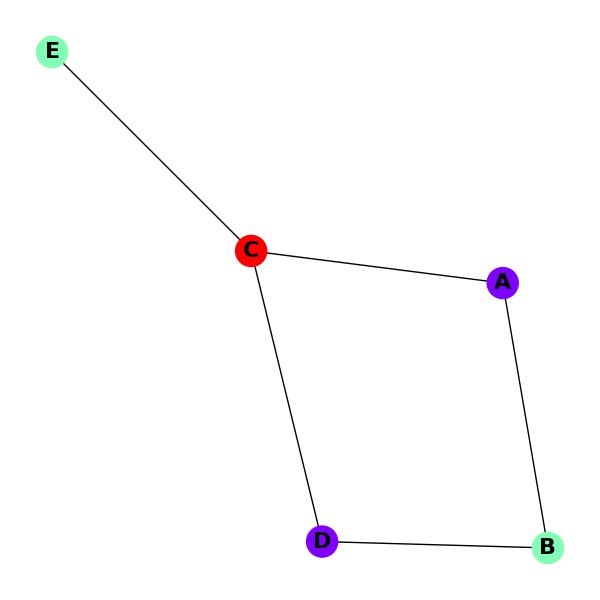
Result: The final coloring of the graph is −
- A: Color 1
- B: Color 2
- C: Color 3
- D: Color 1
- E: Color 2
Greedy Coloring Performance
The greedy algorithm for graph coloring is not guaranteed to find the minimum number of colors, but it works efficiently for many graphs. The performance of the greedy algorithm depends heavily on the order in which the vertices are processed.
In some cases, it may use more colors than necessary, but in others, it can perform quite well and find the optimal coloring.
For graphs with large maximum degrees or highly connected vertices, the greedy algorithm may require a large number of colors. However, in graphs with low degree or sparse connections, the algorithm tends to work more efficiently, producing an optimal solution.
Optimizing Greedy Coloring
To improve the greedy coloring algorithm, heuristics (techniques) are applied to choose the vertex order in a way that minimizes the number of colors used. A few common heuristics are as follows −
- Degree-based Heuristic: Sort the vertices in decreasing order of their degree (the number of edges connected to the vertex). This is known as the degree-of-vertex heuristic and helps reduce the number of colors used.
- Largest First Heuristic: Similar to the degree-based heuristic, but it considers the vertices with the largest degree first, which can lead to a more optimal coloring.
- Smallest Last Heuristic: The opposite of the largest first heuristic, where vertices with the smallest degree are processed first. This method may also help reduce the coloring cost in some cases.
Applications of Greedy Coloring
Greedy coloring has several practical applications, especially in areas that involve resource allocation or scheduling. Some of the main applications are −
- Register Allocation in Compilers: When compiling a program, a graph is created where each variable is a vertex, and edges represent variables that cannot share the same register. Greedy coloring helps in assigning registers to variables in an efficient manner.
- Frequency Assignment in Telecommunications: In wireless communication, frequencies need to be assigned to transmitters in such a way that adjacent transmitters do not use the same frequency. Greedy coloring is used to allocate frequencies.
- Time-Table Scheduling: Greedy coloring is also used for scheduling tasks where adjacent tasks (e.g., tasks sharing a common resource) cannot be scheduled at the same time.
- Traffic Management: In traffic flow optimization, where intersections or routes are treated as vertices, greedy coloring can be used to allocate different signal phases to avoid conflicts at traffic lights.
Greedy Coloring Limitations
While the greedy algorithm is efficient, it has several limitations −
- Suboptimal Results: As mentioned above, greedy coloring does not always produce the minimum number of colors. There are graphs where the algorithm may use more colors than necessary, resulting in suboptimal solutions.
- Dependence on Vertex Order: The outcome of the greedy algorithm depends heavily on the order in which vertices are processed. A poor order can lead to a higher number of colors being used, making the coloring less efficient.
- Limited to Simple Graphs: The greedy algorithm works best on simple graphs but may not perform well on more complex graphs such as bipartite or dense graphs, where more sophisticated algorithms are needed.
Greedy Coloring in Bipartite Graphs
In a bipartite graph, where vertices can be divided into two disjoint sets such that no two vertices within the same set are adjacent, the greedy algorithm can achieve the optimal coloring using only two colors.
This is because no two adjacent vertices will share the same color as they belong to different sets, and only two colors are required for such graphs.
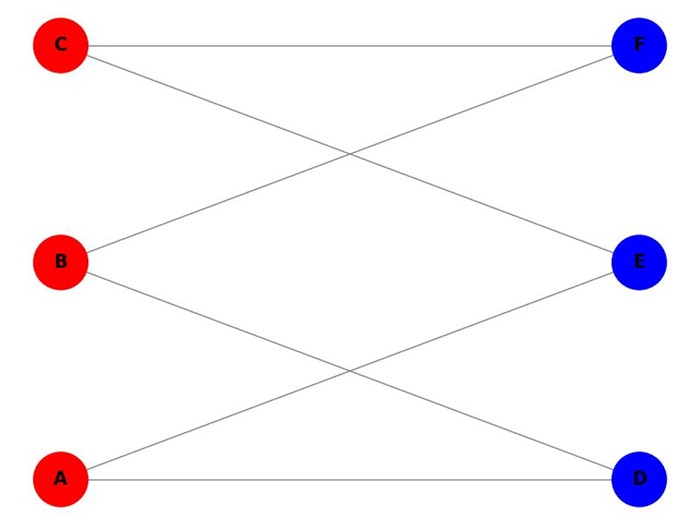
For example, consider a simple bipartite graph with two sets of vertices: {A, B, C} and {D, E, F}. The edges connect vertices between the two sets, but there are no edges within the same set. Greedy coloring would assign color 1 to the vertices in the first set and color 2 to the vertices in the second set.
Greedy Coloring and Planar Graphs
In planar graphs, where edges don't cross when drawn on a plane, greedy coloring can still work well. According to the four-color theorem, any planar graph can be colored with no more than four colors.
The greedy algorithm, especially with heuristics like the degree-based heuristic, can produce a good coloring close to the four-color bound for planar graphs.
However, the greedy algorithm doesn't always guarantee the best solution, especially for large or complex graphs. It may use more than four colors, even though only four are theoretically needed.