
- Graph Theory - Home
- Graph Theory - Introduction
- Graph Theory - History
- Graph Theory - Fundamentals
- Graph Theory - Applications
- Types of Graphs
- Graph Theory - Types of Graphs
- Graph Theory - Simple Graphs
- Graph Theory - Multi-graphs
- Graph Theory - Directed Graphs
- Graph Theory - Weighted Graphs
- Graph Theory - Bipartite Graphs
- Graph Theory - Complete Graphs
- Graph Theory - Subgraphs
- Graph Theory - Trees
- Graph Theory - Forests
- Graph Theory - Planar Graphs
- Graph Theory - Hypergraphs
- Graph Theory - Infinite Graphs
- Graph Theory - Random Graphs
- Graph Representation
- Graph Theory - Graph Representation
- Graph Theory - Adjacency Matrix
- Graph Theory - Adjacency List
- Graph Theory - Incidence Matrix
- Graph Theory - Edge List
- Graph Theory - Compact Representation
- Graph Theory - Incidence Structure
- Graph Theory - Matrix-Tree Theorem
- Graph Properties
- Graph Theory - Basic Properties
- Graph Theory - Coverings
- Graph Theory - Matchings
- Graph Theory - Independent Sets
- Graph Theory - Traversability
- Graph Theory Connectivity
- Graph Theory - Connectivity
- Graph Theory - Vertex Connectivity
- Graph Theory - Edge Connectivity
- Graph Theory - k-Connected Graphs
- Graph Theory - 2-Vertex-Connected Graphs
- Graph Theory - 2-Edge-Connected Graphs
- Graph Theory - Strongly Connected Graphs
- Graph Theory - Weakly Connected Graphs
- Graph Theory - Connectivity in Planar Graphs
- Graph Theory - Connectivity in Dynamic Graphs
- Special Graphs
- Graph Theory - Regular Graphs
- Graph Theory - Complete Bipartite Graphs
- Graph Theory - Chordal Graphs
- Graph Theory - Line Graphs
- Graph Theory - Complement Graphs
- Graph Theory - Graph Products
- Graph Theory - Petersen Graph
- Graph Theory - Cayley Graphs
- Graph Theory - De Bruijn Graphs
- Graph Algorithms
- Graph Theory - Graph Algorithms
- Graph Theory - Breadth-First Search
- Graph Theory - Depth-First Search (DFS)
- Graph Theory - Dijkstra's Algorithm
- Graph Theory - Bellman-Ford Algorithm
- Graph Theory - Floyd-Warshall Algorithm
- Graph Theory - Johnson's Algorithm
- Graph Theory - A* Search Algorithm
- Graph Theory - Kruskal's Algorithm
- Graph Theory - Prim's Algorithm
- Graph Theory - Borůvka's Algorithm
- Graph Theory - Ford-Fulkerson Algorithm
- Graph Theory - Edmonds-Karp Algorithm
- Graph Theory - Push-Relabel Algorithm
- Graph Theory - Dinic's Algorithm
- Graph Theory - Hopcroft-Karp Algorithm
- Graph Theory - Tarjan's Algorithm
- Graph Theory - Kosaraju's Algorithm
- Graph Theory - Karger's Algorithm
- Graph Coloring
- Graph Theory - Coloring
- Graph Theory - Edge Coloring
- Graph Theory - Total Coloring
- Graph Theory - Greedy Coloring
- Graph Theory - Four Color Theorem
- Graph Theory - Coloring Bipartite Graphs
- Graph Theory - List Coloring
- Advanced Topics of Graph Theory
- Graph Theory - Chromatic Number
- Graph Theory - Chromatic Polynomial
- Graph Theory - Graph Labeling
- Graph Theory - Planarity & Kuratowski's Theorem
- Graph Theory - Planarity Testing Algorithms
- Graph Theory - Graph Embedding
- Graph Theory - Graph Minors
- Graph Theory - Isomorphism
- Spectral Graph Theory
- Graph Theory - Graph Laplacians
- Graph Theory - Cheeger's Inequality
- Graph Theory - Graph Clustering
- Graph Theory - Graph Partitioning
- Graph Theory - Tree Decomposition
- Graph Theory - Treewidth
- Graph Theory - Branchwidth
- Graph Theory - Graph Drawings
- Graph Theory - Force-Directed Methods
- Graph Theory - Layered Graph Drawing
- Graph Theory - Orthogonal Graph Drawing
- Graph Theory - Examples
- Computational Complexity of Graph
- Graph Theory - Time Complexity
- Graph Theory - Space Complexity
- Graph Theory - NP-Complete Problems
- Graph Theory - Approximation Algorithms
- Graph Theory - Parallel & Distributed Algorithms
- Graph Theory - Algorithm Optimization
- Graphs in Computer Science
- Graph Theory - Data Structures for Graphs
- Graph Theory - Graph Implementations
- Graph Theory - Graph Databases
- Graph Theory - Query Languages
- Graph Algorithms in Machine Learning
- Graph Neural Networks
- Graph Theory - Link Prediction
- Graph-Based Clustering
- Graph Theory - PageRank Algorithm
- Graph Theory - HITS Algorithm
- Graph Theory - Social Network Analysis
- Graph Theory - Centrality Measures
- Graph Theory - Community Detection
- Graph Theory - Influence Maximization
- Graph Theory - Graph Compression
- Graph Theory Real-World Applications
- Graph Theory - Network Routing
- Graph Theory - Traffic Flow
- Graph Theory - Web Crawling Data Structures
- Graph Theory - Computer Vision
- Graph Theory - Recommendation Systems
- Graph Theory - Biological Networks
- Graph Theory - Social Networks
- Graph Theory - Smart Grids
- Graph Theory - Telecommunications
- Graph Theory - Knowledge Graphs
- Graph Theory - Game Theory
- Graph Theory - Urban Planning
- Graph Theory Useful Resources
- Graph Theory - Quick Guide
- Graph Theory - Useful Resources
- Graph Theory - Discussion
Graph Theory - Graph Diameter
Graph Diameter
The diameter of a graph is the greatest distance between any pair of vertices, where the distance between two vertices is defined as the length of the shortest path connecting them.
In mathematical terms, the diameter of a graph G is denoted as diam(G). If d(u, v) represents the shortest path distance between vertices u and v, the diameter is given by −
diam(G) = max(d(u, v)) for all u, v in G
This means that the diameter is the maximum value among all the shortest path distances between any two vertices in the graph.
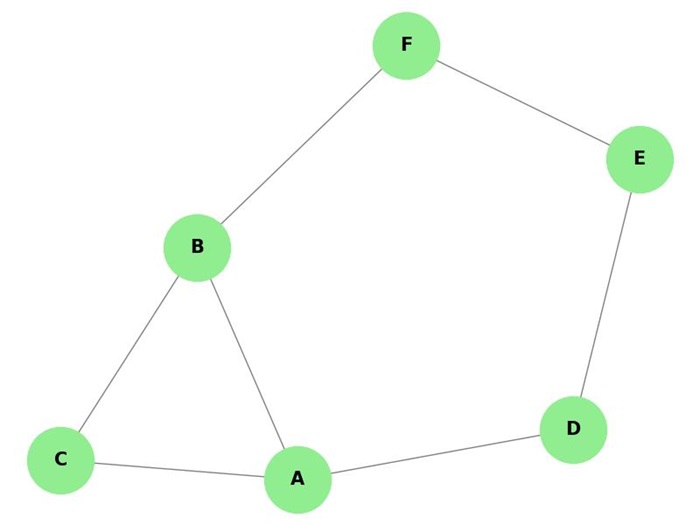
In this graph, the shortest path distances between pairs of vertices are as follows −
- d(A, B) = 1
- d(A, C) = 1
- d(A, D) = 1
- d(A, E) = 2
- d(A, F) = 2
- d(B, C) = 1
- d(B, D) = 2
- d(B, E) = 2
- d(B, F) = 1
- d(C, D) = 2
- d(C, E) = 3
- d(C, F) = 2
- d(D, E) = 1
- d(D, F) = 2
- d(E, F) = 1
The diameter of this graph is 3, which is the longest shortest path between vertices C and E.
Computing the Diameter
We can use various algorithms to compute the diameter of the graph, such as −
- Floyd-Warshall Algorithm
- Breadth-First Search (BFS) Algorithm
- Dijkstra's Algorithm
Floyd-Warshall Algorithm
The Floyd-Warshall algorithm is used to find shortest paths between all pairs of vertices in a graph. It has a time complexity of O(V3), where V is the number of vertices.
In the following graph, we use the Floyd-Warshall algorithm to compute the diameter of a graph −
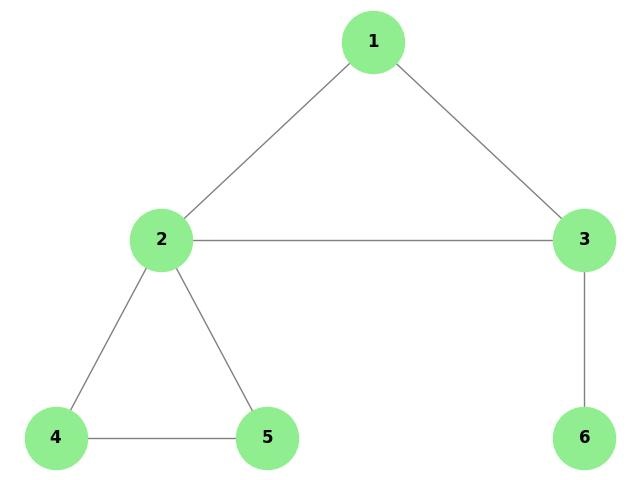
The diameter of the graph is 3 because the longest shortest path between any two vertices in the graph is from node 4 to node 6, passing through nodes 2 and 3. This path has a total length of 3 edges.
Breadth-First Search (BFS)
BFS can be used to find the shortest path between vertices in an unweighted graph. To compute the diameter using BFS, we perform a BFS from each vertex and record the maximum distance found.
In the following example, we use BFS to compute the diameter of an unweighted graph −
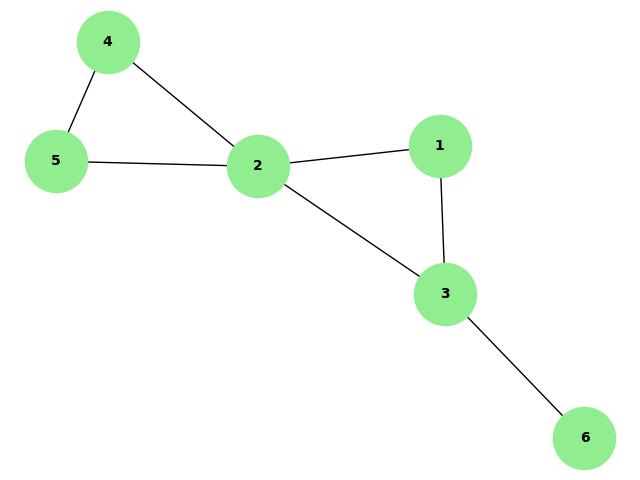
The diameter of the graph is 3. This is because the longest shortest path between any two vertices in the graph is from vertex 1 to vertex 4, passing through vertices 2 and 5.
Graph Diameter: Simple Undirected Graph
The diameter of a simple undirected graph is the longest shortest path between any two nodes in the graph. It measures the maximum distance you need to travel to connect any two nodes.
A simple undirected path is a sequence of distinct nodes in an undirected graph where each node is connected to the next one by an edge, and no node is repeated in the path. In other words, it is a path that doesn't revisit any node, and the edges have no direction, meaning the connection between nodes can be traversed in both directions.
Consider the following simple undirected graph −
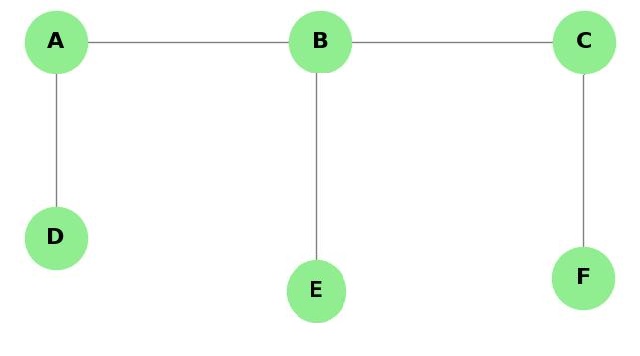
The shortest path distances between pairs of vertices are as follows −
- d(A, B) = 1
- d(A, C) = 2
- d(A, D) = 1
- d(A, E) = 2
- d(A, F) = 3
- d(B, C) = 1
- d(B, D) = 2
- d(B, E) = 1
- d(B, F) = 2
- d(C, D) = 3
- d(C, E) = 2
- d(C, F) = 1
- d(D, E) = 3
- d(D, F) = 4
- d(E, F) = 3
The diameter of this graph is 4, which is the longest shortest path between vertices D and F.
Graph Diameter: Weighted Graph
The diameter of a weighted graph is the longest shortest path between any two nodes, considering the weights (or costs) of the edges. It measures the maximum distance required to travel between any pair of nodes in the graph, where the distance is the sum of edge weights.
Consider the following weighted graph −
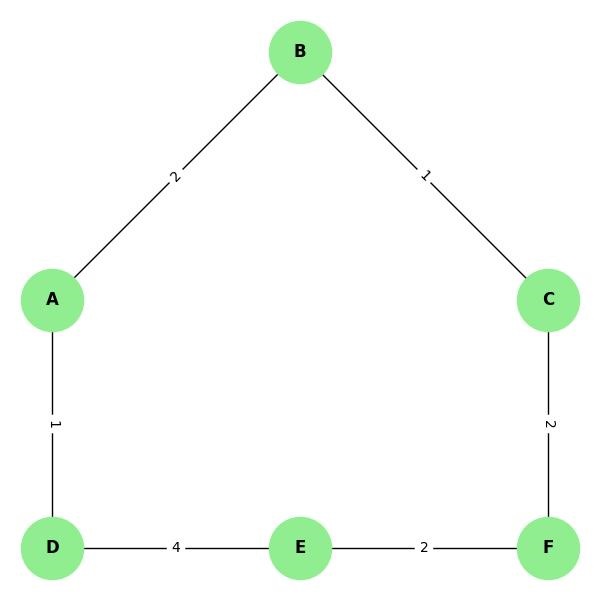
The shortest path distances between pairs of vertices, considering the weights, are as follows:
- d(A, B) = 2
- d(A, C) = 3
- d(A, D) = 1
- d(A, E) = 5
- d(A, F) = 5
- d(B, C) = 1
- d(B, D) = 3
- d(B, E) = 5
- d(B, F) = 3
- d(C, D) = 4
- d(C, E) = 4
- d(C, F) = 2
- d(D, E) = 4
- d(D, F) = 6
- d(E, F) = 2
The diameter of this graph is 6, which is the longest shortest path between vertices D and F.
Properties of Graph Diameter
The diameter of a graph has various important properties, they are −
- Unique for Connected Graphs: The diameter is well-defined and unique for connected graphs. For disconnected graphs, the diameter is considered infinite.
- Symmetric: The diameter is symmetric, meaning diam(G) is the same regardless of the direction of the edges in undirected graphs.
- Affected by Graph Changes: Adding or removing edges or vertices can change the diameter of the graph.
Diameter in Different Types of Graphs
The diameter can vary significantly depending on the type and structure of the graph −
Tree Graphs
In tree graphs, which are acyclic connected graphs, the diameter is the longest path between any two leaves (vertices with degree 1).
For example, in a binary tree, the diameter can be found by identifying the longest path between any two leaf nodes.
Complete Graphs
In complete graphs, where every pair of vertices is connected by an edge, the diameter is always 1. This is because the shortest path between any two vertices is a direct edge.
For instance, in a complete graph with n vertices, each vertex is connected to every other vertex, resulting in a diameter of 1.
Cycle Graphs
In cycle graphs, where vertices form a single cycle, the diameter is n/2 for an even number of vertices and ⌊n/2⌋ (the greatest integer less than or equal to n/2) for an odd number of vertices. This is because the longest shortest path is half the length of the cycle.
For example, in a cycle graph with 6 vertices, the diameter is 3.
Grid Graphs
In grid graphs, which are a regular lattice of vertices, the diameter depends on the dimensions of the grid. For a m x n grid graph, the diameter is m + n - 2 if m and n are the grid dimensions.
For example, in a 3 x 3 grid graph, the diameter is 4.
Diameter in Real-World Networks
Graph diameter is an important measure in various real-world networks −
Social Networks
In social networks, the diameter indicates the maximum degree of separation between individuals. It reflects the "small world" phenomenon, where most individuals are connected by a short path of acquaintances.
For example, studies on social networks like Facebook and Twitter have shown that the diameter is relatively small, indicating a high level of connectivity.
Transportation Networks
In transportation networks, the diameter represents the longest shortest path between any two locations.
For instance, in a road network, the diameter indicates the longest travel distance between any two points, helping in planning and optimizing routes.
Communication Networks
In communication networks, such as the internet, the diameter indicates the maximum number of hops (intermediate nodes) required to transmit data between any two devices. A smaller diameter signifies a more efficient network.
For example, in a well-connected communication network, the diameter is minimized to ensure faster data transmission.
Impact of Graph Modifications on Diameter
Modifying a graph by adding or removing vertices or edges can affect its diameter −
Adding Edges
Adding edges to a graph can potentially decrease its diameter by creating shorter paths between vertices. This is particularly true for sparse graphs where additional edges improve connectivity.
For example, adding an edge between two distant vertices in a tree graph can significantly reduce the diameter.
Removing Edges
Removing edges from a graph can increase its diameter by eliminating direct paths and forcing traversal through longer paths. This effect is stronger in graphs with important edges that are part of the shortest paths between many pairs of vertices.
For instance, removing an edge that connects two clusters in a graph can drastically increase the diameter.
Adding Vertices
Adding vertices to a graph does not directly affect the diameter unless new edges are added as well. The impact on the diameter depends on the placement of the new vertices and the edges connecting them.
For example, adding a vertex with edges connecting to multiple existing vertices can reduce the diameter by providing new shortcuts.
Removing Vertices
Removing vertices from a graph can increase the diameter by eliminating potential shortcuts and forcing traversal through longer paths. The impact is greater if the removed vertices are central to the graph's connectivity.
For instance, removing a central hub vertex in a star graph can significantly increase the diameter.
Diameter in Directed Graphs
In directed graphs, the diameter is calculated considering the direction of edges. The diameter is the longest shortest path considering the directed nature of the paths.
Strongly Connected Components
In strongly connected directed graphs, where every vertex is reachable from every other vertex, the diameter is well-defined. The calculation involves finding the longest shortest path considering the direction of edges.
For example, in a strongly connected component of a directed graph, the diameter reflects the longest shortest path in the directed subgraph.
Weakly Connected Components
In weakly connected directed graphs, where replacing all directed edges with undirected edges results in a connected graph, the diameter is considered infinite if there exists a pair of vertices with no directed path between them.
For instance, in a weakly connected directed graph, the diameter is infinite if there are pairs of vertices with no directed paths connecting them.
