
- Graph Theory - Home
- Graph Theory - Introduction
- Graph Theory - History
- Graph Theory - Fundamentals
- Graph Theory - Applications
- Types of Graphs
- Graph Theory - Types of Graphs
- Graph Theory - Simple Graphs
- Graph Theory - Multi-graphs
- Graph Theory - Directed Graphs
- Graph Theory - Weighted Graphs
- Graph Theory - Bipartite Graphs
- Graph Theory - Complete Graphs
- Graph Theory - Subgraphs
- Graph Theory - Trees
- Graph Theory - Forests
- Graph Theory - Planar Graphs
- Graph Theory - Hypergraphs
- Graph Theory - Infinite Graphs
- Graph Theory - Random Graphs
- Graph Representation
- Graph Theory - Graph Representation
- Graph Theory - Adjacency Matrix
- Graph Theory - Adjacency List
- Graph Theory - Incidence Matrix
- Graph Theory - Edge List
- Graph Theory - Compact Representation
- Graph Theory - Incidence Structure
- Graph Theory - Matrix-Tree Theorem
- Graph Properties
- Graph Theory - Basic Properties
- Graph Theory - Coverings
- Graph Theory - Matchings
- Graph Theory - Independent Sets
- Graph Theory - Traversability
- Graph Theory Connectivity
- Graph Theory - Connectivity
- Graph Theory - Vertex Connectivity
- Graph Theory - Edge Connectivity
- Graph Theory - k-Connected Graphs
- Graph Theory - 2-Vertex-Connected Graphs
- Graph Theory - 2-Edge-Connected Graphs
- Graph Theory - Strongly Connected Graphs
- Graph Theory - Weakly Connected Graphs
- Graph Theory - Connectivity in Planar Graphs
- Graph Theory - Connectivity in Dynamic Graphs
- Special Graphs
- Graph Theory - Regular Graphs
- Graph Theory - Complete Bipartite Graphs
- Graph Theory - Chordal Graphs
- Graph Theory - Line Graphs
- Graph Theory - Complement Graphs
- Graph Theory - Graph Products
- Graph Theory - Petersen Graph
- Graph Theory - Cayley Graphs
- Graph Theory - De Bruijn Graphs
- Graph Algorithms
- Graph Theory - Graph Algorithms
- Graph Theory - Breadth-First Search
- Graph Theory - Depth-First Search (DFS)
- Graph Theory - Dijkstra's Algorithm
- Graph Theory - Bellman-Ford Algorithm
- Graph Theory - Floyd-Warshall Algorithm
- Graph Theory - Johnson's Algorithm
- Graph Theory - A* Search Algorithm
- Graph Theory - Kruskal's Algorithm
- Graph Theory - Prim's Algorithm
- Graph Theory - Borůvka's Algorithm
- Graph Theory - Ford-Fulkerson Algorithm
- Graph Theory - Edmonds-Karp Algorithm
- Graph Theory - Push-Relabel Algorithm
- Graph Theory - Dinic's Algorithm
- Graph Theory - Hopcroft-Karp Algorithm
- Graph Theory - Tarjan's Algorithm
- Graph Theory - Kosaraju's Algorithm
- Graph Theory - Karger's Algorithm
- Graph Coloring
- Graph Theory - Coloring
- Graph Theory - Edge Coloring
- Graph Theory - Total Coloring
- Graph Theory - Greedy Coloring
- Graph Theory - Four Color Theorem
- Graph Theory - Coloring Bipartite Graphs
- Graph Theory - List Coloring
- Advanced Topics of Graph Theory
- Graph Theory - Chromatic Number
- Graph Theory - Chromatic Polynomial
- Graph Theory - Graph Labeling
- Graph Theory - Planarity & Kuratowski's Theorem
- Graph Theory - Planarity Testing Algorithms
- Graph Theory - Graph Embedding
- Graph Theory - Graph Minors
- Graph Theory - Isomorphism
- Spectral Graph Theory
- Graph Theory - Graph Laplacians
- Graph Theory - Cheeger's Inequality
- Graph Theory - Graph Clustering
- Graph Theory - Graph Partitioning
- Graph Theory - Tree Decomposition
- Graph Theory - Treewidth
- Graph Theory - Branchwidth
- Graph Theory - Graph Drawings
- Graph Theory - Force-Directed Methods
- Graph Theory - Layered Graph Drawing
- Graph Theory - Orthogonal Graph Drawing
- Graph Theory - Examples
- Computational Complexity of Graph
- Graph Theory - Time Complexity
- Graph Theory - Space Complexity
- Graph Theory - NP-Complete Problems
- Graph Theory - Approximation Algorithms
- Graph Theory - Parallel & Distributed Algorithms
- Graph Theory - Algorithm Optimization
- Graphs in Computer Science
- Graph Theory - Data Structures for Graphs
- Graph Theory - Graph Implementations
- Graph Theory - Graph Databases
- Graph Theory - Query Languages
- Graph Algorithms in Machine Learning
- Graph Neural Networks
- Graph Theory - Link Prediction
- Graph-Based Clustering
- Graph Theory - PageRank Algorithm
- Graph Theory - HITS Algorithm
- Graph Theory - Social Network Analysis
- Graph Theory - Centrality Measures
- Graph Theory - Community Detection
- Graph Theory - Influence Maximization
- Graph Theory - Graph Compression
- Graph Theory Real-World Applications
- Graph Theory - Network Routing
- Graph Theory - Traffic Flow
- Graph Theory - Web Crawling Data Structures
- Graph Theory - Computer Vision
- Graph Theory - Recommendation Systems
- Graph Theory - Biological Networks
- Graph Theory - Social Networks
- Graph Theory - Smart Grids
- Graph Theory - Telecommunications
- Graph Theory - Knowledge Graphs
- Graph Theory - Game Theory
- Graph Theory - Urban Planning
- Graph Theory Useful Resources
- Graph Theory - Quick Guide
- Graph Theory - Useful Resources
- Graph Theory - Discussion
Graph Theory - Cut Vertices and Bridges
Cut Vertices
A cut vertex (also known as an articulation point) in a graph is a vertex that, when removed along with its associated edges, increases the number of connected components of the graph. In other words, removing a cut vertex will disconnect the graph, splitting it into two or more disconnected subgraphs.
In a connected graph, a vertex v is a cut vertex if there exists at least one connected component that becomes disconnected when v is removed.
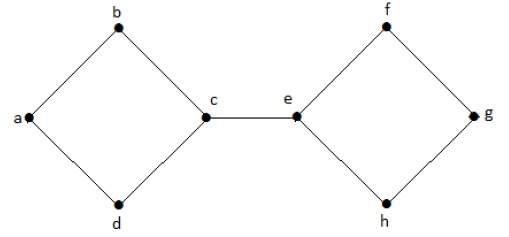
In this graph, vertex 1 is a cut vertex. Removing vertex 1 would result in two disconnected subgraphs: {2, 4, 5} and {3, 6}.
Characteristics of Cut Vertices
Cut vertices have various important characteristics, such as −
- Connectivity Impact:Removing a cut vertex breaks the graph into more disconnected parts. This means the graph will have more separate groups of vertices after the cut vertex is removed.
- Critical Nodes: Cut vertices are essential for keeping the graph connected. If a cut vertex is removed, it disrupts the connections between other vertices.
- Existence: Not all graphs have cut vertices. Whether a graph has cut vertices depends on how its vertices and edges are arranged.
Identifying Cut Vertices
There are several methods to identify cut vertices in a graph −
- Breadth-First Search (BFS)
- Depth-First Search (DFS)
- DFS Tree and Low Values
- Tarjan's Algorithm
Breadth-First Search (BFS)
BFS is a graph traversal algorithm that explores vertices level by level. It can help identify cut vertices by checking the graph's connectivity before and after removing a vertex. If removing a vertex increases the number of connected components, that vertex is a cut vertex.
In the following example, we use BFS to identify cut vertices −
   A
  / \
 B   C
    / \
   D   E
Starting from vertex A, BFS visits A, B, C, D, and E. Removing vertex C splits the graph into two components, making C a cut vertex.
Depth-First Search (DFS)
DFS is another graph traversal algorithm that explores as far along a branch as possible before backtracking. It can also be used to find cut vertices by examining the connectivity of the graph before and after removing a vertex.
In this graph example, we use DFS to identify cut vertices −
   F
  / \
 G   H
    / \
   I   J
Starting from vertex F, DFS visits F, G, H, I, and J. Removing vertex H splits the graph into two components, making H a cut vertex.
DFS Tree and Low Values
Using DFS, we can assign discovery and low values to each vertex. A vertex is a cut vertex if, for any child of the vertex in the DFS tree, there is no ancestor of the child that can be reached without going through the vertex.
In the following example, we use DFS to identify cut vertices:
   A
  / \
 D   B
 \  / \
  E    C
   \   /
    \ /
     F
DFS discovers B with discovery and low values indicating it is a cut vertex.
Tarjan's Algorithm
Tarjan's algorithm finds all cut vertices and bridges in a graph using DFS and maintaining low values for each vertex.
In the following example, we use Tarjan's algorithm to identify cut vertices −
       A
      / \
     B   C
    / \
   D   E
Tarjan's algorithm identifies B as a cut vertex.
Bridges
A bridge (also known as a cut edge) in a graph is an edge that, when removed, increases the number of connected components of the graph. Removing a bridge will disconnect the graph, creating two or more separate subgraphs.
In a connected graph, an edge e is a bridge if there exists at least one connected component that becomes disconnected when e is removed.
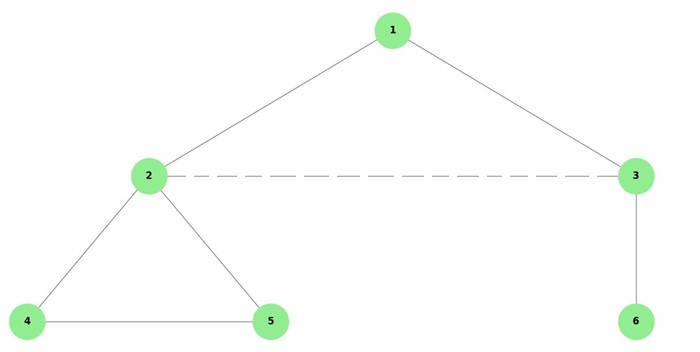
In this graph, the edge between vertices 1 and 3 is a bridge. Removing this edge would result in two disconnected subgraphs: {1, 2, 4, 5} and {3, 6}.
Characteristics of Bridges
Bridges also have major characteristics that affect the structure of the graph −
- Edge Criticality: Removing a bridge splits the graph into more disconnected parts. This means the graph will have more separate groups of vertices after the bridge is removed.
- Maintaining Connectivity: Bridges are essential for keeping different parts of the graph connected. Removing a bridge can disconnect parts of the graph from each other.
- Dependence on Structure: The presence of bridges depends on the arrangement of vertices and edges in the graph. Not all graphs have bridges.
Identifying Bridges
There are various ways to identify cut bridges in a graph −
- Breadth-First Search (BFS)
- Depth-First Search (DFS)
- DFS Tree and Low Values
- Tarjan's Algorithm
Breadth-First Search (BFS)
BFS is a way to explore a graph by visiting all neighbors of a vertex before moving to the next level. To identify cut bridges using BFS, we check if removing an edge causes the graph to split into separate parts. If it does, that edge is a cut bridge.
In the following example, we use BFS to identify bridges −
   A - B - C
  /         \
 D           E
In this example, the edge B-C is a cut bridge because removing it splits the graph into two disconnected parts: {A, B, D} and {C, E}.
Removing edge B-C splits the graph into two components, making B-C a bridge.
Depth-First Search (DFS)
DFS explores a graph by going as long (far/deep) as possible into each branch before backtracking. When used to identify cut bridges, DFS helps to check if removing an edge causes the graph to lose its connection. If removing an edge disconnects parts of the graph, then that edge is a cut bridge.
In the following example, we use DFS to identify bridges −
 A - B
     |
     C
Here, the edge B-C is a cut bridge because removing it disconnects vertex C from the rest of the graph.
DFS Tree and Low Values
Using DFS, we can assign discovery and low values to each vertex. An edge (u, v) is a bridge if low[v] > discovery[u], meaning there is no back edge from v or its descendants to u or its ancestors.
In the following example, we use DFS to identify bridges −
   0
  / \
 1   2
  \
   3
Here, the edge 0-1 is a cut bridge since removing it would disconnect 1 and 3 from 0 and 2.
Tarjan's Algorithm
Tarjan's algorithm finds all cut vertices and bridges in a graph using DFS and maintaining low values for each vertex.
In the following example, we use Tarjan's algorithm to identify bridges −
   0
  / \
 1   2
  \
   3
  /
 4
In this case, removing edge 1-3 would disconnect 4 from rest of the graph.
Challenges to Identify Cut Vertices & Bridges
We can face several challenges while identifying cut vertices and bridges, such as −
- Scalability: Finding cut vertices and bridges in large graphs can be computationally expensive.
- Dynamic Graphs: In dynamic graphs where vertices and edges are frequently added or removed, maintaining an updated list of cut vertices and bridges can be challenging.
- Complex Structures: Graphs with complex structures, such as those with multiple interconnections, can make it difficult to identify cut vertices and bridges.
