
- Data Comm & Networks Home
- DCN - Overview
- DCN - What is Computer Network
- DCN - Uses of Computer Network
- DCN - Computer Network Types
- DCN - Network LAN Technologies
- DCN - Computer Network Models
- DCN - Computer Network Security
- DCN - Components
- DCN - Connectors
- DCN - Switches
- DCN - Repeaters
- DCN - Gateways
- DCN - Bridges
- DCN - Socket
- DCN - Network Interface Card
- DCN - NIC: Pros and Cons
- DCN - Network Hardware
- DCN - Network Port
- Computer Network Topologies
- DCN - Computer Network Topologies
- DCN - Point-to-point Topology
- DCN - Bus Topology
- DCN - Star Topology
- DCN - Ring Topology
- DCN - Mesh Topology
- DCN - Tree Topology
- DCN - Hybrid Topology
- Physical Layer
- DCN - Physical Layer Introduction
- DCN - Digital Transmission
- DCN - Analog Transmission
- DCN - Transmission media
- DCN - Wireless Transmission
- DCN - Transmission Impairments
- DCN - Multiplexing
- DCN - Network Switching
- DCN - Circuit Switching
- DCN - Packet Switching
- DCN - Message Switching
- Data Link Layer
- DCN - Data Link Layer Introduction
- DCN - Data Link Control & Protocols
- DCN - RMON
- DCN - Token Ring Network
- DCN - Hamming Code
- DCN - Byte Stuffing
- DCN - Channel Allocation
- DCN - MAC Address
- DCN - Address Resolution Protocol
- DCN - Cyclic Redundancy Checks
- DCN - Error Control
- DCN - Flow Control
- DCN - Framing
- DCN - Error Detection & Correction
- DCN - Error Correcting Codes
- DCN - Parity Bits
- Network Layer
- DCN - Network Layer Introduction
- DCN - Network Addressing
- DCN - Routing
- DCN - Routing Table
- DCN - Internetworking
- DCN - Network Layer Protocols
- DCN - Routing Information Protocol
- DCN - Border Gateway Protocol
- DCN - OSPF Protocol
- DCN - Network Address Translation
- DCN - Network Address Translation Types
- Transport Layer
- DCN - Transport Layer Introduction
- DCN - Transmission Control Protocol
- DCN - User Datagram Protocol
- DCN - Congestion Control
- DCN - Open Loop Congestion Control
- DCN - Closed Loop Congestion Control
- DCN - Congestion Control Algorithms
- DCN - Token Bucket Algorithm
- DCN - TCP Tahoe Algorithm
- DCN - TCP Reno Algorithm
- DCN - TCP New Reno Algorithm
- DCN - TCP BIC Algorithm
- DCN - TCP CUBIC Algorithm
- DCN - TCP Service Model
- DCN - TLS Handshake
- DCN - TCP Vs. UDP
- Application Layer
- DCN - Session Layer
- DCN - Presentation Layer
- DCN - Application Layer Introduction
- DCN - Client-Server Model
- DCN - Application Protocols
- DCN - Network Services
- DCN - Virtual Private Network
- DCN - Load Shedding
- DCN - Optimality Principle
- DCN - Service Primitives
- DCN - Services of Network Security
- DCN - Hypertext Transfer Protocol
- DCN - File Transfer Protocol
- DCN - Secure Socket Layer
- Network Protocols
- DCN - ALOHA Protocol
- DCN - Pure ALOHA Protocol
- DCN - Sliding Window Protocol
- DCN - Stop and Wait Protocol
- DCN - Link State Routing
- DCN - Link State Routing Protocol
- Network Algorithms
- DCN - Shortest Path Algorithm
- DCN - Routing Algorithm
- DCN - Adaptive Routing Algorithms
- DCN - Non-Adaptive Routing Algorithms
- DCN - Leaky Bucket Algorithm
- Wireless Networks
- DCN - Wireless Networks
- DCN - Wireless LANs
- DCN - Wireless LAN & IEEE 802.11
- DCN - IEEE 802.11 Wireless LAN Standards
- DCN - IEEE 802.11 Networks
- Multiplexing
- DCN - Multiplexing & Its Types
- DCN - Time Division Multiplexing
- DCN - Synchronous TDM
- DCN - Asynchronous TDM
- DCN - Synchronous Vs. Asynchronous TDM
- DCN - Frequency Division Multiplexing
- DCN - TDM Vs. FDM
- DCN - Code Division Multiplexing
- DCN - Wavelength Division Multiplexing
- Miscellaneous
- DCN - Shortest Path Routing
- DCN - B-ISDN Reference Model
- DCN - Design Issues For Layers
- DCN - Selective-repeat ARQ
- DCN - Flooding
- DCN - E-Mail Format
- DCN - Cryptography
- DCN - Unicast, Broadcast, & Multicast
- DCN - Network Virtualization
- DCN - Flow Vs. Congestion Control
- DCN - Asynchronous Transfer Mode
- DCN - ATM Networks
- DCN - Synchronous Vs. Asynchronous Transmission
- DCN - Network Attacks
- DCN - WiMax
- DCN - Buffering
- DCN - Authentication
- DCN Useful Resources
- DCN - Quick Guide
- DCN - Useful Resources
- DCN - Discussion
TCP Tahoe Algorithm
The Transmission Control Protocol (TCP) is one of the most widely used protocols in computer networking. It provides a reliable, ordered, and error-checked delivery of data between applications running on hosts communicating over an IP network.
TCP Tahoe algorithm is a congestion control algorithm by which TCP controls the amount of data that can be sent over a network for avoiding network congestion.
What is TCP Tahoe Algorithm?
TCP Tahoe is one of the earliest congestion control algorithms used in Transmission Control Protocol (TCP) that automatically adjusts its packet sending rate based on the network conditions. It assumes a packet loss as a sign of network congestion and drastically reduces the data transmission rate.
The primary objective of TCP Tahoe was to provide a reliable and efficient approach to controlling congestion in computer networks. This involved detecting network congestion and implementing mechanisms to reduce data transmission rates to prevent packet loss.
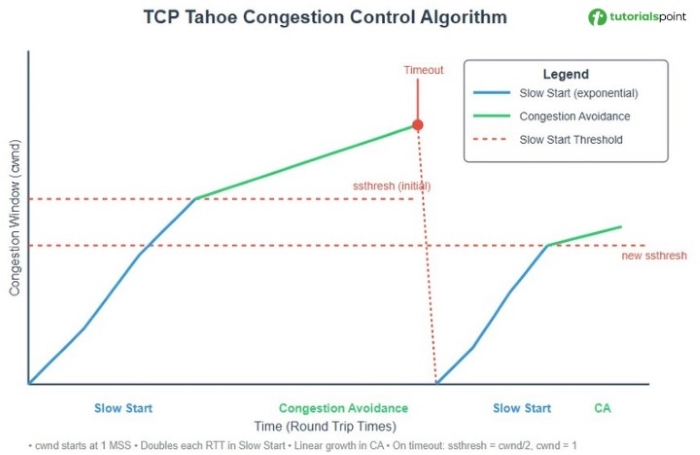
The following graph depicts how the TCP Tahoe algorithm works −
The most important characteristics of TCP Tahoe algorithm are as follows −
- It ensures reliable packet delivery by allowing retransmission of lost packets.
- TCP Tahoe is easy and simple to implement.
- It is good for low-congestion or low-bandwidth networks.
- Any packet loss is treated as congestion.
Working of TCP Tahoe Algorithm
TCP Tahoe works in three main phases that are mentioned below −
- Slow start − In slow start phase, the congestion window (cwnd) starts with a small value and then increases exponentially with each acknowledgment received. It keeps increasing until it reaches a threshold (ssthresh) or packet loss occurs.
- Congestion avoidance − It uses the AIMD (Additive Increase Multiplicative Decrease) method. Once the cwnd reaches the ssthresh, the congestion avoidance phase starts. In this phase, the cwnd increases linearly (earlier it was increasing exponentially) with each acknowledgment received.
- Fast retransmit − When a packet loss occurs , TCP Tahoe immediately reduces the cwnd to 1 MSS and sets the ssthresh to half of the current cwnd. It then enters the slow start phase again.
Here is an example based on the above working of TCP tahoe algorithm. Initially, cwnd = 1 MSS, ssthresh = 8 MSS, and a packet loss occurs when cwnd = 8 MSS
1. Start in Slow Start, cwnd = 1
Receive ACK -> cwnd = 2
Receive ACK -> cwnd = 4
Receive ACK -> cwnd = 8
cwnd = ssthresh = 8 => stop exponential growth.

2. Congestion Avoidance Phase:
cwnd = 8, increase slowly (approx +1 per RTT): cwnd = 9

3. Packet Loss at cwnd = 9
=> New ssthresh = (cwnd / 2) = (9 / 2) = 4
Reset cwnd to 1

4. Restart Slow Start
Restart and grow only until new ssthresh (4):
cwnd = 1 -> ACK -> cwnd = 2
cwnd = 2 -> ACK -> cwnd = 4

cwnd = new ssthresh (4)
=> Repeat from step 2.
Steps to Implement TCP Tahoe Algorithm
Here are the steps to implement TCP Tahoe algorithm given below −
- Set the cwnd = 1 MSS and initial value of ssthresh and the number of iterations.
- In Slow Start phase increase cwnd by 1 MSS for every ACK received.
- When cwnd reaches ssthresh, switch to Congestion Avoidance phase and increase cwnd slowly.
- In case of packet loss, i.e., when timeout or in case of 3 duplicate ACKs, it is considered as congestion.
- Now, set ssthresh = cwnd / 2, reset cwnd to 1 MSS, and go back to Slow Start.
Code Implementation
Here is the code implementation of the above steps for TCP Tahoe algorithm in C++, Java, and python −
#include <iostream>
using namespace std;

int main() {
    int cwnd = 1;       // congestion window (in MSS units)
    int ssthresh = 8;   // slow start threshold
    int maxRounds = 8;  // Updated to 8 rounds

    cout << "Initial cwnd = " << cwnd
         << ", ssthresh = " << ssthresh << "\n\n";

    for (int round = 1; round <= maxRounds; ++round) {
        cout << "Round " << round << ":";

        // Loss simulation at 5th round
        bool loss = (round == 5);

        if (loss) {
            cout << "  Packet loss detected!\n";
            ssthresh = cwnd / 2;
            if (ssthresh < 1)
                ssthresh = 1;
            cwnd = 1;
            cout << "  New ssthresh = " << ssthresh << "\n";
            cout << "  cwnd reset to " << cwnd << " (Slow Start)\n";
        } else {
            if (cwnd < ssthresh) {
                cout << "  Phase: Slow Start\n";
                cwnd *= 2;
            } else {
                cout << "  Phase: Congestion Avoidance\n";
                cwnd += 1;
            }
            cout << "  cwnd = " << cwnd << ", ssthresh = " << ssthresh << "\n";
        }
    }
    return 0;
}
The output of the above code is as follows −
Initial cwnd = 1, ssthresh = 8

Round 1:  Phase: Slow Start
  cwnd = 2, ssthresh = 8
Round 2:  Phase: Slow Start
  cwnd = 4, ssthresh = 8
Round 3:  Phase: Slow Start
  cwnd = 8, ssthresh = 8
Round 4:  Phase: Congestion Avoidance
  cwnd = 9, ssthresh = 8
Round 5:  Packet loss detected!
  New ssthresh = 4
  cwnd reset to 1 (Slow Start)
Round 6:  Phase: Slow Start
  cwnd = 2, ssthresh = 4
Round 7:  Phase: Slow Start
  cwnd = 4, ssthresh = 4
Round 8:  Phase: Congestion Avoidance
  cwnd = 5, ssthresh = 4
public class Main {
    public static void main(String[] args) {
        int cwnd = 1;       // congestion window
        int ssthresh = 8;   // slow start threshold
        int maxRounds = 8;  // total 8 rounds

        System.out.println("Initial cwnd = " + cwnd + ", ssthresh = " + ssthresh + "\n");

        for (int round = 1; round <= maxRounds; round++) {
            System.out.print("Round " + round + ":");

            boolean loss = (round == 5); // Loss simulation only at 5th round

            if (loss) {
                System.out.println("  Packet loss detected!");
                ssthresh = cwnd / 2;
                if (ssthresh < 1)
                    ssthresh = 1;
                cwnd = 1;
                System.out.println("  New ssthresh = " + ssthresh);
                System.out.println("  cwnd reset to " + cwnd + " (Slow Start)");
            } else {
                if (cwnd < ssthresh) {
                    System.out.println("  Phase: Slow Start");
                    cwnd *= 2;
                } else {
                    System.out.println("  Phase: Congestion Avoidance");
                    cwnd += 1;
                }
                System.out.println("  cwnd = " + cwnd + ", ssthresh = " + ssthresh);
            }
        }
    }
}
The output of the above code is as follows −
Initial cwnd = 1, ssthresh = 8

Round 1:  Phase: Slow Start
  cwnd = 2, ssthresh = 8
Round 2:  Phase: Slow Start
  cwnd = 4, ssthresh = 8
Round 3:  Phase: Slow Start
  cwnd = 8, ssthresh = 8
Round 4:  Phase: Congestion Avoidance
  cwnd = 9, ssthresh = 8
Round 5:  Packet loss detected!
  New ssthresh = 4
  cwnd reset to 1 (Slow Start)
Round 6:  Phase: Slow Start
  cwnd = 2, ssthresh = 4
Round 7:  Phase: Slow Start
  cwnd = 4, ssthresh = 4
Round 8:  Phase: Congestion Avoidance
  cwnd = 5, ssthresh = 4
def tcp_tahoe():
    cwnd = 1       # congestion window
    ssthresh = 8   # slow start threshold
    max_rounds = 8 # total 8 rounds

    print(f"Initial cwnd = {cwnd}, ssthresh = {ssthresh}\n")

    for round_num in range(1, max_rounds + 1):
        print(f"Round {round_num}:", end="")

        loss = (round_num == 5)  # Packet loss at round 5

        if loss:
            print("  Packet loss detected!")
            ssthresh = max(cwnd // 2, 1)
            cwnd = 1
            print(f"  New ssthresh = {ssthresh}")
            print(f"  cwnd reset to {cwnd} (Slow Start)")
        else:
            if cwnd < ssthresh:
                print("  Phase: Slow Start")
                cwnd *= 2
            else:
                print("  Phase: Congestion Avoidance")
                cwnd += 1

            print(f"  cwnd = {cwnd}, ssthresh = {ssthresh}")


if __name__ == "__main__":
    tcp_tahoe()
The output of the above code is as follows −
Initial cwnd = 1, ssthresh = 8

Round 1:  Phase: Slow Start
  cwnd = 2, ssthresh = 8
Round 2:  Phase: Slow Start
  cwnd = 4, ssthresh = 8
Round 3:  Phase: Slow Start
  cwnd = 8, ssthresh = 8
Round 4:  Phase: Congestion Avoidance
  cwnd = 9, ssthresh = 8
Round 5:  Packet loss detected!
  New ssthresh = 4
  cwnd reset to 1 (Slow Start)
Round 6:  Phase: Slow Start
  cwnd = 2, ssthresh = 4
Round 7:  Phase: Slow Start
  cwnd = 4, ssthresh = 4
Round 8:  Phase: Congestion Avoidance
  cwnd = 5, ssthresh = 4
Pros and Cons of TCP Tahoe Algorithm
The following list highligths the advantages of TCP Tahoe algorithm −
- It is simple to implement. It is effective in controlling congestion in networks.
- It helps to avoid network collapse due to congestion.
- It is a stable congestion control mechanism.
- It increases the reliability of data transmission.
The limitations of TCP Tahoe are as follows −
- The network resources remain underutilized.
- It is not suitable for high-speed networks.
- It can cause high latency.
- Bandwidth utilization remains inefficient as window size drops to 1 MSS.
- It restarts from slow Start on packet loss.
- It treats a loss like a congestion.
Conclusion
TCP Tahoe is a congestion control algorithm that provides a reliable, ordered, and error-checked delivery of data packets. In this chapter, we covered the features, working, implementation steps, code implementation, advantages, and limitations of the TCP Tahoe algorithm.
