
- Data Comm & Networks Home
- DCN - Overview
- DCN - What is Computer Network
- DCN - Uses of Computer Network
- DCN - Computer Network Types
- DCN - Network LAN Technologies
- DCN - Computer Network Models
- DCN - Computer Network Security
- DCN - Components
- DCN - Connectors
- DCN - Switches
- DCN - Repeaters
- DCN - Gateways
- DCN - Bridges
- DCN - Socket
- DCN - Network Interface Card
- DCN - NIC: Pros and Cons
- DCN - Network Hardware
- DCN - Network Port
- Computer Network Topologies
- DCN - Computer Network Topologies
- DCN - Point-to-point Topology
- DCN - Bus Topology
- DCN - Star Topology
- DCN - Ring Topology
- DCN - Mesh Topology
- DCN - Tree Topology
- DCN - Hybrid Topology
- Physical Layer
- DCN - Physical Layer Introduction
- DCN - Digital Transmission
- DCN - Analog Transmission
- DCN - Transmission media
- DCN - Wireless Transmission
- DCN - Transmission Impairments
- DCN - Multiplexing
- DCN - Network Switching
- DCN - Circuit Switching
- DCN - Packet Switching
- DCN - Message Switching
- Data Link Layer
- DCN - Data Link Layer Introduction
- DCN - Data Link Control & Protocols
- DCN - RMON
- DCN - Token Ring Network
- DCN - Hamming Code
- DCN - Byte Stuffing
- DCN - Channel Allocation
- DCN - MAC Address
- DCN - Address Resolution Protocol
- DCN - Cyclic Redundancy Checks
- DCN - Error Control
- DCN - Flow Control
- DCN - Framing
- DCN - Error Detection & Correction
- DCN - Error Correcting Codes
- DCN - Parity Bits
- Network Layer
- DCN - Network Layer Introduction
- DCN - Network Addressing
- DCN - Routing
- DCN - Routing Table
- DCN - Internetworking
- DCN - Network Layer Protocols
- DCN - Routing Information Protocol
- DCN - Border Gateway Protocol
- DCN - OSPF Protocol
- DCN - Network Address Translation
- DCN - Network Address Translation Types
- Transport Layer
- DCN - Transport Layer Introduction
- DCN - Transmission Control Protocol
- DCN - User Datagram Protocol
- DCN - Congestion Control
- DCN - Open Loop Congestion Control
- DCN - Closed Loop Congestion Control
- DCN - Congestion Control Algorithms
- DCN - Token Bucket Algorithm
- DCN - TCP Tahoe Algorithm
- DCN - TCP Reno Algorithm
- DCN - TCP New Reno Algorithm
- DCN - TCP BIC Algorithm
- DCN - TCP CUBIC Algorithm
- DCN - TCP Service Model
- DCN - TLS Handshake
- DCN - TCP Vs. UDP
- Application Layer
- DCN - Session Layer
- DCN - Presentation Layer
- DCN - Application Layer Introduction
- DCN - Client-Server Model
- DCN - Application Protocols
- DCN - Network Services
- DCN - Virtual Private Network
- DCN - Load Shedding
- DCN - Optimality Principle
- DCN - Service Primitives
- DCN - Services of Network Security
- DCN - Hypertext Transfer Protocol
- DCN - File Transfer Protocol
- DCN - Secure Socket Layer
- Network Protocols
- DCN - ALOHA Protocol
- DCN - Pure ALOHA Protocol
- DCN - Sliding Window Protocol
- DCN - Stop and Wait Protocol
- DCN - Link State Routing
- DCN - Link State Routing Protocol
- Network Algorithms
- DCN - Shortest Path Algorithm
- DCN - Routing Algorithm
- DCN - Adaptive Routing Algorithms
- DCN - Non-Adaptive Routing Algorithms
- DCN - Leaky Bucket Algorithm
- Wireless Networks
- DCN - Wireless Networks
- DCN - Wireless LANs
- DCN - Wireless LAN & IEEE 802.11
- DCN - IEEE 802.11 Wireless LAN Standards
- DCN - IEEE 802.11 Networks
- Multiplexing
- DCN - Multiplexing & Its Types
- DCN - Time Division Multiplexing
- DCN - Synchronous TDM
- DCN - Asynchronous TDM
- DCN - Synchronous Vs. Asynchronous TDM
- DCN - Frequency Division Multiplexing
- DCN - TDM Vs. FDM
- DCN - Code Division Multiplexing
- DCN - Wavelength Division Multiplexing
- Miscellaneous
- DCN - Shortest Path Routing
- DCN - B-ISDN Reference Model
- DCN - Design Issues For Layers
- DCN - Selective-repeat ARQ
- DCN - Flooding
- DCN - E-Mail Format
- DCN - Cryptography
- DCN - Unicast, Broadcast, & Multicast
- DCN - Network Virtualization
- DCN - Flow Vs. Congestion Control
- DCN - Asynchronous Transfer Mode
- DCN - ATM Networks
- DCN - Synchronous Vs. Asynchronous Transmission
- DCN - Network Attacks
- DCN - WiMax
- DCN - Buffering
- DCN - Authentication
- DCN Useful Resources
- DCN - Quick Guide
- DCN - Useful Resources
- DCN - Discussion
Non Adaptive Routing Algorithm
A routing algorithm is a procedure that lays down the route or path to transfer data packets from source to destination. They help in directing Internet traffic efficiently. After a data packet leaves its source, it can choose among many different paths to reach its destination. Routing algorithm mathematically computes the best path, i.e., least cost path that the packet can be routed through.
Routing algorithms can be broadly categorized into two types, adaptive and non-adaptive routing algorithms. Read this chapter to understand Non-adaptive Routing Algorithms in detail.
What is Non-adaptive Routing Algorithm?
Non-adaptive algorithm or static routing algorithm is constructed based upon the routing information stored in the routers when the network is booted up. It is independent of the current traffic and topology volume. The route is computed and downloaded to the routers when the network is booted. Thus, routing data is manually specified.
It provides fixed-route data to each router. If there is no change in route, it is created manually. The path remains fixed regardless of current network traffic, congestion, or topology changes. Once the static paths are available to all the routers, they transmit the data packets along these paths. The changing network topology and traffic conditions do not affect the routing decisions.
The routing table is not changed unless the network administrator changes or modifies them manually. It does not use complex routing algorithms and hence it provides high or more security than the dynamic routing. Static routing is mainly implemented in small networks. failure of link can disrupt the rerouting.
Characteristics of Non-adaptive Routing Algorithm
The key characteristics of static routing are given below −
- In static routing, routes are pre-determined and do not change based on any network condition.
- It is simple to implement and maintain.
- The route is known to network administrators.
- Low computational overhead since resources required are pre-computed.
- The routing table is static.
- There is no mechanism of real-time monitoring of network.
Types of Non-adaptive Routing Algorithms
There are three types of non-adaptive or static routing algorithms −
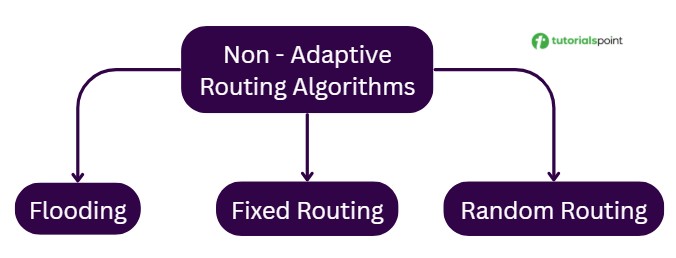
Flooding
In flooding, when a data packet arrives at a router, it is sent to all the outgoing links except the one it has arrived on. It thus generates a large number of duplicate packets. To decrease this, a counter is used with every packet decremented at every hop and one whose counter cost is zero before destination reach is discarded.
Most of the time, the sender knows the destination's path length, but if it does not see, the counter is initialized by a number equal to the subnet's total diameter.
There are three types of flooding techniques −
- Uncontrolled Flooding − In uncontrolled flooding, each router unconditionally transmits the incoming data packets to all its neighbors.
- Controlled Flooding − The controlled flooding uses some methods to control the transmission of packets to the neighboring nodes. The two popular algorithms for controlled flooding are Sequence Number Controlled Flooding (SNCF) and Reverse Path Forwarding (RPF).
- Selective Flooding − In selective flooding, the routers transmit the incoming packets only along those paths which are heading approximately in the right direction, instead of sending them on every available path.
To overcome the issue of flooding, the following techniques are used −
- Sequence Numbers − Each packet is provided with a sequence number. When a node receives the packet, it views its source and destination number. If the node discovers that it has transmitted a similar packet before, it will not send the packet and eliminate it.
- Hop Counts − Each packet has a hop count related to it. This is decremented by one by each node that sees it. When the hop count turns to zero, the packet is released.
- Spanning Tree − This packet is transmitted only on this connection leading to the destination by generating a spanning tree finish at the source. This prevents loops in transmission but is feasible only when all the transitional nodes know the network topology.
The advantages of flooding are as follows −
- It guarantees packet delivery if at least a single path exists.
- It does not require routing table.
The disadvantages of flooding are given below −
- It has high bandwidth consumption.
- It is not suitable for large networks.
- Generates a large amounts of duplicate packets.
- It can cause network congestion.
- It uses network resources inefficiently.
Fixed Routing
Fixed routing or shortest path routing is the most common static routing algorithm where routes are pre defined on the basis of network topology. It remains unchanged until it is manually updated by network administrators.
The advantages of fixed routing are as follows −
- The path is stable and predictable.
- It choses optimal path based on chosen metrics.
- Simple forwarding decisions
- Low computational overhead.
- It is easy to understand and troubleshoot.
The disadvantages of fixed routing are given below −
- It cannot adapt to network changes since the route is already pre determined and fixed.
- Manual updation of routes is required.
- There is single point of failure if path breaks
Random Routing
In random routing, a node chooses any random available outgoing link and sends the packet through it. The node does not check traffic, congestion, or routing tables before forwarding the packet.
Here is how the random routing algorithm works −
- When a packet arrives, the node randomly chooses any available outgoing link.
- The packet is then forwarded through that link.
- This process repeats at each node.
The advantages of random routing are as follows −
- It is simple and easy to implement.
- No routing table maintenance is required.
- Load distribution across multiple paths.
- It can be useful in spreading traffic.
The disadvantages of random routing are listed below −
- It does not guarantee optimal path.
- Packets may loop infinitely without any hop count limit.
- Packet delivery time is unpredictable.
- Inefficient resource utilization.
Pros and Cons of Non-adaptive Routing Algorithms
The advantages of non-adaptive routing algorithms are as follows −
- Non-adaptive routing algorithms are easier to implement and understand due to their static nature.
- They require less computational resources and bandwidth, since they do not need to constantly monitor the network conditions.
- The predetermined paths make it easier to predict the behavior of the network, which can be beneficial for certain applications.
The disadvantages of non-adaptive routing algorithms include the following −
- Non-adaptive routing algorithms cannot adjust to changing network conditions.
- Since the paths are fixed, some routes may remain underutilized while some routes may become congested.
- If the link or node in path fails, it may not find any alternative route. It can lead to packet loss.
Difference between Adaptive and Non-Adaptive Routing Algorithm
The main difference between non-adaptive and adaptive routing algorithms is the way they update their routing tables. Here are the key differences −
| Static Routing | Dynamic Routing |
|---|---|
| In static routing, network administrator manually enters route in the routing table. | In dynamic routing, routes are updated dynamically as per the changes in network using. |
| In this, algorithm like Dijkstra's is used to pre-calculate the shortest path. | Dynamic routing uses algorithms like distance vector or link state to find the shortest routes dynamically. |
| In static routing, updating routes is a manual process. | In dynamic routing, updating routes is an automatic process. |
| Static routing is used in smaller networks. | Dynamic routing is implemented in large networks. |
| Static routing does not use routing protocols. | Dynamic routing follows routing protocols like BGP, RIP and EIGRP. |
| Static routing requires less resources. | Dynamic routing requires additional resources like memory, bandwidth etc. |
| It is simple and easy to implement. | It uses complex algorithms. |
Conclusion
Non-adaptive algorithms are also known as static routing algorithms. They use predetermined routing tables designed by the network administrators for routing the packets to their destination. In this chapter, we covered in detail the characteristics, types, working, advantages and disadvantages of non-adaptive algorithms.
