
- Data Comm & Networks Home
- DCN - Overview
- DCN - What is Computer Network
- DCN - Uses of Computer Network
- DCN - Computer Network Types
- DCN - Network LAN Technologies
- DCN - Computer Network Models
- DCN - Computer Network Security
- DCN - Components
- DCN - Connectors
- DCN - Switches
- DCN - Repeaters
- DCN - Gateways
- DCN - Bridges
- DCN - Socket
- DCN - Network Interface Card
- DCN - NIC: Pros and Cons
- DCN - Network Hardware
- DCN - Network Port
- Computer Network Topologies
- DCN - Computer Network Topologies
- DCN - Point-to-point Topology
- DCN - Bus Topology
- DCN - Star Topology
- DCN - Ring Topology
- DCN - Mesh Topology
- DCN - Tree Topology
- DCN - Hybrid Topology
- Physical Layer
- DCN - Physical Layer Introduction
- DCN - Digital Transmission
- DCN - Analog Transmission
- DCN - Transmission media
- DCN - Wireless Transmission
- DCN - Transmission Impairments
- DCN - Multiplexing
- DCN - Network Switching
- DCN - Circuit Switching
- DCN - Packet Switching
- DCN - Message Switching
- Data Link Layer
- DCN - Data Link Layer Introduction
- DCN - Data Link Control & Protocols
- DCN - RMON
- DCN - Token Ring Network
- DCN - Hamming Code
- DCN - Byte Stuffing
- DCN - Channel Allocation
- DCN - MAC Address
- DCN - Address Resolution Protocol
- DCN - Cyclic Redundancy Checks
- DCN - Error Control
- DCN - Flow Control
- DCN - Framing
- DCN - Error Detection & Correction
- DCN - Error Correcting Codes
- DCN - Parity Bits
- Network Layer
- DCN - Network Layer Introduction
- DCN - Network Addressing
- DCN - Routing
- DCN - Routing Table
- DCN - Internetworking
- DCN - Network Layer Protocols
- DCN - Routing Information Protocol
- DCN - Border Gateway Protocol
- DCN - OSPF Protocol
- DCN - Network Address Translation
- DCN - Network Address Translation Types
- Transport Layer
- DCN - Transport Layer Introduction
- DCN - Transmission Control Protocol
- DCN - User Datagram Protocol
- DCN - Congestion Control
- DCN - Open Loop Congestion Control
- DCN - Closed Loop Congestion Control
- DCN - Congestion Control Algorithms
- DCN - Token Bucket Algorithm
- DCN - TCP Tahoe Algorithm
- DCN - TCP Reno Algorithm
- DCN - TCP New Reno Algorithm
- DCN - TCP BIC Algorithm
- DCN - TCP CUBIC Algorithm
- DCN - TCP Service Model
- DCN - TLS Handshake
- DCN - TCP Vs. UDP
- Application Layer
- DCN - Session Layer
- DCN - Presentation Layer
- DCN - Application Layer Introduction
- DCN - Client-Server Model
- DCN - Application Protocols
- DCN - Network Services
- DCN - Virtual Private Network
- DCN - Load Shedding
- DCN - Optimality Principle
- DCN - Service Primitives
- DCN - Services of Network Security
- DCN - Hypertext Transfer Protocol
- DCN - File Transfer Protocol
- DCN - Secure Socket Layer
- Network Protocols
- DCN - ALOHA Protocol
- DCN - Pure ALOHA Protocol
- DCN - Sliding Window Protocol
- DCN - Stop and Wait Protocol
- DCN - Link State Routing
- DCN - Link State Routing Protocol
- Network Algorithms
- DCN - Shortest Path Algorithm
- DCN - Routing Algorithm
- DCN - Adaptive Routing Algorithms
- DCN - Non-Adaptive Routing Algorithms
- DCN - Leaky Bucket Algorithm
- Wireless Networks
- DCN - Wireless Networks
- DCN - Wireless LANs
- DCN - Wireless LAN & IEEE 802.11
- DCN - IEEE 802.11 Wireless LAN Standards
- DCN - IEEE 802.11 Networks
- Multiplexing
- DCN - Multiplexing & Its Types
- DCN - Time Division Multiplexing
- DCN - Synchronous TDM
- DCN - Asynchronous TDM
- DCN - Synchronous Vs. Asynchronous TDM
- DCN - Frequency Division Multiplexing
- DCN - TDM Vs. FDM
- DCN - Code Division Multiplexing
- DCN - Wavelength Division Multiplexing
- Miscellaneous
- DCN - Shortest Path Routing
- DCN - B-ISDN Reference Model
- DCN - Design Issues For Layers
- DCN - Selective-repeat ARQ
- DCN - Flooding
- DCN - E-Mail Format
- DCN - Cryptography
- DCN - Unicast, Broadcast, & Multicast
- DCN - Network Virtualization
- DCN - Flow Vs. Congestion Control
- DCN - Asynchronous Transfer Mode
- DCN - ATM Networks
- DCN - Synchronous Vs. Asynchronous Transmission
- DCN - Network Attacks
- DCN - WiMax
- DCN - Buffering
- DCN - Authentication
- DCN Useful Resources
- DCN - Quick Guide
- DCN - Useful Resources
- DCN - Discussion
Message Switching in Computer Networks
Message switching is a connectionless switching method, which means there is no fixed or dedicated path created before the message is sent. Instead, the complete message is sent from one node to the next node, like passing a letter from hand to hand, until it finally reaches the destination. This method came before packet switching and helped shape many ideas we use in modern networks.
In message switching, the message travels hop-by-hop. Each intermediate node receives the full message, stores it temporarily, checks it, and then forwards it to the next node. Because the intermediate nodes store the message completely, this technique is also called store and forward.
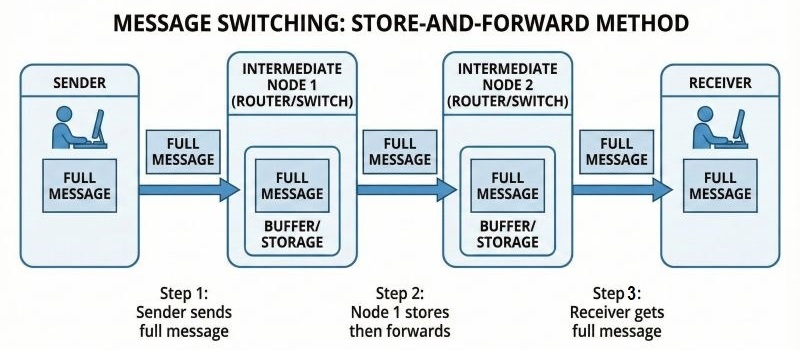
Message switching does not require a continuous connection between the sender and the receiver from start to end, which makes it different from circuit switching.
Characteristics of Message Switching
The most important Characteristics of message switching are listed below −
- There is no dedicated connection needed between the sender and the receiver.
- Entire message is sent as one single unit.
- Intermediate nodes use store and forward method.
- Messages wait in queue if the line is busy.
- Routing can change depending on the availability.
- Suitable for situations where delivery must take place, even during congestion.
These characteristics show why message switching was important in earlier communication systems before packet switching became common.
How Message Switching Works?
Let's understand step by step how message switching works −
- First, the sender prepares the complete message and attaches the destination address to it. Next, the sender sends the message to the nearest switching node.
- The switching node receives the message, checks for any errors, inspects the address and then decides through which path it should forward the message.
- If the next outgoing route is free, the node forwards the message immediately.
- If the route is busy, the message is kept in a queue within the switching node. The message is not lost or discarded. It waits patiently until the route becomes available. This queuing system reduces the risk of data loss and keeps the network functioning even when the traffic is high.
Messsage switching is reliable because each node makes sure the entire message is stored safely before forwarding. But it also causes delay because every node must store the message completely first. So, the message does not flow instantly, it moves step-by-step.
Store and Forward Mechanism
A very important idea in message switching is the store and forward technique. Every incoming message is stored entirely in the intermediate node. It is checked for mistakes, checked for address, and then passed to the next node when the path is clear. Because of this, there is no risk of losing the message even if temporary congestion happens.
Let's understand this concept through an example. Imagine a post office system. A person sends a long letter. The letter first reaches one post office, where it is kept for some time until the next mail truck is ready. Then, the letter goes to the next post office, and the same thing happens again. Finally, it reaches the receiver. Message switching works exactly like this.
Routing in Message Switching
Message switching does not require a fixed path. Different messages between the same sender and receiver may take different routes depending on network conditions. Nodes always try to choose the best next hop that is free and available at that moment. This gives flexibility, especially when one route is overloaded or temporarily not working.
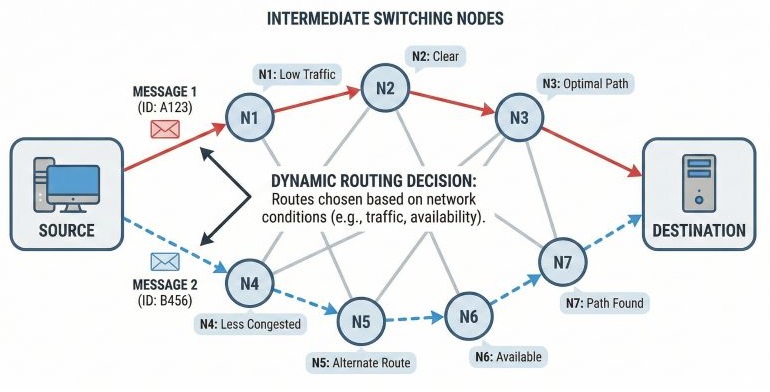
Since each message is independent, the network can adjust itself dynamically. It improves the utilization of available lines, because messages move through whichever route is currently open.
Advantages of Message Switching
Message switching comes with several strong points that made it useful in the early days of networking −
- Better usage of bandwidth because multiple messages share the same communication lines.
- Reduced chances of congestion due to store-and-forward mechanism.
- Messages of unlimited size can be sent because the entire message is stored.
- Easier broadcasting because a single copy can be forwarded to multiple destinations.
- No need to worry about out-of-order packets since the entire message moves together.
These advantages made message switching stable and dependable, especially in environments where message delivery was more important than speed.
Disadvantages of Message Switching
Even though message switching has many benefits, it also has some limitations −
- Every intermediate node must have large storage capacity to hold entire messages.
- Because of store and forward, there is delay at each switching node.
- Not suitable for real-time applications like voice or video calls.
- If the message is too long, the delay becomes even larger.
These drawbacks are the main reason message switching is not used today for most communication, because modern systems require fast and continuous data flow.
Message Switching vs Circuit Switching
Message switching is very different from circuit switching. Circuit switching creates a dedicated path from sender to receiver and keeps it reserved. Message switching does not do this. It uses whichever routes are free at the moment.
In circuit switching, if a call is in progress, no one else can use that path. In message switching, many senders share the same lines because no fixed route is locked.
Circuit switching is good for real-time conversations, while message switching is good for sending large documents or non-urgent communications.
Why Message Switching Was Important
Message switching played a very important role in the evolution of networking. It showed that connectivity does not always require dedicated paths and that networks can handle congestion more intelligently. It introduced the idea of store and forward, which was later used in packet switching.
Message switching made earlier telegraph systems, postal-like communication models, and large message transfers possible without needing fixed circuits. It gave rise to flexible routing and safe storage of data at intermediate points.
Conclusion
Message switching is a connectionless technique where complete messages travel hop-by-hop through the network. Each switching node stores the entire message and forwards it when the path is free. It improves bandwidth usage, reduces congestion, and allows messages of unlimited size. However, because of storage requirements and delays, message switching is not suitable for real-time communication.
Even though it is not widely used today, message switching helped build the foundation for modern packet-based networks. It remains an important concept for understanding how networking methods evolved over time.
