
- Data Comm & Networks Home
- DCN - Overview
- DCN - What is Computer Network
- DCN - Uses of Computer Network
- DCN - Computer Network Types
- DCN - Network LAN Technologies
- DCN - Computer Network Models
- DCN - Computer Network Security
- DCN - Components
- DCN - Connectors
- DCN - Switches
- DCN - Repeaters
- DCN - Gateways
- DCN - Bridges
- DCN - Socket
- DCN - Network Interface Card
- DCN - NIC: Pros and Cons
- DCN - Network Hardware
- DCN - Network Port
- Computer Network Topologies
- DCN - Computer Network Topologies
- DCN - Point-to-point Topology
- DCN - Bus Topology
- DCN - Star Topology
- DCN - Ring Topology
- DCN - Mesh Topology
- DCN - Tree Topology
- DCN - Hybrid Topology
- Physical Layer
- DCN - Physical Layer Introduction
- DCN - Digital Transmission
- DCN - Analog Transmission
- DCN - Transmission media
- DCN - Wireless Transmission
- DCN - Transmission Impairments
- DCN - Multiplexing
- DCN - Network Switching
- DCN - Circuit Switching
- DCN - Packet Switching
- DCN - Message Switching
- Data Link Layer
- DCN - Data Link Layer Introduction
- DCN - Data Link Control & Protocols
- DCN - RMON
- DCN - Token Ring Network
- DCN - Hamming Code
- DCN - Byte Stuffing
- DCN - Channel Allocation
- DCN - MAC Address
- DCN - Address Resolution Protocol
- DCN - Cyclic Redundancy Checks
- DCN - Error Control
- DCN - Flow Control
- DCN - Framing
- DCN - Error Detection & Correction
- DCN - Error Correcting Codes
- DCN - Parity Bits
- Network Layer
- DCN - Network Layer Introduction
- DCN - Network Addressing
- DCN - Routing
- DCN - Routing Table
- DCN - Internetworking
- DCN - Network Layer Protocols
- DCN - Routing Information Protocol
- DCN - Border Gateway Protocol
- DCN - OSPF Protocol
- DCN - Network Address Translation
- DCN - Network Address Translation Types
- Transport Layer
- DCN - Transport Layer Introduction
- DCN - Transmission Control Protocol
- DCN - User Datagram Protocol
- DCN - Congestion Control
- DCN - Open Loop Congestion Control
- DCN - Closed Loop Congestion Control
- DCN - Congestion Control Algorithms
- DCN - Token Bucket Algorithm
- DCN - TCP Tahoe Algorithm
- DCN - TCP Reno Algorithm
- DCN - TCP New Reno Algorithm
- DCN - TCP BIC Algorithm
- DCN - TCP CUBIC Algorithm
- DCN - TCP Service Model
- DCN - TLS Handshake
- DCN - TCP Vs. UDP
- Application Layer
- DCN - Session Layer
- DCN - Presentation Layer
- DCN - Application Layer Introduction
- DCN - Client-Server Model
- DCN - Application Protocols
- DCN - Network Services
- DCN - Virtual Private Network
- DCN - Load Shedding
- DCN - Optimality Principle
- DCN - Service Primitives
- DCN - Services of Network Security
- DCN - Hypertext Transfer Protocol
- DCN - File Transfer Protocol
- DCN - Secure Socket Layer
- Network Protocols
- DCN - ALOHA Protocol
- DCN - Pure ALOHA Protocol
- DCN - Sliding Window Protocol
- DCN - Stop and Wait Protocol
- DCN - Link State Routing
- DCN - Link State Routing Protocol
- Network Algorithms
- DCN - Shortest Path Algorithm
- DCN - Routing Algorithm
- DCN - Adaptive Routing Algorithms
- DCN - Non-Adaptive Routing Algorithms
- DCN - Leaky Bucket Algorithm
- Wireless Networks
- DCN - Wireless Networks
- DCN - Wireless LANs
- DCN - Wireless LAN & IEEE 802.11
- DCN - IEEE 802.11 Wireless LAN Standards
- DCN - IEEE 802.11 Networks
- Multiplexing
- DCN - Multiplexing & Its Types
- DCN - Time Division Multiplexing
- DCN - Synchronous TDM
- DCN - Asynchronous TDM
- DCN - Synchronous Vs. Asynchronous TDM
- DCN - Frequency Division Multiplexing
- DCN - TDM Vs. FDM
- DCN - Code Division Multiplexing
- DCN - Wavelength Division Multiplexing
- Miscellaneous
- DCN - Shortest Path Routing
- DCN - B-ISDN Reference Model
- DCN - Design Issues For Layers
- DCN - Selective-repeat ARQ
- DCN - Flooding
- DCN - E-Mail Format
- DCN - Cryptography
- DCN - Unicast, Broadcast, & Multicast
- DCN - Network Virtualization
- DCN - Flow Vs. Congestion Control
- DCN - Asynchronous Transfer Mode
- DCN - ATM Networks
- DCN - Synchronous Vs. Asynchronous Transmission
- DCN - Network Attacks
- DCN - WiMax
- DCN - Buffering
- DCN - Authentication
- DCN Useful Resources
- DCN - Quick Guide
- DCN - Useful Resources
- DCN - Discussion
Circuit Switching in Computer Networks
Circuit Switching is a connection-oriented service that uses a dedicated path from the sender to the receiver. Before sending any data from the source to the destination, it needs to set up an end-to-end path. Once this path is set, the entire message travels on the same route without changing direction or waiting at any intermediate point. This idea came mainly from the traditional telephone systems, where every call needed its own private line to carry voice signals smoothly.
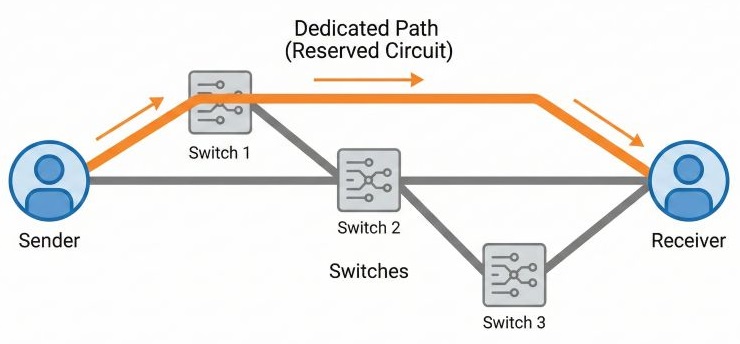
In circuit switching, the network behaves as if it is creating a private lane for two users. As long as they are talking or sending data, that lane remains reserved. No other users are allowed to use that route, even if the connection is silent for some time. Because of this, the communication becomes steady and predictable. There is hardly any delay once the route is set. But this also means that resources stay locked even when not fully used, which is one of the big drawbacks of this method.
What Circuit Switching Really Does?
When a device wants to communicate with another device, the switching system first tries to find a continuous path. This path usually passes through many intermediate switching centres. Each switch must have a free line to the next switch, and this continues until the final destination is connected. Only when the entire chain is ready, the sender is allowed to start the transmission.
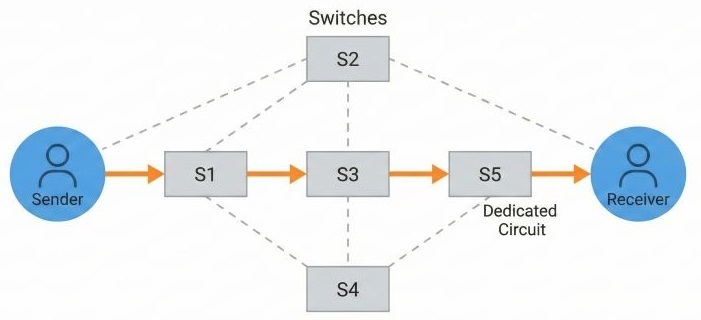
Think of it like making a long-distance phone call. First, the telephone exchange checks if there is a free channel to the next location, and then the next exchange checks the same, and so on. You cannot talk unless all exchanges successfully form the chain. This is why the technique is called "circuit switching," because a complete electrical circuit is created from end to end.
Phases of Circuit Switching
Circuit switching takes place in three basic phases. Each phase plays an important role in building, using, and breaking the connection.
1. Circuit Establishment
Establishing a circuit is the starting phase, where the network tries to create a dedicated path between the source and the destination. The sender sends a request signal, and each switching centre along the way checks whether it can forward this request. If all switching centres find free lines, a full circuit is created. Both the sender and receiver then exchange acknowledgement signals that confirm the link is ready.
During this phase, if even one part of the route is busy, the whole connection fails and the sender may try again. Because the circuit must stay continuous, even one blocked line can delay the entire call or transmission. This is why connection setup sometimes takes noticeable time.
2. Data Transfer
Once the circuit is successfully set up, the second phase begins. This is where the actual communication happens. Data, voice, or any other form of information travels from source to destination using the reserved path. The important thing here is that the "path remains dedicated", so the data rate remains steady. There are no sudden packet losses or changes in speed.
This phase continues as long as the users are actively communicating. If they pause, the reserved path still stays locked. It cannot be used by someone else. This provides stable transmission but also causes "bandwidth wastage", especially in cases like voice calls where users remain silent for long moments.
3. Circuit Disconnection
Once the communication ends, either user can initiate a request to disconnect the circuit. When this happens, all switching centres along the route release the reserved lines. These freed lines can now be used by other connections. Disconnection frees system resources and helps improve overall network efficiency.
In circuit switching, this phase is important because the network must cleanly remove the entire chain from memory and routing tables. Any leftover connections or half-released links can create confusion in busy networks.
Why Circuit Switching Was Important
Before the growth of the Internet, most long-distance communication relied on voice calls. Voice requires a continuous, steady stream without interruptions. Circuit switching was perfect for telephone networks because it could provide:
- Constant bandwidth during the entire call
- No packet delays once the path is set
- Ordered delivery since data follows the same route
- Full-duplex communication where both sides talk at once
Because of these qualities, circuit switching remained the backbone of telephone systems for many decades. Even today, in some private networks or special communication systems, this technique is still used when a dedicated path is needed.
Advantages of Circuit Switching
Circuit switching offers several strong benefits, especially for time-sensitive communication −
- Dedicated Path − A complete, private route ensures reliable communication. Since no other data enters the path, the conversation or data stream remains clean and uninterrupted.
- Constant Data Rate − Once the path is set, the speed stays the same throughout the session. There is no competition for bandwidth and no fluctuation in performance.
- No Waiting at Intermediate Switches − Since the path is fixed, the data does not need to wait in queues at each switch. It simply flows from one end to the other without delay.
- Ordered Delivery − Since all data uses the same path, the sequence never gets mixed up. This is useful in applications where order matters a lot.
- Suitable for Long Continuous Transmission − For services like voice calls or live communication, a stable, lengthy connection is needed. Circuit switching provides exactly that.
Disadvantages of Circuit Switching
Even though circuit switching was very successful in earlier networks, it also has notable drawbacks −
- Wastage of Bandwidth − The entire path stays reserved even when no data is flowing. For example, if two people stay silent during a call, the network still holds the path, and no one else can use it.
- High Cost − Since every connection needs its own dedicated line, network construction becomes expensive. More users means more lines, which increases costs.
- Slow Connection Setup − Finding an unbroken path through many switches takes time. Users notice this delay before the communication begins.
- Inefficient Resource Utilisation − Once a circuit is reserved, its resources stay locked. Even short breaks in communication cause under-utilisation of the system.
- Routing Cannot Change Midway − Once the path is set, it stays fixed. If a switch becomes overloaded or a link fails, the connection drops. Modern networks prefer flexible routing, which circuit switching cannot offer.
How Circuit Switching Works in Real Telephone Networks
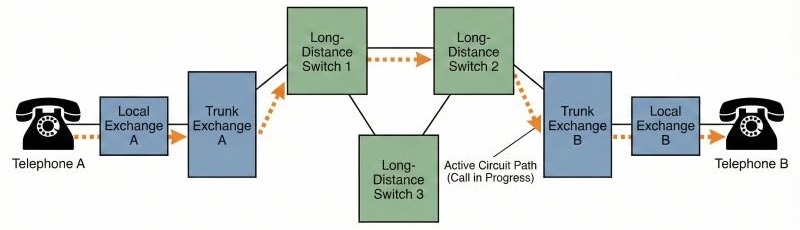
A classic telephone network consists of many switching offices connected by permanent lines. When a user dials a number, the local office checks for free routes to the next office. This continues until the receiver’s office responds. Inside each switching office, internal links are activated to form one continuous electrical circuit.
The network had to activate many switches before the call could begin. This is why old telephones often had small delays when making long-distance calls. But once the call started, the voice quality remained stable because the circuit was reserved only for those two users.
Circuit Switching vs Modern Packet Switching
Today’s Internet uses packet switching, not circuit switching. In packet switching, data is broken into packets, and each packet takes any available route. The network does not reserve a complete path. This makes packet switching faster, cheaper, and more flexible.
However, real-time communication like voice calls still needs steady performance. To handle this, modern networks use methods like VoIP and QoS, which imitate some benefits of circuit switching but without the drawbacks.
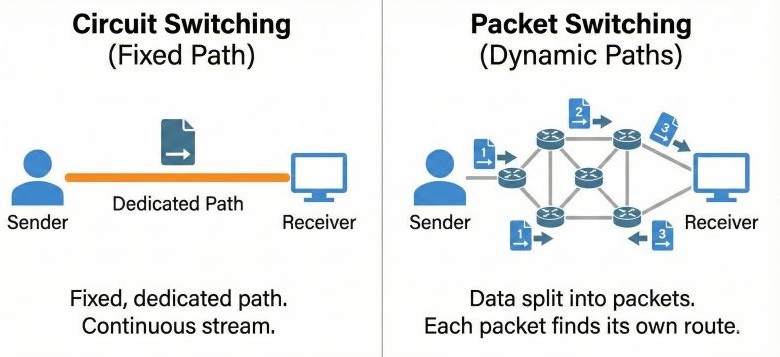
Although packet switching is the standard today, circuit switching is still used in −
- Traditional telephone lines
- Private branch exchange (PBX) systems
- Old mobile networks (1G, 2G)
- Special military or emergency networks
These systems prefer circuit switching because they need predictable performance and stable communication lines.
Conclusion
Circuit switching played a very important role in the development of communication networks. It gave a simple way to send data by creating a dedicated connection between two points. The method offers reliable and ordered communication with steady data rates, which is excellent for real-time applications. At the same time, it also wastes bandwidth, has high setup time, and is costly for large-scale networks.
Even though modern networks use packet switching for flexibility and efficiency, circuit switching remains an important concept. It helps in understanding how early communication systems worked and why newer methods were developed. Knowing the strengths and weaknesses of circuit switching gives a clear picture of how communication evolved over time.
