
- BEEE - Home
- BEEE - Introduction
- Basic Electrical Quantities
- Ohm's Law
- Kirchhoff's Current Law
- Kirchhoff's Voltage Law
- Types of Circuit Elements
- Series Circuit
- Parallel Circuit
- Voltage Division and Voltage Divider
- Current Division and Current Divider
- Star and Delta Connection
- Electric Power and Electrical Energy
- Effects of Electric Current
- Electrical Safety Measures
- DC Circuits and Network Theorems
- Basics of DC Circuits
- Nodal Analysis
- Mesh Analysis
- Thevenin's Theorem
- Norton's Theorem
- Superposition Theorem
- Maximum Power Transfer Theorem
- Source Transformation
- BEEE Useful Resources
- BEEE - Useful Resources
- BEEE - Discussion
Voltage Division and Voltage Divider
Voltage division is nothing but a concept which explains how a supply voltage is divided or distributed among different components like resistors of a circuit that are connected in series. The circuit which performs voltage division is called a Voltage Divider.
Voltage divider circuits are widely used in various electrical and electronic systems, ranging from simple sensor-based circuits to large sophisticated control or power systems. Therefore, it is very important to learn the principle of voltage division to understand the advanced concepts like signal conditioning, voltage regulation, and more. This chapter will explain voltage division, voltage divider circuit, and related formulae in detail.
What is Voltage Division?
Voltage division is a concept in electrical and electronics engineering in which the input supply voltage is distributed across components connected in series.
In more simple terms, whenever two or more circuit elements mainly resistors are connected in series, the total input voltage is divided among them according to their resistances. This phenomenon is referred to as Voltage Division.
What is a Voltage Divider?
Voltage divider is a series circuit which has two or more resistors connected in series. The two-resistor voltage divider is the most common type used in various electrical and electronic systems.
A typical two-resistor voltage divider is shown in the following figure.
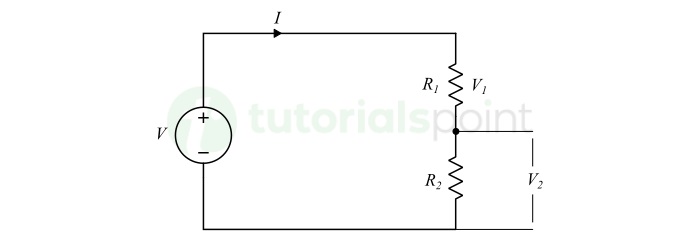
This circuit operates as follows −
- It has same current flowing through both resistors.
- The total supply voltage divides between the two resistors and equals to their sum.
- Voltage across each resistor depends on the resistance value.
- Resistor with higher resistance value receives a higher voltage across it.
Principle of Voltage Division
In a series circuit, voltage division takes place according to Ohm's law, which states that
$$\mathrm{V = I \times R}$$
From this equation, we can observe that
- Current remains the same through both resistors.
- Voltage is directly proportional to resistance. Thus, large resistance will have higher voltage drop and vice-versa.
Theory of Voltage Division
The voltage division theory is explained below −
Applying KVL in the loop of the voltage divider circuit, we can write,
$$\mathrm{V = V_1 + V_2}$$
$$\mathrm{V = I R_1 + I R_2}$$
$$\mathrm{\Rightarrow V = I (R_1 + R_2)}$$
$$\mathrm{\Rightarrow I = \frac{V}{R_1 + R_2}}$$
Therefore, the voltage across resistor R1 is
$$\mathrm{V_1 = I R_1 = \frac{V}{R_1 + R_2} \times R_1}$$
Similarly, the voltage across resistor R2 is
$$\mathrm{V_2 = I R_2 = \frac{V}{R_1 + R_2} \times R_2}$$
In general,
$$\mathrm{V_x = \frac{V}{R_{\text{total}}} \times R_x}$$
Applications of Voltage Division and Voltage Divider
Voltage division rule and voltage divider circuit are used in the following key applications −
- It is used for interfacing of sensors like temperature, light, pressure, etc.
- It is also used for monitoring of battery voltage.
- It is used for biasing transistors and Op-Amps.
- It is also employed for generating reference voltage.
In addition, voltage dividers are used in measurement circuits and multi-meter.
Key Points on Voltage Division
Given below are some key points related to voltage division to keep in mind while working with voltage division or voltage divider −
- Voltage divider is a series circuit.
- Voltage divides in proportion to the resistance value.
- Resistor with higher resistance value receives higher voltage across it and vice-versa.
- Voltage division occurs as per the Ohm's law.
- Voltage division or voltage divider are not suitable for high power applications.
Limitations of Voltage Divider
Apart from voltage division feature, a voltage divider has the following key limitations −
- The output of voltage divider can be affected when a heavy load is connected to it.
- A certain amount of power is dissipated as heat in the resistors of the divider circuit.
- Voltage divider circuit cannot be used for high power circuits, It is suitable for signal-level applications only.
Conclusion
Voltage division is a fundamental concept in the field of electrical and electronics engineering. It explains how voltage is divided when multiple components are connected in series. This builds the foundation for understanding advanced concepts in power systems, power electronics, control systems, etc.
