
- BEEE - Home
- BEEE - Introduction
- Basic Electrical Quantities
- Ohm's Law
- Kirchhoff's Current Law
- Kirchhoff's Voltage Law
- Types of Circuit Elements
- Series Circuit
- Parallel Circuit
- Voltage Division and Voltage Divider
- Current Division and Current Divider
- Star and Delta Connection
- Electric Power and Electrical Energy
- Effects of Electric Current
- Electrical Safety Measures
- DC Circuits and Network Theorems
- Basics of DC Circuits
- Nodal Analysis
- Mesh Analysis
- Thevenin's Theorem
- Norton's Theorem
- Superposition Theorem
- Maximum Power Transfer Theorem
- Source Transformation
- BEEE Useful Resources
- BEEE - Useful Resources
- BEEE - Discussion
Current Division and Current Divider
Current division is nothing but a principle that explains how an electric current divides into multiple smaller currents in a parallel circuit. The circuit which performs current division is referred to as a current divider.
In this chapter, we will cover current division rule, current divider circuit, formula of current division, laws related to current division, and real-world applications of current division.
What is Current Division?
Current Division is nothing but a process in an electric circuit in which an electric current divides among multiple smaller currents flowing through parallel branches of the circuit.
In an electric circuit, current division takes place when there are multiple parallel branches between two junction points. In such a case, when total current reaches to a junction point and finds multiple parallel paths, it divides into those paths in proportion to their resistances.
Circuit Law Related to Current Division
KCL (Kirchhoff's Current Law) is related to current division, where KCL is a basic circuit law. According to this law, the algebraic sum of all currents (incoming and outgoing) at a junction in a circuit is zero.
What is a Current Divider?
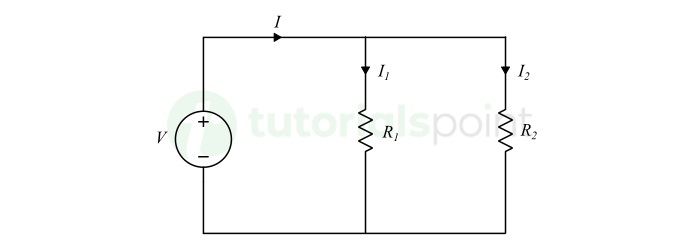
A current divider is nothing but a parallel electric circuit which has two or more components like resistors connected in parallel across a source of energy.
A simple two resistor current divider is shown in the following figure.
A current divider has the following key characteristics –
- It has the same voltage across all its branches, as they are connected between the same two junction points.
- Each branch has a different current according to their resistance.
- Equivalent resistance of the circuit is smaller than the smallest resistance.
The electric current flowing through each branch can be found using Ohm's law as,
$$\mathrm{I = \frac{V}{R}}$$
Since the voltage is constant across all resistors, thus, we get,
$$\mathrm{I \propto \frac{1}{R}}$$
Hence, there is an inverse relationship between the resistance and current in a current division circuit. This states that
- Lower resistance branch will have higher current through it.
- Higher resistance branch will have a lower current through it.
Theory of Two Resistor Current Divider
Let us now derive the equation for current through each branch of a two-resistor current divider circuit. For this, consider the current divider shown above.
According to Ohm's law
$$\mathrm{I_1 = \frac{V}{R_1}}$$
And,
$$\mathrm{I_2 = \frac{V}{R_2}}$$
Also,
$$\mathrm{I = I_1 + I_2}$$
$$\mathrm{I = \frac{V}{R_1} + \frac{V}{R_2} = V\left(\frac{1}{R_1} + \frac{1}{R_2}\right)}$$
$$\mathrm{\Rightarrow I = V\left(\frac{R_1 + R_2}{R_1 R_2}\right)}$$
$$\mathrm{V = I \times \frac{R_1 R_2}{R_1 + R_2}}$$
Substituting the value of $\mathrm{V}$ in $\mathrm{I_1}$ and $\mathrm{I_2}$, we get,
$$\mathrm{I_1 = I \times \frac{R_2}{R_1 + R_2}}$$
And,
$$\mathrm{I_2 = I \times \frac{R_1}{R_1 + R_2}}$$
From these two expressions, it can be observed that current flowing through R1 resistor depends on another resistors R2 and vice-versa.
Applications of Current Division
Some of the common real-world applications of current division are listed below −
- It is used in electronic circuits for biasing purposes.
- It is used for parallel load distribution.
- It is also employed in processing of analog signals.
- This is also used for current measurement using shunt resistors.
Important Points About Current Division
Some of the key points to keep in mind related to current division are listed here −
- Current divider is a parallel circuit.
- Branch current in a current divider depends on the resistance in an inverse relation.
- Current division is based on Ohm's law and KCL.
Conclusion
Both these concepts are fundamental and important in electrical and electronics engineering. These concepts are very crucial for simplifying and solving complex electric circuit in circuit analysis. Let's move to the next chapter in the tutorial and learn about Star and Delta Connections in Electrical.
