
- BEEE - Home
- BEEE - Introduction
- Basic Electrical Quantities
- Ohm's Law
- Kirchhoff's Current Law
- Kirchhoff's Voltage Law
- Types of Circuit Elements
- Series Circuit
- Parallel Circuit
- Voltage Division and Voltage Divider
- Current Division and Current Divider
- Star and Delta Connection
- Electric Power and Electrical Energy
- Effects of Electric Current
- Electrical Safety Measures
- DC Circuits and Network Theorems
- Basics of DC Circuits
- Nodal Analysis
- Mesh Analysis
- Thevenin's Theorem
- Norton's Theorem
- Superposition Theorem
- Maximum Power Transfer Theorem
- Source Transformation
- BEEE Useful Resources
- BEEE - Useful Resources
- BEEE - Discussion
Basics of DC Circuits
A DC Circuit is one of the most important types of electric circuit in electrical and electronics engineering. DC stands for Direct Current, and an electric circuit in which only a direct current source is used for excitation is called a DC circuit. In a DC circuit, electric current has a constant magnitude and flows in one direction all times.
Read this chapter to learn the fundamentals of DC circuits such as definition, main components, quantities, laws, types, and applications.
What is a DC Circuit?
A type of an electric circuit in which only one or more direct current sources are used for excitation is called a DC circuit. In a DC circuit, the current flow takes place in one direction.
In other words, a DC circuit can be defined as a closed path consisting of electrical components allowing direct current to flow.
A DC circuit can have following major components −
- DC Source - Battery, DC generator, PV cell, or DC power supplies
- Conducting wires
- Load - Resistors, lamps, or DC motors
- Switch
Electrical Quantities in DC Circuit
Direct Current (DC) − A type of electric current which always flow in a single direction is called a direct current. It is given by charge per unit time, i.e.,
$$\mathrm{I_{dc} = \frac{Q}{t}}$$
Where, Q is charge in coulomb and t is time in seconds.
Direct Voltage (DC Voltage) − DC voltage is a type of electric voltage having a constant polarity. It is measured in volts. DC voltage is the driving force in a DC circuit that forces electric current to flow.
Resistance − Resistance in DC circuits is the parameter that opposes electric current to flow through the circuit. It is measured in Ohms and is given by,
$$\mathrm{R = \frac{V}{I}}$$
Types of DC Circuits
There are two main types of DC circuits as given below −
- Series DC Circuit
- Parallel DC Circuit
Series DC Circuit
A series DC circuit is one in which circuit components are connected end-to-end and there is only one path for the flow of electric current as shown in the following figure.
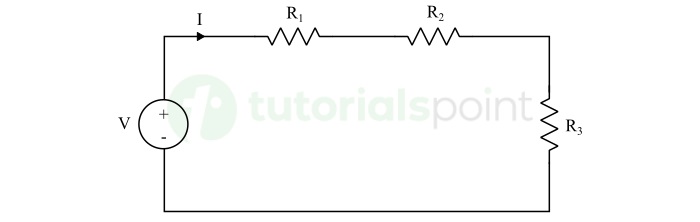
In a DC circuit the equivalent resistance is calculated by summing up all the resistances, i.e.,
$$\mathrm{R_{eq} = R_1 + R_2 + R_3}$$
The following are some important characteristics of DC circuits −
- In DC circuits, same electric current flows through all components as there is only one path available.
- In DC circuits, total voltage divides among all circuit components depending on their resistances.
Parallel DC Circuit
A DC circuit in which all components are connected between two common points as shown in the following figure is called a parallel DC circuit.
In a Parallel DC circuit, the equivalent resistance is calculated as follows −
$$\mathrm{\frac{1}{R_{eq}} = \frac{1}{R_1} + \frac{1}{R_2} + \frac{1}{R_3}}$$
Some of the important characteristics of parallel DC circuits are listed below –
- In parallel DC circuit, same voltage is applied across all the branches/components.
- Total circuit current divides into multiple branch current depending on their resistances.
Power in DC Circuits
Electric power is defined as the rate of energy consumed in a circuit. In DC circuits, electric power can be computed by multiplying the supply voltage and circuit current i.e.,
$$\mathrm{P = V \times I}$$
By Ohm's law, the electric power consumed in DC circuits can also be calculated as follows,
$$\mathrm{P = I^2 R = \frac{V^2}{R}}$$
Conclusion
In conclusion, a DC circuit is the simplest form of electric circuit in which a direct current source and a number of resistors are used as main components. DC circuits are widely used in low power applications such as control circuits, toys, electronic devices, and much more.
