
- BEEE - Home
- BEEE - Introduction
- Basic Electrical Quantities
- Ohm's Law
- Kirchhoff's Current Law
- Kirchhoff's Voltage Law
- Types of Circuit Elements
- Series Circuit
- Parallel Circuit
- Voltage Division and Voltage Divider
- Current Division and Current Divider
- Star and Delta Connection
- Electric Power and Electrical Energy
- Effects of Electric Current
- Electrical Safety Measures
- DC Circuits and Network Theorems
- Basics of DC Circuits
- Nodal Analysis
- Mesh Analysis
- Thevenin's Theorem
- Norton's Theorem
- Superposition Theorem
- Maximum Power Transfer Theorem
- Source Transformation
- BEEE Useful Resources
- BEEE - Useful Resources
- BEEE - Discussion
Types of Circuit Elements
Circuit elements are the most fundamental components of any electrical or electronic network or circuit. Circuit elements are considered the most elementary part of a circuit, hence they cannot be further broken down into small two-terminal components. Some of the common examples of circuit elements include resistor, inductor, capacitor, voltage or current source, diode, etc.
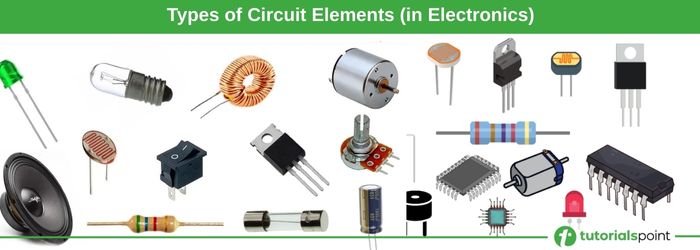
Depending on the behavior in an electrical or electronic circuit, circuit elements can be classified into different types, which we will discuss in this chapter.
What is a Circuit Element?
Circuit Elements are the basic building block of an electrical or electronic circuit. Basically, a circuit element is a mathematical model of an electrical device which is characterized by the relationship between voltage and current at its terminals.
Circuit elements are the most elementary part of a circuit, therefore they cannot be further divided into sub-components. The common examples of circuit elements are resistors, inductors, capacitors, energy sources, etc.
Types of Circuit Elements
Depending on the characteristics/behavior, the circuit elements can be classified into the following major categories −
- Active Elements
- Passive Elements
- Unilateral Elements
- Bilateral Elements
- Linear Elements
- Non-Linear Elements
- Lumped Elements
- Distributed Elements
Each of these types of circuit elements have different behavior in electric circuits. Let us now discuss each type of circuit elements in detail.
Active Elements
Circuit elements that provide/deliver electrical energy to an electrical or electronic circuit or provide power gain/amplification in the circuit are called active elements.
Examples of active elements include voltage and current sources, batteries, electric generators, transistors, operational amplifiers, etc.
The VI characteristic of an active element shows a negative slope at some point, which indicates power delivered to the circuit as shown in the figure.
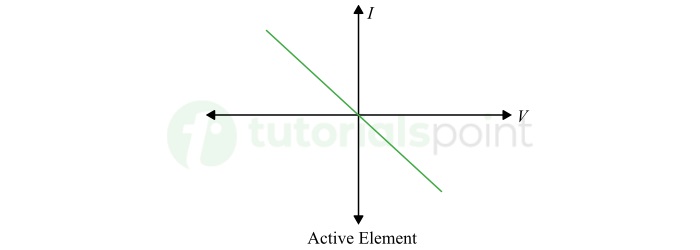
In practical electrical circuits, there must be at least one active element to provide or sustain energy for functioning.
Passive Elements
Circuit elements that only absorb, dissipate, store, or transform, electrical energy into other forms like motion, light, or heat are called passive elements. These elements do not supply energy to the circuit, and perform an inverse function of active elements.
Examples of passive elements include resistor, inductor, capacitor, or transformer.
The VI characteristic of passive elements has a positive slope, which indicates power consumption.
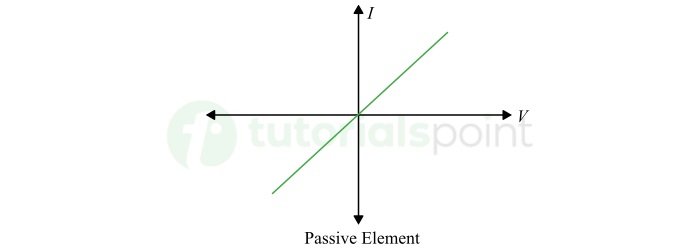
It is also important to note that these elements can store a certain amount of energy and can momentarily return it to the circuit, but they cannot supply energy or do power gain indefinitely.
Unilateral Elements
Depending on the directionality, circuit elements can be classified into two types namely unilateral and bilateral.
Circuit elements for which the relationship between voltage and current is different for different directions of current flow are called unilateral elements.
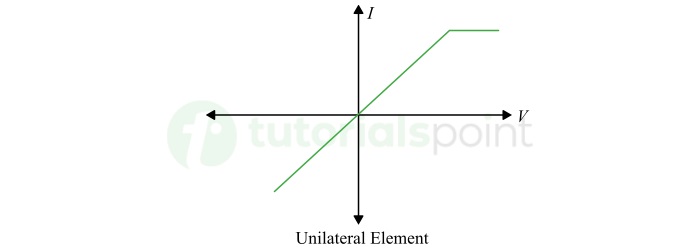
The VI characteristic of unilateral circuit elements is shown in the figure, it shows that the shape of characteristic changes with the change in polarity of voltage or direction of current. Semiconductor diode, LEDs, etc. are the examples of unilateral circuit elements.
Therefore, it can be stated that unilateral elements have the response to excitation relationship dependent on the direction of applied excitation.
Bilateral Elements
Circuit elements for which the relationship between applied voltage and current flow is the same irrespective of direction are called bilateral elements. In other words, if we reverse the polarity of applied voltage, elements will behave the same. Thus, these elements have a symmetric behavior.
Examples of bilateral elements include resistors, capacitors, inductors in their pure form.
Bilateral elements have a relationship between response to excitation which is independent of the direction of the applied excitation. Therefore, bilateral elements behave equally in either direction of current flow as shown in the VI characteristic.
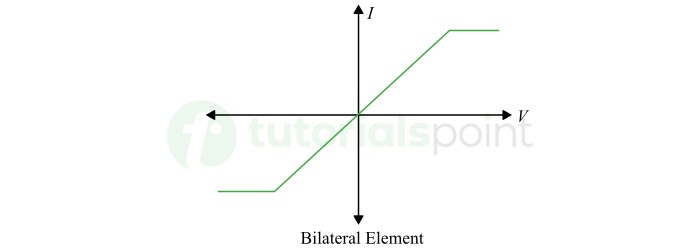
For example, if a voltage of V volts is applied to a resistor, then the current through the resistor would always be V/R, irrespective of the direction of the applied voltage.
Linear Elements
A linear element is one that obeys the principle of homogeneity and additivity. These two principles states that if the input of the circuit element is doubled, then output must also be doubled.
The behavior of these elements can be described by linear differential equations. Some examples of linear elements include ideal resistor, inductor, and capacitor.
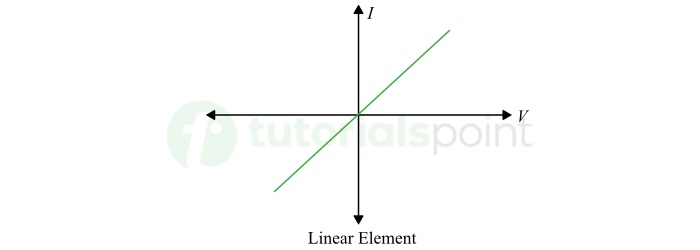
The VI characteristic of a linear element takes the shape as shown in the figure. For a linear element, the response is directly proportional to the applied excitation.
Non-Linear Elements
A circuit element which does not follow homogeneity and additivity properties for the relationship between excitation and response is called a non-linear element. Thus, in simple terms, a circuit element which is not linear is a non-linear circuit element.
In other words, we can describe a linear element as a circuit element for which the response does not scale linearly with the applied input and also does not hold the principle of superposition.
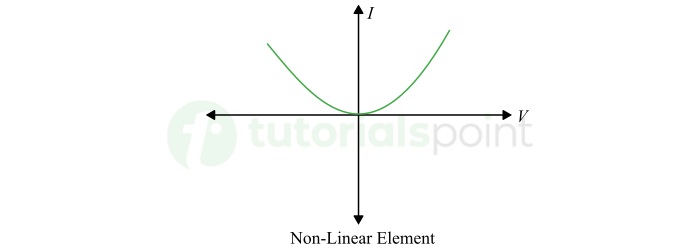
In case of a non-linear circuit element, the response is no directly proportional to the applied excitation as shown in the VI characteristics. Examples of non-linear circuit elements are diodes, transistors, and other semiconductor devices.
For a diode, when the applied voltage is less than the cut-in voltage, the current through the diode is practically zero. Though, if the applied voltage is increased above the cut in voltage, the current through the diode becomes excessively high. Thus, the diode is a non-linear circuit element.
Lumped Elements
When the physical size of the circuit element is small with respect to the signal wavelength is called a lumped element. Thus, the lumped elements are the elements which are pure and physically separable. Pure resistors, inductors and capacitors are the examples of lumped elements.
Lumped elements are treated as discrete components and have well-defined input output terminals.
Distributed Elements
When the physical size of the circuit element is of the order of single wavelength, it is called distributed element. Therefore, distributed elements are not pure and physically separable, instead these are distributed over the entire length of the circuit. Transmission lines are the examples of distributed elements.
For distributed elements, we must consider variations in parameters such as voltage, current, phase, etc. along their entire length.
A very common example of distributed circuit element is transmission lines, because they cannot be accurately modelled as a single resistor, inductor, or capacitor and their behavior distributes over the whole length, with wave propagation, reflections, delay, etc.
Importance of Circuit Element Classification
We have classified circuit elements in a number of categories as described above. This classification is important because −
- It helps in circuit modelling and analysis.
- It supports decision making in circuits/system design.
- It helps in predicting behavior of circuit element or circuit.
Summary of Circuit Element Types
The following tables provide a summarized overview of different types of circuit elements used in electrical and electronic circuits −
| Circuit Element Type | Description | Examples |
|---|---|---|
| Active Elements | They supply power to the circuit or provide power gain in the circuit. | Voltage sources, current sources, batteries, generators, transistors, op-amps, etc. |
| Passive Elements | They do not supply energy to the circuit, instead absorbs, stores or dissipates energy. | Resistor, inductor, capacitor, transformer, etc. |
| Unilateral Elements | They have behavior dependent on direction of current or polarity of voltage. | Diode, LED, other semiconductor devices, etc. |
| Bilateral Elements | They have same behavior regardless direction of current or polarity of voltage. | Ideal resistor, inductor, capacitor, etc. |
| Linear Elements | They have output proportional to input and obeys superposition principle. | Ideal resistor, inductor, capacitor, etc. |
| Non-Linear Elements | They have output not proportional to input. | Diode, transistor, semiconductor devices, etc. |
| Lumped Elements | They have physical size small relative to signal wavelength. | Resistor, inductor, capacitor, etc. |
| Distributed Elements | They have properties distributed across the entire length and have size comparable to signal wavelength. | Transmission lines, waveguides, etc. |
Conclusion
In conclusion, circuit elements can be classified on the basis of their characteristics into various categories such as active, passive, unilateral, bilateral, linear, non-linear, lumped and distributed elements. In this chapter, we have explained all these elements in detailed. Let’s move to the next chapter in the tutorial, named Series Circuit and Its Properties.
