
- BEEE - Home
- BEEE - Introduction
- Basic Electrical Quantities
- Ohm's Law
- Kirchhoff's Current Law
- Kirchhoff's Voltage Law
- Types of Circuit Elements
- Series Circuit
- Parallel Circuit
- Voltage Division and Voltage Divider
- Current Division and Current Divider
- Star and Delta Connection
- Electric Power and Electrical Energy
- Effects of Electric Current
- Electrical Safety Measures
- DC Circuits and Network Theorems
- Basics of DC Circuits
- Nodal Analysis
- Mesh Analysis
- Thevenin's Theorem
- Norton's Theorem
- Superposition Theorem
- Maximum Power Transfer Theorem
- Source Transformation
- BEEE Useful Resources
- BEEE - Useful Resources
- BEEE - Discussion
Source Transformation
Source Transformation, also referred to as Source Conversion, is an important concept in electric circuit theory. This tool allows us to reduce complexity of electrical circuits by converting voltage sources into current sources and vice-versa.
According to the theory of source transformation, we can convert a current source in parallel with a resistor into an equivalent voltage source in series with the same resistor and vice-versa. This circuit analysis concept is widely used in solving network problems, circuit simplification, solving/analyzing circuits containing multiple sources, etc.
In this comprehensive chapter, we will learn the application of source transformation in −
- Voltage to Current Source Transformation
- Current to Voltage Source Transformation
Here, it is important to note that we can convert practical voltage and current sources only.
Introduction to Source Transformation
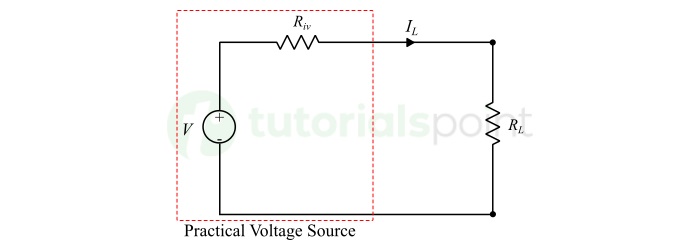
A practical voltage source consists of an ideal voltage source in series with an internal resistance (for an ideal voltage source, this internal resistance being zero, so that the output voltage becomes independent of the load current). While a practical current source consists of an ideal current source in parallel with an internal resistance (for an ideal current source, this parallel resistance is infinity).
According to source transformation/conversion, The practical voltage and current sources are mutually convertible, i.e., a practical voltage source can be converted into a practical current source and vice-versa.
Let us now learn the practicality of how to convert a voltage source into a current source and a current source into a voltage source.
Voltage to Current Source Transformation
First, we will understand the theory behind conversion of a practical voltage source intro an equivalent current source.
For this consider a practical voltage source of V volts having a series internal resistance Riv Ohms. Also, a load resistance of RL Ohms is connected across the load terminals as shown in the following figure.
Step 1 − Find the equivalent source current
Relace the load resistance by a short circuit and find the short-circuit current ISC.
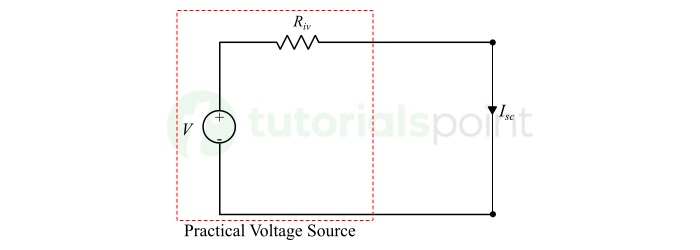
$$\mathrm{I_{SC} = \frac{V}{R_{iv}}}$$
This will be the current of the current source equivalent to the given voltage source.
Step 2 − Find the equivalent internal resistance
For this, remove open the load terminals and replace the voltage source by a short circuit. Then, calculate the equivalent resistance of the circuit, seen from load terminals.
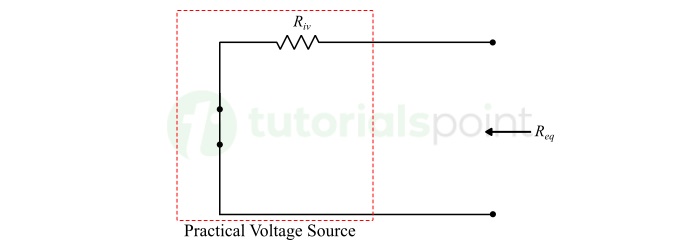
$$\mathrm{R_{eq} = R_{iv}}$$
This will be the internal resistance of the current source equivalent to the given voltage source.
Hence, the equivalent current source will be as shown in the following figure.
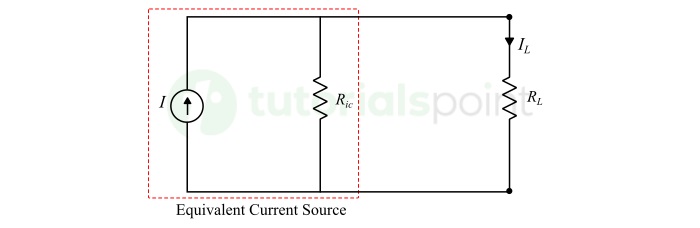
Here,
$$\mathrm{I = I_{SC} = \frac{V}{R_{iv}}}$$
$$\mathrm{R_{ic} = R_{eq} = R_{iv}}$$
Thus, a practical voltage source of constant voltage V and internal resistance Riv is equivalent to a current source of current I = V/Riv and internal resistance Ric = Riv in parallel with current source.
Here, it can be noted that the internal resistance of the equivalent current source has the same value as the internal resistance of the given voltage source.
Current to Voltage Source Transformation
Let us now understand the way of converting a practical current source into an equivalent voltage source. For this, we will consider a practical current source of constant current I amperes with a parallel internal resistance Ric, with a connected load resistance RL as shown in the following figure.
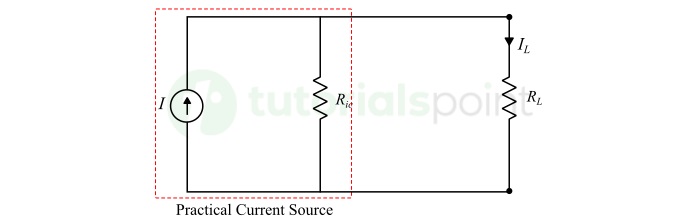
This current source can be converted into an equivalent voltage source as described below.
Step 1 − Find the equivalent source voltage
Remove the load resistance and find the voltage across open-circuited load terminals.
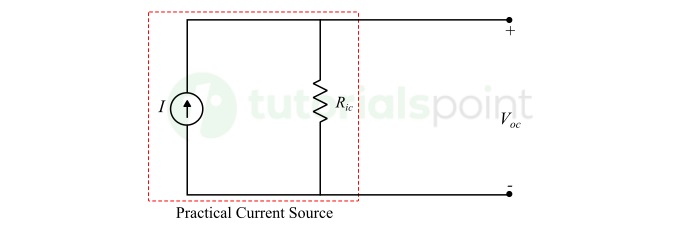
$$\mathrm{V_{oc} = I \times R_{ic}}$$
This will be the voltage of the voltage source equivalent to the given current source.
$$\mathrm{V_{oc}}$$
Step 2 − Find the equivalent internal resistance
For this, eliminate the current source by replacing it with open circuit and find the resistance, seen from the load terminals.
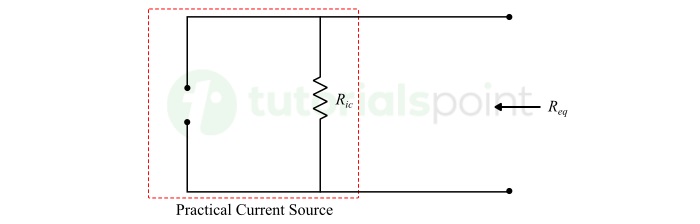
$$\mathrm{R_{eq} = R_{ic}}$$
Hence, the equivalent voltage source will be as shown in the following figure −
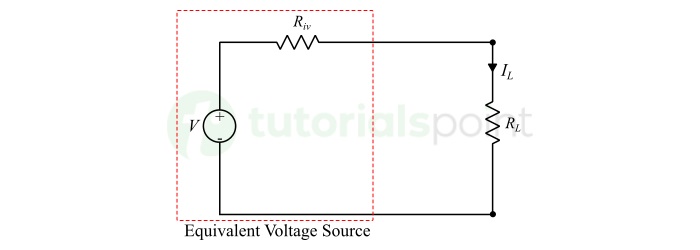
Here,
$$\mathrm{V = V_{oc} = I \times R_{ic}}$$
$$\mathrm{R_{iv} = R_{eq} = R_{ic}}$$
Therefore, a current source can be converted into an equivalent voltage source, where the value of voltage of the equivalent voltage source is V = IRic and the series resistance Ri of voltage source has the same value as the parallel resistance of the current source.
Conclusion
Source Transformation a.k.a. Source Conversion is an important circuit analysis tool in electrical engineering. This concept allows us to convert practical voltage and current sources between them, keeping the circuit behavior unchanged. Let's move ahead in the tutorial and learn another important concept known as Star-Delta Transformation.
