
- BEEE - Home
- BEEE - Introduction
- Basic Electrical Quantities
- Ohm's Law
- Kirchhoff's Current Law
- Kirchhoff's Voltage Law
- Types of Circuit Elements
- Series Circuit
- Parallel Circuit
- Voltage Division and Voltage Divider
- Current Division and Current Divider
- Star and Delta Connection
- Electric Power and Electrical Energy
- Effects of Electric Current
- Electrical Safety Measures
- DC Circuits and Network Theorems
- Basics of DC Circuits
- Nodal Analysis
- Mesh Analysis
- Thevenin's Theorem
- Norton's Theorem
- Superposition Theorem
- Maximum Power Transfer Theorem
- Source Transformation
- BEEE Useful Resources
- BEEE - Useful Resources
- BEEE - Discussion
Star and Delta Connection
Star Connection and Delta Connection (or Star and Delta Connections) are most commonly used in three-phase electrical systems for applications such as a power generation, transmission, and distribution. Star connection is also referred to as Y-Connection and the Delta Connection is also known as Δ- Connection.
It is very important to understand the configuration and voltage-current relationships in star and delta connections to concepts of electrical machines, power systems, and industrial motor control.
What is Star Connection?
Star Connection, also called Y-Connection is a circuit configuration in which one end of each three-phase windings is connected to a common points and other ends are taken out as line terminals. The common points where three ends of three-phase windings join each other is called the Neutral Point.
The star connection forms the shape of Y, hence it is also called Y-connection. The circuit diagram of star connection is shown in the following figure.
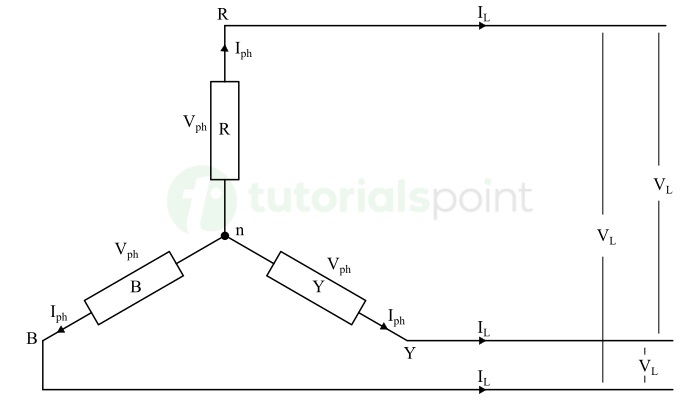
It has the following −
- Three phase windings, namely Rn, Yn, and Bn.
- One common point called neutral point (n).
- Three line terminals namely, R, Y, and B.
Voltage Relation in Star Connection
From the above circuit diagram of star connection, it can be observed that
$$\mathrm{\text{Line Voltage } V_L = \sqrt{3} \times V_{ph}}$$
Where, Vph is the phase voltage. Hence, for star connection, the line voltage is higher than the phase voltage.
Current Relation in Star Connection
From the circuit diagram of star connection, the phase winding is connected in series with the line. Hence, the same current will flow through both phase winding and the line. Therefore,
$$\mathrm{\text{Line Current } I_L = \text{Phase Current } I_{ph}}$$
Power Relation in Star Connection
For a balanced three-phase system, the power is given by,
$$\mathrm{P = 3 \times V_{ph} \times I_{ph} \times \cos \phi}$$
Hence, for the star connection, we get,
$$\mathrm{P = 3 \times \frac{V_L}{\sqrt{3}} \times I_L \times \cos \phi}$$
$$\mathrm{\therefore P = \sqrt{3} \, V_L \, I_L \, \cos \phi}$$
Where, cos ϕ is the power factor of the system.
Advantages of Star Connection
The following are some key benefits of star connections in electrical systems −
- It has lower phase voltage as compared to line voltage, hence improves the insulation safety between phases.
- It provides a neutral point, which makes it a suitable connection for single-phase circuits.
- It is suitable for high-voltage transmission systems due to lower phase voltage and higher line voltage.
- Star connection increase resistance, hence reduces starting current in motors.
Disadvantages of Star Connection
Apart from advantages, star connection also has certain downsides which are as follows −
- In motor applications, star connection produces lower torque.
- Star connection is not suitable for staring heavy loads.
- Star connection requires a neutral wire for unbalanced loads.
Applications of Star Connection
The following are common real-world applications of star connection −
- It is used in distribution transformers.
- It is also used in windings of generators and alternators.
- It is used in star-delta starter used for motors.
- It is used in single-phase and three-phase residential and commercial power supplies.
What is Delta Connection?
Delta connection is another configuration in which electrical components are connected, especially in three-phase circuits. In the case of delta connection, three-phase windings are connected end-to-end to form a closed loop like a triangle or delta (Δ).
Note − The most important thing to note about delta connection is that it does not have any neutral point.
The circuit diagram of delta connection is shown in the following figure −
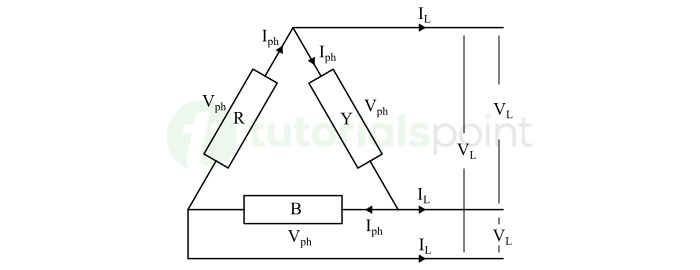
It has the following key characteristics −
- It has three windings connected to form a closed loop.
- Three terminals from which line wires are taken.
- No neutral point.
Voltage Relation in Delta Connection
In delta connection, we can observe that line voltage is equal to the phase voltage as shown in the above circuit diagram of delta connection. Thus,
$$\mathrm{\text{Line Voltage } (V_L) = \text{Phase Voltage } (V_{ph})}$$
Current Relation in Delta Connection
In delta connection, the line current is the phasor sum of two phase currents. Hence, the line current is root three times of the phase current in delta connection i.e.,
$$\mathrm{\text{Line Current } I_L = \sqrt{3} \times \text{Phase Current } (I_{ph})}$$
Thus, delta connection has higher line current as compared to phase current.
Power Relation in Delta Connection
For a balanced delta connection, the power is given by,
$$\mathrm{P = 3 \times V_{ph} \times I_{ph} \times \cos \phi}$$
$$\mathrm{\Rightarrow P = 3 \times \frac{V_L \times I_L}{\sqrt{3}} \times \cos \phi}$$
$$\mathrm{\therefore P = \sqrt{3} \, V_L \, I_L \, \cos \phi}$$
Hence, the power equation for both star and delta connection is the same.
Advantages of Delta Connection
The key benefits of delta connection are highlighted below −
- It can produce high starting torque in electric motors.
- It does not require a neutral wire.
- It is suitable for high power applications.
Disadvantages of Delta Connection
Delta connection also has certain disadvantages, some of them are given below −
- It requires higher insulation between phases.
- It draws higher starting current.
- It is not suitable for very high-voltage systems.
- It does not provide neutral points required for single-phase systems.
Applications of Delta Connection
The following are some real-world applications of delta connection −
- It is used in windings of industrial induction motors.
- It is used in motors driving heavy mechanical loads.
- It is used in low-voltage high current systems.
- It is also used in star-delta starter of motor.
Difference between Star and Delta Connection
The following table provides a comparative study of star and delta connection −
| Parameter | Star Connection | Delta Connection |
|---|---|---|
| Alternate Name | Y-Connection | Δ-Connection |
| Phase & Line Voltage | $\mathrm{ V_{ph} = \frac{V_L}{\sqrt{3}}}$ | $\mathrm{V_{ph} = V_L}$ |
| Phase & Line Current | $\mathrm{I_{ph} = I_L}$ | $\mathrm{I_{ph} = \frac{I_L}{\sqrt{3}}}$ |
| Neutral Point | Present | Not present |
| Starting Current | Low | High |
| Insulation Requirement | Low | High |
| Usage Example | Power transmission and motor starters | Motor windings and power transformers |
Conclusion
In this chapter, we covered the fundamental concepts related to these two types of electrical configurations. Star and delta connection are important in three-phase systems, as they allow efficient power transmission in power systems and torque generation in motors. Let's move ahead in the tutorial and learn about another important concept of electrical and electronics engineering i.e., Electric Power and Electrical Energy.
