
- DBMS - Home
- DBMS - Overview
- DBMS - Architecture
- DBMS - Data Models
- DBMS - Data Schemas
- DBMS - Data Independence
- DBMS - System Environment
- Centralized and Client/Server Architecture
- DBMS - Classification
- Relational Model
- DBMS - Codd's Rules
- DBMS - Relational Data Model
- DBMS - Relational Model Constraints
- DBMS - Relational Database Schemas
- DBMS - Handling Constraint Violations
- Entity Relationship Model
- DBMS - ER Model Basic Concepts
- DBMS - ER Diagram Representation
- Relationship Types and Relationship Sets
- DBMS - Weak Entity Types
- DBMS - Generalization, Aggregation
- DBMS - Drawing an ER Diagram
- DBMS - Enhanced ER Model
- Subclass, Superclass and Inheritance in EER
- Specialization and Generalization in Extended ER Model
- Data Abstraction and Knowledge Representation
- Relational Algebra
- DBMS - Relational Algebra
- Unary Relational Operation
- Set Theory Operations
- DBMS - Database Joins
- DBMS - Division Operation
- DBMS - ER to Relational Model
- Examples of Query in Relational Algebra
- Relational Calculus
- Tuple Relational Calculus
- Domain Relational Calculus
- Relational Database Design
- DBMS - Functional Dependency
- DBMS - Inference Rules
- DBMS - Minimal Cover
- Equivalence of Functional Dependency
- Finding Attribute Closure and Candidate Keys
- Relational Database Design
- DBMS - Keys
- Super keys and candidate keys
- DBMS - Foreign Key
- Finding Candidate Keys
- Normalization in Database Designing
- Database Normalization
- First Normal Form
- Second Normal Form
- Third Normal Form
- Boyce Codd Normal Form
- Difference Between 4NF and 5NF
- Structured Query Language
- Types of Languages in SQL
- Querying in SQL
- CRUD Operations in SQL
- Aggregation Function in SQL
- Join and Subquery in SQL
- Views in SQL
- Trigger and Schema Modification
- Storage and File Structure
- DBMS - Storage System
- DBMS - File Structure
- DBMS - Secondary Storage Devices
- DBMS - Buffer and Disk Blocks
- DBMS - Placing File Records on Disk
- DBMS - Ordered and Unordered Records
- Indexing and Hashing
- DBMS - Indexing
- DBMS - Single-Level Ordered Indexing
- DBMS - Multi-level Indexing
- Dynamic B- Tree and B+ Tree
- DBMS - Hashing
- Query Processing and Optimization
- Heuristics in Query Processing
- Transaction and Concurrency
- DBMS - Transaction
- DBMS - Scheduling Transactions
- DBMS - Testing Serializability
- DBMS - Conflict Serializability
- DBMS - View Serializability
- DBMS - Concurrency Control
- DBMS - Lock Based Protocol
- DBMS - Timestamping based Protocol
- DBMS - Phantom Read Problem
- DBMS - Dirty Read Problem
- DBMS - Thomas Write Rule
- DBMS - Deadlock
- Backup and Recovery
- DBMS - Data Backup
- DBMS - Data Recovery
- DBMS Useful Resources
- DBMS - Quick Guide
- DBMS - Useful Resources
- DBMS - Discussion
DBMS - Thomas Write Rule
Transactions and concurrency control are the most critical tasks in managing a DBMS and ensuring its smooth functioning. If these two critical tasks are not handled properly, it can cause major problems in data consistency, leading to massive failures.
Thomas Write Rule is a concurrency control technique used in DBMS to manage concurrent transactions efficiently. It extends the traditional timestamp-ordering protocol by introducing conditions where outdated writes are ignored. It enhances the system performance while maintaining data consistency.
Understanding the Thomas Write Rule
The Thomas Write Rule focuses on managing write operations in concurrent transactions. It addresses scenarios where transactions attempt to update the same data. It resolves the conflicts by using timestamps to track the sequence of operations.
Each transaction is assigned a timestamp when it begins, indicating the logical sequence of its operations. This approach helps to determine whether a transaction's write should be performed or ignored.
Conditions for Applying the Thomas Write Rule
Let us see the set of conditions that we need to follow when working with the Thomas Write Rule. Consider a transaction $T_i$ attempting to write a value Q in the database. The Thomas Write Rule considers the following conditions −
- If $TS(T_i)$ < R(Q) −
- TS(Ti) is the timestamp of transaction $T_i$, and R(Q) is the last read timestamp of data Q.
- If $TS(T_i)$ is less than R(Q), it means the value Q created by Ti was already needed but was never produced. In this case, $T_i$ is rolled back.
- If $TS(T_i)$ < W(Q) −
- W(Q) is the last write timestamp of Q.
- If $TS(T_i)$ is less than W(Q), $T_i$ is writing an outdated value, so its write operation is ignored.
- Otherwise −
- If neither of the above conditions applies, the write operation proceeds. Here the W(Q) is updated to $TS(T_i)$.
By applying these rules, the DBMS maintains data consistency with multiple transactions to proceed in parallel.
Example: Applying the Thomas Write Rule
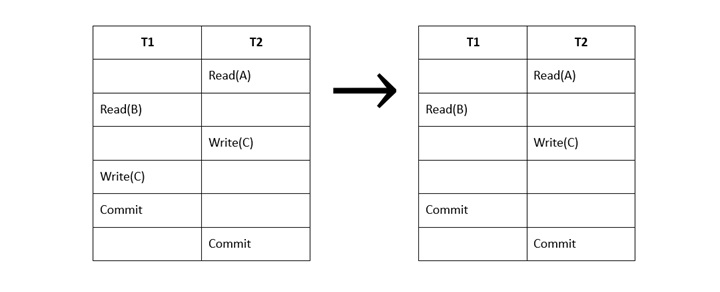
Imagine a database with three variables A, B, and C. Now two transactions T1 and T2 perform the following operations −
- T1: C := A
- T2: C := B
These operations are atomic operations. Suppose T1 receives an earlier timestamp than T2. If T2 updates C after T1 has read A but before T1 writes to C. Now with applying the Thomas Write Rule it prevents T1 from overwriting C with an outdated value.
How It Works
- T2 writes B to C with its timestamp TS(T2).
- When T1 attempts to write A to C, the system checks:
If TS(T1) < W(C), this is indicating T2's write occurred after T1 was supposed to write. Since this is true, T1's write is ignored. This is ensuring C holds the correct value.
This process avoids unnecessary rollbacks and do only the most recent transaction's update is considered valid.
Features of the Thomas Write Rule
Here are some of the important features of the Thomas Write Rule −
- Timestamp-Based Control − This uses timestamps for managing transaction order and ensuring data consistency.
- Conflict Avoidance − Prevents outdated writes. This is reducing write-write conflicts.
- Decentralized Management − Each transaction manages its own timestamps. It is minimizing centralized control issues.
- Simplicity and Scalability − The approach simplifies concurrency control while supporting large-scale distributed systems.
The rule is particularly useful in distributed databases. When there are centralized control might be challenging. By allowing transactions to manage their timestamps independently, the system can scale more effectively.
Difference between Thomas Write Rule and Basic Timestamp Protocol
The following table compares and contrasts the features of Thomas Write Rule and Basic Timestamp Protocol −
| Aspect | Basic Timestamp Protocol | Thomas Write Rule |
|---|---|---|
| Concurrency Control | Provides strict serializability using timestamps. | Allows view serializability by ignoring outdated writes. |
| Conflict Handling | Aborts conflicting transactions immediately. | Ignores outdated writes, reducing aborts. |
| Timestamp Management | Centralized timestamp management. | Decentralized timestamp management. |
| Implementation | Complex due to conflict resolution. | Simpler due to fewer rollbacks. |
| Performance Impact | May cause delays due to frequent aborts. | Improves performance by reducing conflicts. |
Pros and Cons the Thomas Write Rule
Following are the advantages of the Thomas Write Rule −
- View Serializability − This gives options for transactions to follow a logical order. This is preserving view serializability.
- Improved Efficiency − This is reduces unnecessary rollbacks and improves system throughput.
- Data Consistency − This prevents inconsistencies caused by outdated writes.
- Reduced Overhead − This minimizes the need for complex conflict resolution mechanisms.
Additionally, the transactions only proceed if they have the latest timestamp. The rule effectively manages conflicting writes and maintains overall database integrity.
Following are limitations of the Thomas Write Rule −
- Conflict Serializability − It does not guarantee that it will conflict serializability which is focusing on view serializability.
- Complexity in Large Systems − Although scalable, implementing decentralized timestamp management can become complex in distributed environments.
In some cases, if transactions are not timestamped accurately. This is due to clock synchronization issues. There Thomas Write Rule's effectiveness could be compromised. Therefore, reliable time management is needed.
Conclusion
In this chapter, we covered the basics of Thomas Write Rule in DBMS. We explored its purpose, operational logic, and application through a detailed example. We also explained the essential conditions for its use, how it handles concurrent transactions, and its notable features. Additionally, we highlighted its benefits and limitations, focusing on how it enhances data consistency and system performance while maintaining logical transaction ordering.
The Thomas Write Rule simplifies the process of managing concurrent transactions and ensures only the most relevant updates are applied, which makes it an effective tool, especially in distributed and high-concurrency environments.
