
Article Categories
- All Categories
-
 Data Structure
-
 Networking
-
 RDBMS
RDBMS
-
 Operating System
-
 Java
Java
-
 MS Excel
-
 iOS
iOS
-
 HTML
HTML
-
 CSS
CSS
-
 Android
-
 Python
-
 C Programming
-
 C++
C++
-
 C#
C#
-
 MongoDB
-
 MySQL
MySQL
-
 Javascript
-
 PHP
PHP
-
 Economics & Finance
How to convert the finite automata into regular expressions?
Problem
Convert the given finite automata (FA) into regular expression (RE).
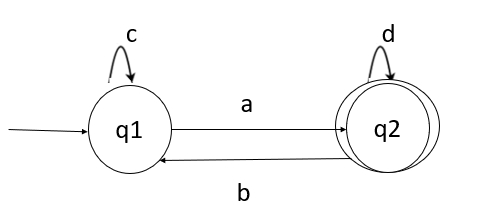
Solution
There are two popular methods for converting a DFA to its regular expression −
- Arden’s Method
- State elimination method
Let’s consider the state elimination method to convert FA to RE.
Rules
The rules for state elimination method are as follows −
Rule 1
The initial state of DFA must not have any incoming edge.
If there is any incoming edge to the initial edge, then create a new initial state having no incoming edge to it.
Rule 2
There must exist only one final state in DFA.
If there exist multiple final states, then convert all the final states into non-final states and create a new single final state.
Rule 3
The final state of DFA must not have any outgoing edge.
If this exists, then create a new final state having no outgoing edge from it.
Rule 4
Eliminate all intermediate states one by one.
Now, apply these rules to convert the FA to RE easily.
The given FA is as follows −
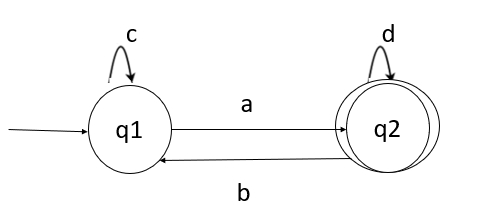
Step 1
Initial state q1 has an incoming edge so create a new initial state qi.
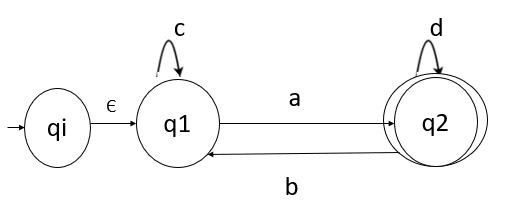
Step 2
Final state q2 has an outgoing edge. So, create a new final state qf.
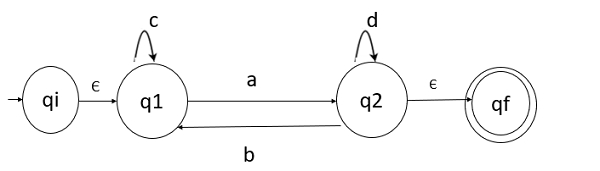
Step 3
Start eliminating intermediate states
First eliminate q1
There is a path going from qi to q2 via q1. So, after eliminating q1 we can connect a direct path from qi to q2 having cost.
εc*a=c*a
There is a loop on q2 using state qi. So, after eliminating q1 we put a direct loop to q2 having cost.
b.c*.a=bc*a
After eliminating q1, the FA looks like following −
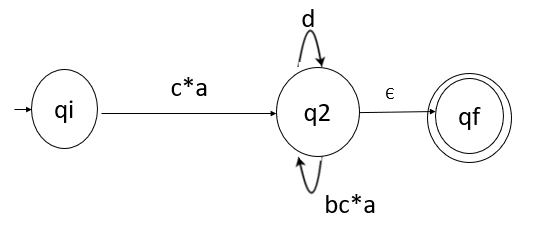
Second eliminate q2
There is a direct path from qi to qf so, we can directly eliminate q2 having cost −
C*a(d+bc*a)* ε = c*a(d+bc*a)*
Which is our final regular expression for given finite automata.

14K+ Views
