
- Groovy Tutorial
- Groovy - Home
- Groovy - Overview
- Groovy - Environment
- Groovy - Basic Syntax
- Groovy - Data Types
- Groovy - Variables
- Groovy - Optionals
- Groovy - Numbers
- Groovy - Strings
- Groovy - Ranges
- Groovy - Lists
- Groovy - Maps
- Groovy - Dates & Times
Groovy Operators
- Groovy - Operators
- Groovy - Arithmetic Operators
- Groovy - Assignment Operators
- Groovy - Relational Operators
- Groovy - Logical Operators
- Groovy - Bitwise Operators
- Groovy - Spaceship Operator
- Groovy - in Operator
- Groovy - Elvis Operator
- Groovy - Safe Navigation Operator
- Groovy Operator Precedence & Associativity
Control Statements
- Groovy - Decision Making
- Groovy - If Else Statement
- Groovy - Switch Statement
- Groovy - Loops
- Groovy - For Loop
- Groovy - For-in Loop
- Groovy - While Loop
- Groovy - Do While Loop
- Groovy - Break Statement
- Groovy - Continue Statement
Groovy File Handling
- Groovy - File I/O
- Java - Create a File
- Java - Write to File
- Java - Append to File
- Java - Read Files
- Java - Delete Files
- Java - File Properties
- Java - File Existence and Type
- Java - File Size
- Java - File Permissions
- Java - Directories
- Java - Listing Directories
- Java - Filtering Files/Directories
- Java - Deleting Directories
- Java - Renaming Files/Directories
Groovy Error & Exceptions
- Groovy - Exception Handling
- Groovy - try-catch Block
- Groovy - try-with-resources
- Groovy - Multi-catch Block
- Groovy - Nested try Block
- Groovy - Finally Block
- Groovy - throw Exception
- Groovy - Exception Propagation
- Groovy - Built-in Exceptions
- Groovy - Custom Exception
Groovy Multithreading
- groovy - Multithreading
- groovy - Thread Life Cycle
- groovy - Creating a Thread
- groovy - Starting a Thread
- groovy - Joining Threads
- groovy - Naming Thread
- groovy - Thread Scheduler
- groovy - Thread Pools
- groovy - Main Thread
- groovy - Thread Priority
- groovy - Daemon Threads
- groovy - Shutdown Hook
Groovy Synchronization
- groovy - Synchronization
- groovy - Block Synchronization
- groovy - Static Synchronization
- groovy - Inter-thread Communication
- groovy - Thread Deadlock
- groovy - Interrupting a Thread
- groovy - Thread Control
- groovy - Reentrant Monitor
- Groovy - Methods
- Groovy - Methods
- Groovy - Optional parenthesis
- Groovy - Named Arguments
- Groovy - Closures as Arguments
- Groovy - Method Overloading
- Groovy - Method Scope and Visibility
- Groovy - isCase Method
- Groovy - Implicit Return
- Groovy - Variable Arguments
- Groovy - Regular Expressions
- Groovy - Regular Expressions
- Groovy - Defining Regular Expressions
- Groovy - Matcher Object
- Groovy - Regex Tasks
- Groovy - XML
- Groovy - XML
- Groovy - Parsing XML
- Groovy - Creating XML
- Groovy - Modifying XML
- Groovy - Querying XML
- Groovy - Simplified Notation
- Groovy - Closure based Querying
- Groovy - Closure based Creation
- Groovy - JSON
- Groovy - JSON
- Groovy - Parsing JSON
- Groovy - Creating JSON using JsonOutput
- Groovy - Creating JSON using JsonBuilder
- Groovy - Modifying JSON
- Groovy - Error Handling
- Groovy - Handling JSON Arrays
- Groovy - JSON Array Operations
- Groovy - JSON Objects
- Groovy - JSON Object Operations
- Groovy - Generics
- Groovy - Generics
- Groovy - Declaring Generic Types
- Groovy - Bound Type Parameters
- Groovy - Wild Cards
- Groovy - Miscellaneous
- Groovy - Object Oriented
- Groovy - Closures
- Groovy - Annotations
- Groovy - JMX
- Groovy - DSLS
- Groovy - Database
- Groovy - Builders
- Groovy - Command Line
- Groovy - Unit Testing
- Groovy - Template Engines
- Groovy - Meta Object Programming
- Groovy Useful Resources
- Groovy - Quick Guide
- Groovy - Useful Resources
- Groovy - Discussion
Groovy - If else Statement
The next decision-making statement we will see is the if/else statement. The general form of this statement is −
if(condition) {
   statement #1
   statement #2
   ...
} else{
   statement #3
   statement #4
}
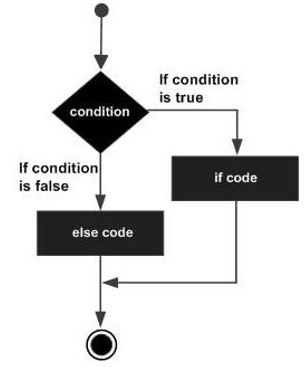
The general working of this statement is that first a condition is evaluated in the if statement. If the condition is true it then executes the statements thereafter and stops before the else condition and exits out of the loop. If the condition is false it then executes the statements in the else statement block and then exits the loop. The following diagram shows the flow of the if statement.
Example - Usage of if else statement
Following is an example of a if/else statement −
Example.groovy
class Example {
   static void main(String[] args) {
      // Initializing a local variable
      int a = 2

      //Check for the boolean condition
      if (a<100) {
         //If the condition is true print the following statement
         println("The value is less than 100");
      } else {
         //If the condition is false print the following statement
         println("The value is greater than 100");
      }
   }
}
Output
In the above example, we are first initializing a variable to a value of 2. We are then evaluating the value of the variable and then deciding on which println statement should be executed. The output of the above code would be
The value is less than 100.
Example - Usage of if else if statement
Following is an example of a if else if statement −
Example.groovy
class Example {

   static void main(String[] args) {
      int x = 30;

      if( x == 10 ) {
         System.out.print("Value of X is 10");
      }else if( x == 20 ) {
         System.out.print("Value of X is 20");
      }else if( x == 30 ) {
         System.out.print("Value of X is 30");
      }else {
         System.out.print("This is else statement");
      }
   }
}
Output
In the above example, we are first initializing a variable to a value of 30. We are then evaluating the value of the variable and then deciding on which println statement should be executed. The output of the above code would be
Value of X is 30
Example - Usage of if else if statement
Following is an example of a if else if statement −
Example.groovy
class Example {

   static void main(String[] args) {
      int x = 20;

      if( x == 10 ) {
         System.out.print("Value of X is 10");
      } else if( x == 20 ) {
         System.out.print("Value of X is 20");
      } else {
         System.out.print("This is else statement");
      }
   }
}
Output
In the above example, we are first initializing a variable to a value of 20. We are then evaluating the value of the variable and then deciding on which println statement should be executed. The output of the above code would be
Value of X is 20
Example - Usage of multiple if else if statement
Following is an example of multiple if else if statement −
Example.groovy
class Example {

   static void main(String[] args) {
      double x = 30.0;

      if( x == 10.0 ) {
         System.out.print("Value of X is 10.0");
      }else if( x == 20.0 ) {
         System.out.print("Value of X is 20.0");
      }else if( x == 30.0 ) {
         System.out.print("Value of X is 30.0");
      }else {
         System.out.print("This is else statement");
      }
   }
}
Output
In the above example, we are first initializing a variable to a value of 30.0. We are then evaluating the value of the variable and then deciding on which println statement should be executed. The output of the above code would be
Value of X is 30.0