- Display Advertising - Home
- Display Advertising - Introduction
- Display Advertising - Formats
- Display Advertising - Types
- Display Advertising - Sizes
- Display Advertising - Design
- Display Advertising - Plan & Strategy
- Display Advertising - Implementation
- Display Advertising - Placement
- Display Advertising - Track & Monitor
- Display Advertising - Optimization
- Display Advertising - Performance Tip
- Display Advertising - PPC & Ad
- Display Advertising - Limitations
- Display Advertising - Legal Issues
Display Advertising - Quick Guide
Display Advertising - Introduction
Many small and big industries, in the recent years, have reported magic growth figures in their businesses. There might be plenty of reasons why they could achieve such phenomenal growth rates, but display advertisement has played a critical role in it.
Display advertisement is a very effective and potential medium to enough to promote your business and get more visibility.
What is Online Display Advertisement?
Online Display Advertisement is one of the techniques to advertise products and/or services using Internet as a medium. In such advertisements, promotional messages are normally displayed on related websites, social media websites, and/or search engine page results.
These messages consist of a brief information (as texts) about the products, logos, and images. You can use either a simple jpg image or an elaborate animated flash template for your display ad.
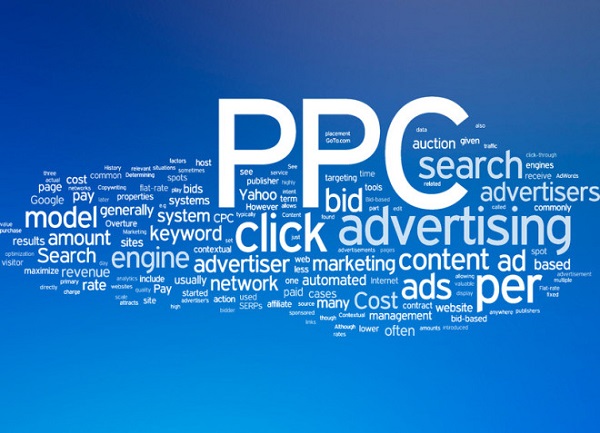
The two common ways to buy display advertisement are − Pay per Click (PPC) and Cost per Impression (CPI).
Pay per Click (PPC)
PPC is one of the internet advertising techniques used to direct traffic to websites. For this service, advertisers pay to the publisher (who publishes advertisement on his website/s) only when an ad is clicked by the visitors. This is the cost spent to get an advertisement clicked, so this is also known as cost per click.
Cost per Impression (CPI)
CPI is similar to PPC, but the difference in this case is that the advertiser pays when an ad is displayed. So, it is the cost incurred against each potential customer who clicks and views an ad. CPM is another term, which means cost per thousand impression. In this case, the advertiser pays for the thousand potential customers who click and view the ad.

Why Online Display Advertising?
Online display advertising provides greater visibility over other advertising media. Starting from cost-cutting to increasing the customer base, it has many effective features.
Wide Coverage − Where other channels of advertising focus on a particular level of the market funnel, display advertising influences the consumers of every level of the marketing funnel. The objective of display advertising is to provide awareness, education, and proposal to a potential audience.
High Conversion Rate − Display advertising can be very effective to approach to nearby as well as to remote audience and most likely increases their conversion rate. It has more power to educate and convince the audience to buy your service.
Immediate Effect − You dont need to wait for long rather it gives immediate result.
Display Innovation − It is designed to capture the audience attention. It also convinces audience to remember your ad, which serves your purpose effectively. In addition, the display of 3 D images, audio, video, and animation ad creates more effective impression.
Display on Mobile Devices − Use of smart mobile phones is becoming popular because of its accessibility anywhere and anytime. So, mobile friendly display advertising is an effective way to increase the business.
Display Advertising - Formats
The format of a display advertisement has the power to compel the users to click on it. In this chapter, we will discuss the formats that are regularly used in online display advertising.
What is Display Advertising Format?
The basic meaning of a format is the way something is arranged or set out. So, using the template design, text arrangement, image selection, and static or video presentation everything is the part of display advertising format.
Following are some of the popular formats those are being used for the display advertising −
Banner
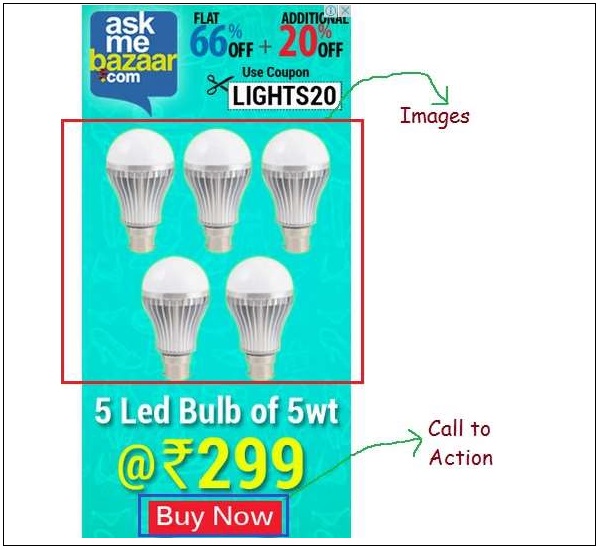
Banner is the most common form of advertisement, which consists of image and logo with brief description. It also includes call to action (as shown in the following image).

However, these days, banners are also designed to include audio and video features. These are designed in various shapes and sizes depending upon the place where they are planned to display. Further, design choice of a banner also depends upon the budget and other requirements including the type of products and services. Image of a video banner is shown below −

Textual Format
As name suggests, textual format carries the information in text format only (as shown in the following image).
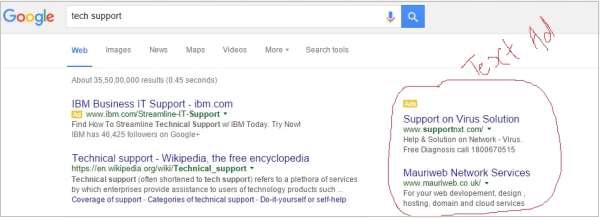
For many types of ad, textual format is more effective. Another advantage is - it does not carry any malware/cookies/virus and easy to download. In addition to this, Major search engines such as Google, Bing, etc. support only text ads on their search engine result pages.
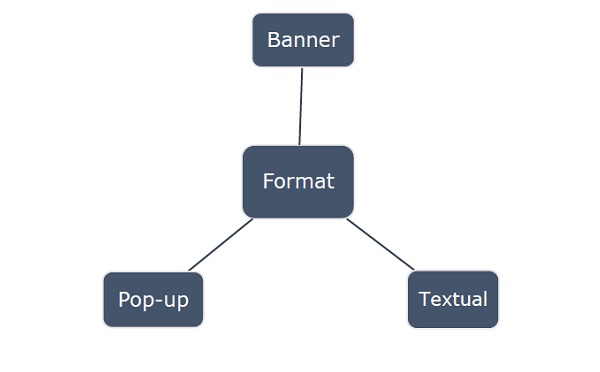
Pop-up
This is similar to banner, but it has typical format that appears between two content pages. An example of pop-up format is shown below −
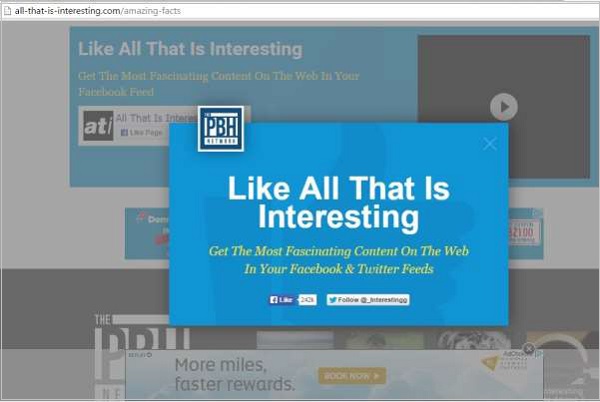
Remember, pop-up format is not suggestible because it irritates user and leads to low click rate. Better to avoid such format for your ad.
Display Advertising - Types
The type of display advertising depends upon your purpose, context, or placement. Let us discuss how we classify different advertisements based on the requirements they fulfil.
Ads based on Category
Primarily, you need to identify what category your product/service falls under, so that you can accordingly design a format as well as also the types of websites where you want to place.
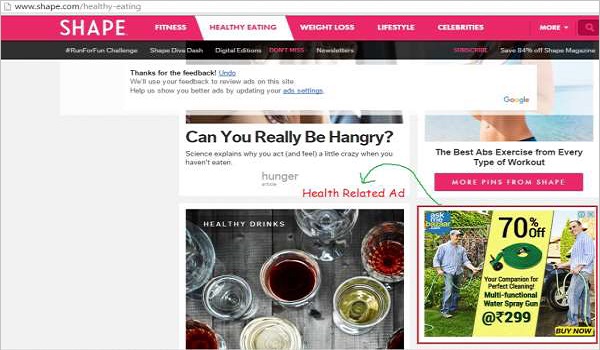
For example, if you want to sell a health product per se, so where you will get the potential audience?
You need to place your ad largely on the websites, which are into the business of health and fitness, beauty care, etc. So, category helps you to find the place where you can get the potential audience.
Ads based on Context
This is similar to category, however, it has greater meaning in context. For example − if you want to sell sports product such as cricket bat, then place it on a sports website. In such a way, you get the potential audience.
Ads based on Placement
Based on placement, there are two types of display advertisement, i.e.,
Automatic − It is managed by Google and hence it is based on the type and context of your product/ad, google places it on relevant websites.
Managed − In this case, the advertiser decides where to publish his/her ad.
In the following sections, we will discuss some of the significant types of display ads.
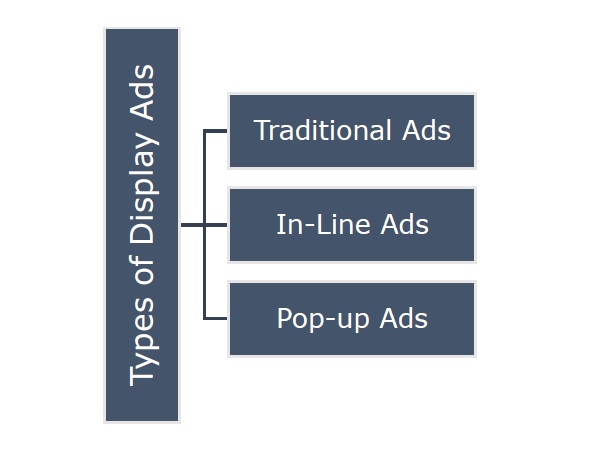
Traditional Ads
Because of its easy and cost effective design, traditional ads are very popular. It normally used to be in rectangular shape and consists text, jpeg or gif image/s, and links to another website.
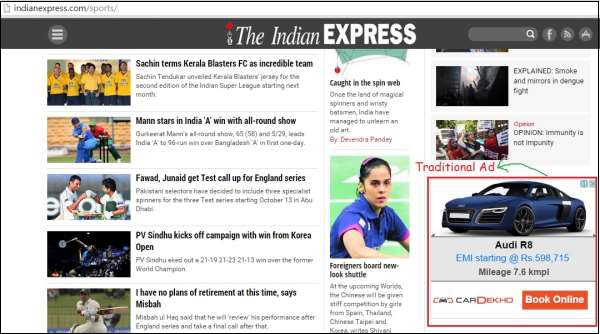
Moreover, it can also be modified and uploaded easily.
In-Line Ads
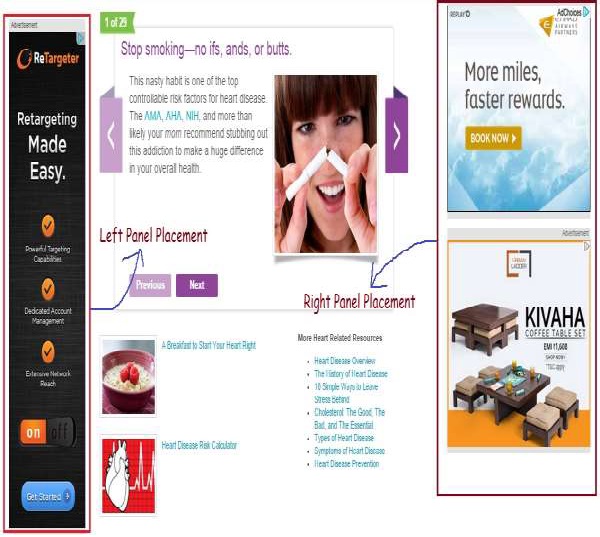
In-line ads normally appear on either left or right panel of the web page. It contains textual graphical information along with links. However, some may be only with some texts and link and some may be only with a small size image and link (as shown in the following image).
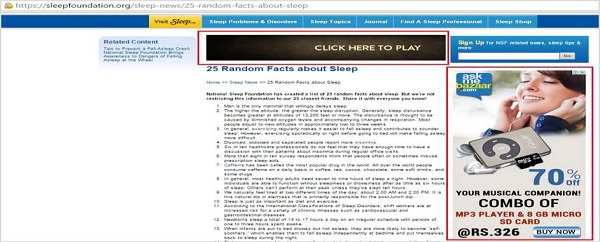
Pop-up Ads
Pop-up ads are typical ads that appear on the web pages once you visit the respective web page (where it is designed to appear). It is pretty disturbing because it covers the main content of the page and restrains visitors to read what he/she is interested to read. An example of pop-up ad is shown in the previous chapter.
Display Advertising - Sizes
Before you design your display advertising, you need to fix the size of your ad.
Elements of Display Advertising Size
Following are the major elements of display advertising size −
Length of Message
Determines the length of your message and the type and size of the font that you will be using on the template.
Size of Image
If you are using any image, then its size is very important that decides the size of the banner. However, it is suggested to use a small image for such display advertising.
Budget
Last but not the list; budget is very important. As the bigger size you chose you need to pay higher amount and for the smaller size, you need to pay lesser amount.
Standard Sizes of Display Advertising
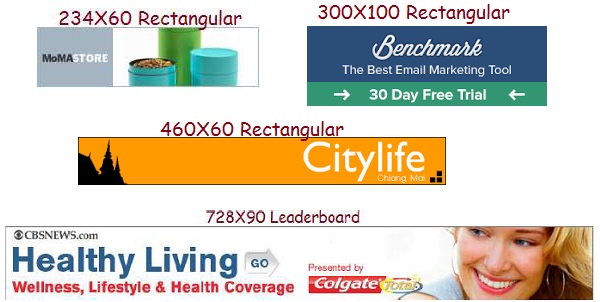
Following are the standard sizes commonly accepted for the display advertising



Display Advertising - Design
Design is one of the most important features that gets noticed first by the audience. If your design is not convincing, then the chances of a user clicking on your ad is bleak.
Elements of Display Advertising
We will discuss here the major elements of display advertising. It will give you an idea how to design a display ad −
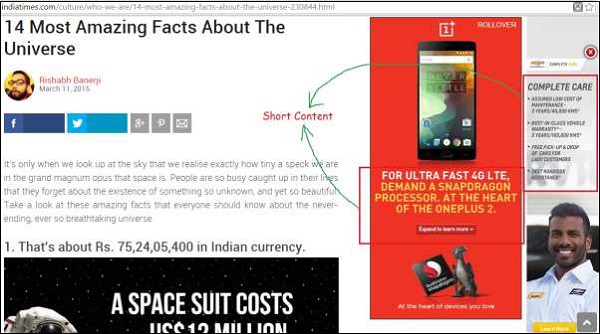
Short Content
For display advertising design, your text message is the most important. So, write short, clear, and convincing message. The message should include what are/is the benefit/s you have and call to action. The following example will help you to understand about the type of content.
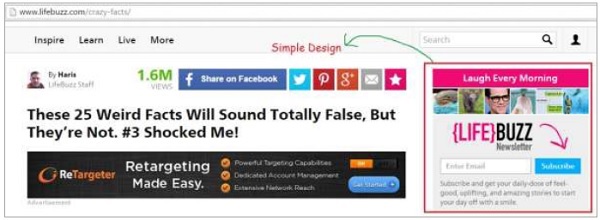
Simple Design
The colors, format, design, and background colors you develop for the ad should be simple and matching with each other (as shown in the following example).
Image
Image is always more convincing than texts, put a small, but relevant image as per the size of banner.
Call to Action Message
Asking people to take an action is the focal point of display ad. Therefore, call to action message is the most important element that prompts your user to take an action and click on the link (as shown in the above image).
Do not Use Animation
Normally, it is an assumption that animated ad attracts more number of users, but it is not true. In fact, animated ad distracts more and users normally off the ad immediately.
Display Advertising - Plan & Strategy
Plan
Plan is an important aspect that gives an overall view of your work starting from the creation of an idea to execution of the ad. It resolves the issues and confusion in advance and clears the path to initiate a project.
Identification of Goal
Primarily, you need to identify your objectives and goals. For examples, you need to find the answers of the following questions −
Do you want to increase only awareness of your company?
Do you want to sell your products/services?
What are your target audience?
Do you want to clear your stock?
When you want to advertise?
What are the offers and discount you have?
Target Audience
Once identified your objectives and goals, now define your target audience and their markets. Also research their income level, frequency of shopping, and mediums of shopping i.e. how much they are interested in online shopping.
Geographic Location
What are the geographic regions that you want to cover?
Develop Team − Identify the right people to work with.
Set Budget − Your strength depends upon your budget, so set the budget.
Measurement of Display Ad − Identify what are the tracking and measuring tools that will help you to measure Return on Investment (ROI).

Strategy
Do not confuse strategy with plan; plan is something that you do in-house, but once you come to the market to execute your plan, you need a better strategy. Plan defines what will you do and strategy defines how and when you should do.
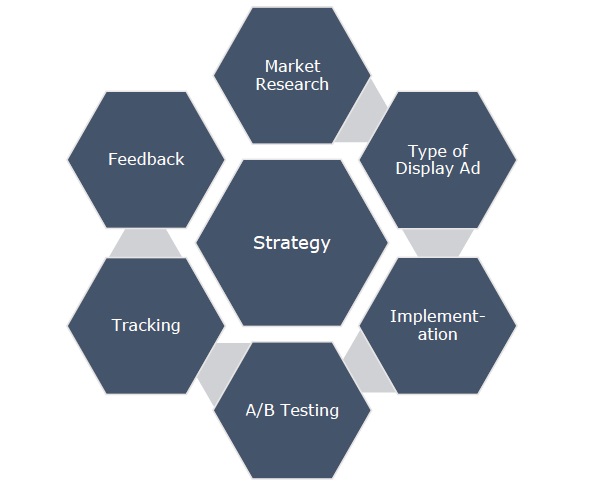
The following strategies are helpful to execute your display advertising −
Market Research − Research your market properly to understand the specific, achievable, realistic, measurable, and time specific objectives.
Decide the Type of Display Ad − Fix the size, content, image, logo, and call to action. Also fix the type of ad either it would be traditional or line-in.
Implementation − After a thorough review, put your ad on display.
A/B Testing − A/B testing is one of the best strategies to improve the productivity of your display ad.
Tracking − To know the performance and effectiveness of your ad, track your ad. It will also suggest you, where you can improve your ad.
Result and Feedback − Dont forget to check out the end result and taking feedback. Result will help you to analyze ROI and feedback will help you to further improve your display ad strategy.
Display Advertising - Implementation
Once you developed an ad for your product/service, now the big question is how to implement it, where to implement it, whom to ask for this, etc.
How to Implement?
For the successful result, proper implementation is required. If you could not implement properly, then your whole efforts and costs both will be worthless. Publishing is the common way of implementation.
Publishing
Publishing is a common technique of display advertising. You can publish your ad on others websites. But putting your ad on someone else website is tricky; you need to check the relevancy, content, and ranking of the respective websites.
So, it must be a professional website as well as providing the relevant services; I mean, dealing with the users of your interest. For example, if you want to sell health product (such as health supplement that helps to gain body weight), then search for the health related website, which offers health tips and provides other health related information.
Besides, following are the points that you also need to be taken care while implementing the display ad −
Design and message have to be clear and attractive so that user can understand that it is an ad of health supplement per se.
Do not fix an ad for long time rather keep regulating in terms of offers, design, and message.
Keep your advertisers as well users engaged and happy by providing satisfactory services.
Where to Publish?
Identification of a right website is next step. For this, it is always suggestible to contact Internet Advertising Networks. It is a company that works like a middle man, it connects the people who want to display their ad with the people who offer space on their websites for the display ad.
Ad networks are categorized depending upon its size and working area. For example, specialized ad networks are the one who focus on one section such as technology, industry sector, fashion, health sector, etc.
Following are the important examples of the ad networks −
Google AdSense
It matches ads with the websites content and accordingly displays your ad.
Yahoo Publisher
It also matches ads with the websites content and accordingly places your ad.

adBrite
It has special function that facilitates you to approve or reject ads.
Display Advertising - Placement
Placement of display ad depends upon your budget and the size of banner. The bigger the banner higher the rate. Various standard sizes of banners are discussed above. So, depending upon your budget, you can choose the banner size.
Where to Place?
Once, you fix your banner size, then you can fix the placement accordingly. For example, a large rectangle banner i.e. 160X600 can be placed either in the right or left panel of the website (as shown in the following image).
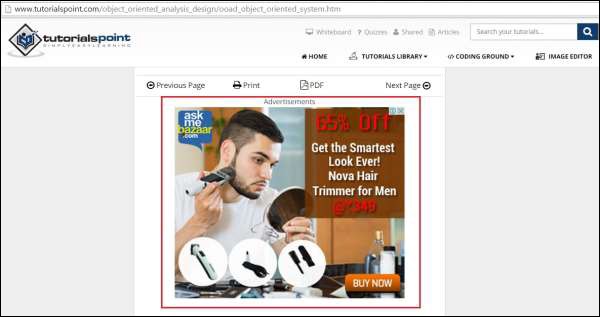
728X90 leaderboard can be placed either left, right, or at top of the website (as shown in the following image).
720X300 pop-under can be placed at the bottom of the website (as shown in the following image).
Always remember larger the banner, higher the price.
How to Display Your Ads
Following are the convincing methods of displaying your Ads on relevant websites −
Ad Exchange
It is mutual approach, you display my ad and I will display your ad. The best way to find an interested fellow is google banner exchange, you will get the result. But remember, find only the website, which is complementary of yours.
Purchase Ad Space Directly
Search a complementary (which has similar content), but high rank website and purchase ad space directly. Price will vary as per the size of banner.
Bid on Specific Keywords
In this method, you need to bid on specific keyword or phrase, which describes your product/service adequately. The benefit is when any user will search for that keyword, your ad will appear normally on the search engine result page. This is particularly textual display ad. Remember, the cost of this ad will vary as per the popularity of the keyword that you opted.
Display Advertising - Track & Monitor
Monitoring and tracking your online campaign is imperative for the assessment of display advertising. It helps to identify the weak and strong areas, so that you can repeat the strong part and correct the weak part.

How to Track Display Advertising?
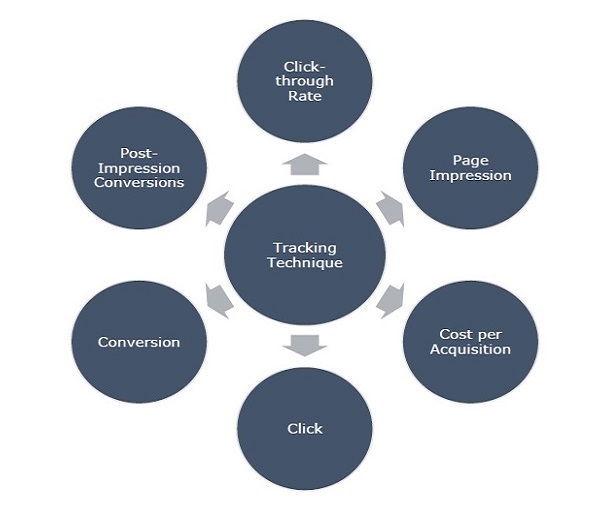
You can measure or track display advertising through various metrics; however, the popular metrics are −
Click-through Rate − It is the ratio of the number of clicks and the number of impressions.
Page Impression − It is the number of times, your ad has been seen by the users.
Cost per Acquisition − This is the amount you agree to pay for per conversion.
Click − This is simply the number of clicks your ad received.
Conversion − Through conversion tracking, you can measure the number of sales that you received from your display ad.
Post-Impression Conversions − Tracking after impression conversions gives the data regarding how many people have seen your ad, and how many people actually purchased a product.
Tracking Tools
There are many online tools available that offer full package of tracking services. For example, the cheapest one is Google AdWords, it offers some of tracking services free; however, its paid services are also of low cost.
Other popular website analytic tools are −
- Google Analytics
- Web Trends
- Yahoo Site Explorer
- Microsoft adCenter
- AWStats
Display Advertising - Optimization
Optimization increases the visibility of your display ad to maximum audience and suggests techniques to maximize return on investment (ROI).
What is Optimization?
Optimization is a process or technique of making business activity functional and productive as much as possible. The end objective of optimization is to maximize the gain.
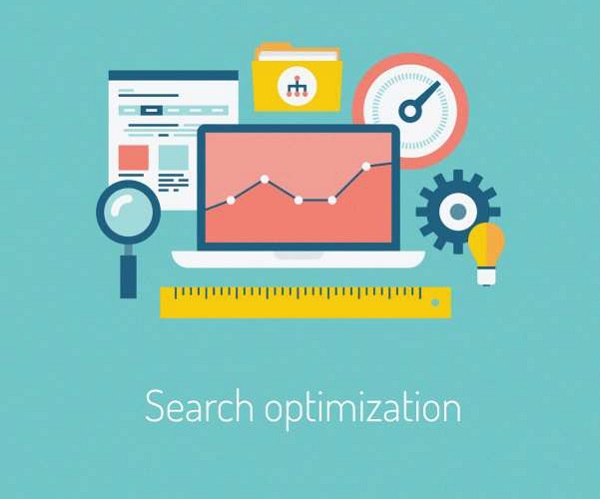
Optimization provides the following information to the advertiser −
Which display ad is the most preferred by users
What are the points that users like in the ads
What are the points that users do not like
What are the categories of the people who view ads
Optimization suggests the interactive changes based upon the report prepared through the tracking of an ad.
Likewise, the report of each version of an ad are regularly tracked, compared, and analyzed to give the best result.
Methods of Optimization
Following are the major methods of optimization that help advertiser to increase the effectiveness of an ad and maximize ROI −
Updating Users Target
Normally, display ads are user targeted; so, as per the performance of an ad, keep updating your user target. As per the requirements of your business, focus on −
Behavioral Target − Derive the data related to your products and check which brand is doing well, why people liking more a particular brand, etc.
Profile Target − Check out users class, gender, age, and geographical location who are liking more the products of your interest and update your data accordingly.
Re-target − Based on the recent online activity by a group of users in response of your display ad re-target your users.
Update your Publishers List
Depending upon the performance and users preference, ad new inventories/publishers (to place your display ad on their websites) that can work more effectively. On the other hand, also remove the names of those publishers where your ad is not doing well.
Update Ad Frequency
Ad frequency is how many times your ad appear on a particular website in given period of time. The frequency has to be regulated more frequently. For example, if a single ad appears too many times in short span of time to the same person, it might irritate him/her, so display in perfectly balanced form.
Regulate Ad Display Timings
Based on performance, regulate the display time and day of your ad. For example, if a specific ad doing good in the evening particularly on Saturday and Sunday, then regulate ad display timings accordingly.
Modify/Change Ad
Do not display an ad carrying same design and content for long time. Even a particular ad, which is doing well, change it, create some new design, and new message. Change and modification is very important for an effective performance.
Track your Ad Performance
Last but not the Least; track your ad performance because it will help you to improve all the methods discussed above.
Display Advertising - Performance Tips
Honestly, there are no foolproof techniques that can make your display ad hundred percent successful. However, if you follow the improvement tips discussed in this chapter, then it will definitely help you to improve the effectiveness of your display ad.

Improve the Effectiveness of Your Display Ad
Here is a list of some of the tips that you can practice to improve the performance of your Display Ad −
Publish your ad on ONLY relevant websites.
Use attractive, but balanced design that should perfectly match with content and size of banner.
Use less content.
Say directly, but in convincing way.
Use standard format. If you have more contents and large image, preferably use 720X300 (pop under format). 300X250 (medium rectangle) and 336X280 (large rectangle) are the standard size. However, you can opt banner size based upon the content and type of ad.
Track the display ad performance and update your ad accordingly.
Design your ad banner as per the place where you want to publish. In other words, size of ad banner must fit into the place where it is going to publish. For example, if you want to publish your ad on the bottom of a website, then you should design bigger banner, if you want to publish either right or left panel, then choose 160X600 (skyscraper) size and so on (all the sizes discussed here are illustrated in the chapter of Size).
Do not use intrusive types of display ad including pop up display ad. It is not at all beneficial.
Choose the publisher carefully. Do not choose any such kind of website, which is either not relevant or if relevant, then it has no traffic.
Review properly the publisher who offers to display your ad (for) free.
Monitor the results of your advertising strategy and refine your strategy to better reach your target audience.
Display Advertising - PPC & Display Ad
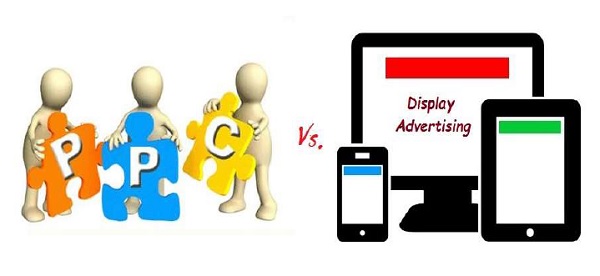
The display ad and the PPC both have their own advantages and give perceptible results if the campaign executed strategically. Secondly, the objective behind both the techniques is same, i.e., grow the business, but both are not suitable for all sorts of business.
This chapters describes both the concepts along with the major distinctions between them.
Display Ad
A display ad is a sort of online advertisement that is advertised through different formats such as banner ads, text, etc. It could be in the form of either textual, graphics (with images), audio, or video, or even combination of two or more of them.
Pay Per Click (PPC)
PPC is also a sort of online advertisement, but the difference is the advertisers pay only when someone click on the ad. Google AdWords, adCenter, Yahoo, Bing, etc. are the popular internet advertising platforms.
Display Ad vs PPC
The following table illustrates the major differences between a display ad and PPC −
| Display Ad | Pay Per Click (PPC) |
|---|---|
| It is economic, as needs low cost. | It is expensive; sometimes, for a single click, advertiser has to pay $2.5. |
| Needs artistic graphics, image, and convincing content. | Needs simple and direct message. |
| It is shown on relevant websites pages. | It is normally shown on search engines pages. |
| It has wider visibility. | It has very limited visibility; only interested person can see. |
| Slow response. | Immediate response. |
| It has general target. | It has very specific target. |
| It is visible on the websites page. | It is visible on search engines page. |
| Needs deep research to target the potential audience. | It does not. |
| Difficult to target and manipulate specific keywords. | Keywords can be easily targeted and managed. |
| Tracking the performance of ad is vague. | Tracking is very simple and can be easily managed. |
Which One to Choose?
There is as such no point that can acclaim that one is better over the other. Both of them have their own advantages on their places; so, which one to opt cannot be judged on the basis of their advantages and disadvantages, but rather it depends upon the requirements of your business.
The most important points that you need to consider before opting for PPC or Display Ad are as follows −
Costing − PPC is very expensive; so, you need to think how much worth to invest on ad, is this investment worth for your business or not, how long you can afford PPC, etc.
Type of Business − This is very important to consider before opting for a particular type of ad. For example, PPC normally is highly beneficial for the service providing companies such as BPO and other Tech. support companies (the company who offers online technical support). On the other hand, if you have to sell mobile devices, the display ad is more suitable.
Display Advertising - Limitations
Every coin has two faces, similarly display advertisement also carries some limitations with itself that need to be addressed with proper care.
Internet Speed
Display ads carrying interactive message with images are heavy and it needs faster Internet speeds to get displayed on the webpages. Unfortunately, faster internet is not available with every one every time.

Technical Obstacles
Normally, the display ad is of intrusive type (pop-up), which is irritating for many people. Because of this, many of the browsers block pop-up ads. For example, the Adblock Plus (extension of Firefox Browser) blocks advertising on web pages.
Limitation to Measure
Measurement of a display ad is a difficult task and hence, it cannot be adequately tracked.
Consumers Apathy
As research report says, consumers are reluctant to heed online ads; or in other words suffering from advertising fatigue. Resultantly, they ignore ads coming on web pages. It is a big disadvantage of a display advertising.
Risk Associated with PPC Ad
There is an inherent risk accompanying with pay per click ads, i.e., your competitors can increase your cost by clicking on your ad and not purchasing.
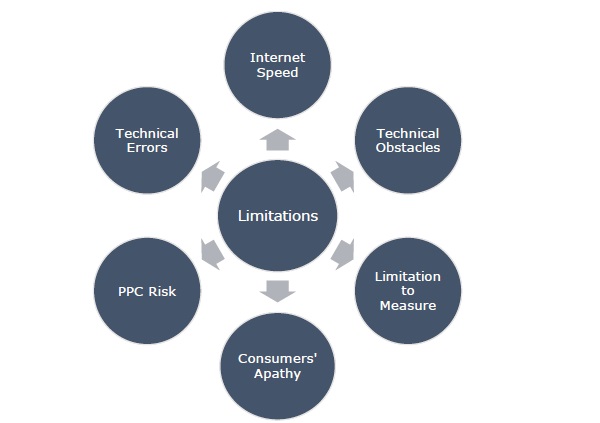
Technical Errors
Following are some of the technical errors associated with Display Ads −
Some ads are heavy and take a lot of time to load.
Some of the ads dont have close option.
Some ads cover the main content that you are intended to see.
Some ads are not clear at all and very difficult to understand.
Some are bigger enough to cover more than half page.
Some ads are floating that keep moving all over the screen.
Some ads are intermittent, i.e., keep coming and going on the screen.
Some ads automatically play video or audio.
Display Advertising - Legal Issues
Display advertising sounds fascinating because it increases business (especially online business) very fast. But before opting display advertising, you need to consider some ethical and legal points to run your business smoothly.
Whether you want to advertise your ads on others website or you provide space to someone else on your website to advertise, in both the condition, you need to take care the following points −
False Information
Using false or exasperated words to increase the sale is not acceptable. It is illegal and unethical. Therefore, claim only those points that you can provide through your services/products. For example, claiming that your medicine can re-grow someones hair in one month is not acceptable simply because it is not feasible. Such kind of claim will also defame your brand.
Ad of Illegal Product/Service
Use of some products such as drugs and alcohol are illegal in many countries; giving ad of these products in a country where it is prohibited is illegal. Similarly, gambling, casino, or betting services are illegal in many countries, so you cannot promote it.

Age Restriction
Many products and services are age specific and exclusive for the adult, so you cannot give ad of such products or services on the websites where childrens interests are involved.
Disclaimer
If you are selling some sensitive products put disclaimer in note. For example, if you are selling weight gain medicine, then add disclaimer saying that your medicine is not approved by any authority and hence you would be responsible for any side effect caused by the use of this medicine. You may also include that your medicine will work in some specific condition, if you do not follow that then it wont work.
Practice of these points will protect you from any sort of legal implications in future and maintain your brand reputation.
