
- PHP - Home
- PHP - Roadmap
- PHP - Introduction
- PHP - Installation
- PHP - History
- PHP - Features
- PHP - Syntax
- PHP - Hello World
- PHP - Comments
- PHP - Variables
- PHP - Echo/Print
- PHP - var_dump
- PHP - $ and $$ Variables
- PHP - Constants
- PHP - Magic Constants
- PHP - Data Types
- PHP - Type Casting
- PHP - Type Juggling
- PHP - Strings
- PHP - Boolean
- PHP - Integers
- PHP - Files & I/O
- PHP - Maths Functions
- PHP - Heredoc & Nowdoc
- PHP - Compound Types
- PHP - File Include
- PHP - Date & Time
- PHP - Scalar Type Declarations
- PHP - Return Type Declarations
- PHP - Operators
- PHP - Arithmetic Operators
- PHP - Comparison Operators
- PHP - Logical Operators
- PHP - Assignment Operators
- PHP - String Operators
- PHP - Array Operators
- PHP - Conditional Operators
- PHP - Spread Operator
- PHP - Null Coalescing Operator
- PHP - Spaceship Operator
- PHP Control Statements
- PHP - Decision Making
- PHP - If…Else Statement
- PHP - Switch Statement
- PHP - Loop Types
- PHP - For Loop
- PHP - Foreach Loop
- PHP - While Loop
- PHP - Do…While Loop
- PHP - Break Statement
- PHP - Continue Statement
- PHP Arrays
- PHP - Arrays
- PHP - Indexed Array
- PHP - Associative Array
- PHP - Multidimensional Array
- PHP - Array Functions
- PHP - Constant Arrays
- PHP Functions
- PHP - Functions
- PHP - Function Parameters
- PHP - Call by value
- PHP - Call by Reference
- PHP - Default Arguments
- PHP - Named Arguments
- PHP - Variable Arguments
- PHP - Returning Values
- PHP - Passing Functions
- PHP - Recursive Functions
- PHP - Type Hints
- PHP - Variable Scope
- PHP - Strict Typing
- PHP - Anonymous Functions
- PHP - Arrow Functions
- PHP - Variable Functions
- PHP - Local Variables
- PHP - Global Variables
- PHP Superglobals
- PHP - Superglobals
- PHP - $GLOBALS
- PHP - $_SERVER
- PHP - $_REQUEST
- PHP - $_POST
- PHP - $_GET
- PHP - $_FILES
- PHP - $_ENV
- PHP - $_COOKIE
- PHP - $_SESSION
- PHP File Handling
- PHP - File Handling
- PHP - Open File
- PHP - Read File
- PHP - Write File
- PHP - File Existence
- PHP - Download File
- PHP - Copy File
- PHP - Append File
- PHP - Delete File
- PHP - Handle CSV File
- PHP - File Permissions
- PHP - Create Directory
- PHP - Listing Files
- Object Oriented PHP
- PHP - Object Oriented Programming
- PHP - Classes and Objects
- PHP - Constructor and Destructor
- PHP - Access Modifiers
- PHP - Inheritance
- PHP - Class Constants
- PHP - Abstract Classes
- PHP - Interfaces
- PHP - Traits
- PHP - Static Methods
- PHP - Static Properties
- PHP - Namespaces
- PHP - Object Iteration
- PHP - Encapsulation
- PHP - Final Keyword
- PHP - Overloading
- PHP - Cloning Objects
- PHP - Anonymous Classes
- PHP Web Development
- PHP - Web Concepts
- PHP - Form Handling
- PHP - Form Validation
- PHP - Form Email/URL
- PHP - Complete Form
- PHP - File Inclusion
- PHP - GET & POST
- PHP - File Uploading
- PHP - Cookies
- PHP - Sessions
- PHP - Session Options
- PHP - Sending Emails
- PHP - Sanitize Input
- PHP - Post-Redirect-Get (PRG)
- PHP - Flash Messages
- PHP AJAX
- PHP - AJAX Introduction
- PHP - AJAX Search
- PHP - AJAX XML Parser
- PHP - AJAX Auto Complete Search
- PHP - AJAX RSS Feed Example
- PHP XML
- PHP - XML Introduction
- PHP - Simple XML Parser
- PHP - SAX Parser Example
- PHP - DOM Parser Example
- PHP Login Example
- PHP - Login Example
- PHP - Facebook Login
- PHP - Paypal Integration
- PHP - MySQL Login
- PHP Advanced
- PHP - MySQL
- PHP.INI File Configuration
- PHP - Array Destructuring
- PHP - Coding Standard
- PHP - Regular Expression
- PHP - Error Handling
- PHP - Try…Catch
- PHP - Bugs Debugging
- PHP - For C Developers
- PHP - For PERL Developers
- PHP - Frameworks
- PHP - Core PHP vs Frame Works
- PHP - Design Patterns
- PHP - Filters
- PHP - JSON
- PHP - Exceptions
- PHP - Special Types
- PHP - Hashing
- PHP - Encryption
- PHP - is_null() Function
- PHP - System Calls
- PHP - HTTP Authentication
- PHP - Swapping Variables
- PHP - Closure::call()
- PHP - Filtered unserialize()
- PHP - IntlChar
- PHP - CSPRNG
- PHP - Expectations
- PHP - Use Statement
- PHP - Integer Division
- PHP - Deprecated Features
- PHP - Removed Extensions & SAPIs
- PHP - PEAR
- PHP - CSRF
- PHP - FastCGI Process
- PHP - PDO Extension
- PHP - Built-In Functions
- PHP Useful Resources
- PHP - Cheatsheet
- PHP - Questions & Answers
- PHP - Quick Guide
- PHP - Useful Resources
- PHP - Discussion
- PHP - Online Compiler
PHP cURL curl_multi_add_handle() Function
The PHP Client URL curl_multi_add_handle() function is used to add a normal cURL handle to a cURL multi handle. As a result, this function created different cURL handles within a cURL multi handle. This lets you send multiple cURL requests at once.
Syntax
Below is the syntax of the PHP cURL curl_multi_add_handle() function −
int curl_multi_add_handle (resource $multi_handle, resource $curl_handle)
Parameters
Below are the required parameters of the curl_multi_add_handle() function:
$multi_handle − It is the cURL multi handle resource returned by curl_multi_init()
$curl_handle − It is the individual cURL handle resource to add.
Return Value
The curl_multi_add_handle() function returns 0 on success else it returns errors code from one of the CURLM_XXX.
PHP Version
First introduced in core PHP 5, the curl_multi_add_handle() function continues to function easily in PHP 7, and PHP 8.
Example 1
Here is the basic example of the PHP cURL curl_multi_add_handle() function to add a single cURL handle to a multi handle −
<?php
   // Start a cURL multi handle
   $mh = curl_multi_init();

   // Start a cURL handle
   $ch1 = curl_init();
   curl_setopt($ch1, CURLOPT_URL, "https://tutorialspoint.com");
   curl_setopt($ch1, CURLOPT_RETURNTRANSFER, true);

   // Add the cURL handle to the multi handle
   curl_multi_add_handle($mh, $ch1);

   // Execute all queries at the same time
   $running = null;
   do {
       curl_multi_exec($mh, $running);
       curl_multi_select($mh);
   } while ($running > 0);

   // Get the content
   $res1 = curl_multi_getcontent($ch1);

   // Remove the handle from the multi handle
   curl_multi_remove_handle($mh, $ch1);

   // Close the handle
   curl_close($ch1);

   // Close the multi handle
   curl_multi_close($mh);

   // Output the response
   echo $res1;
Output
It will show the HTML content fetched from the URL −

Example 2
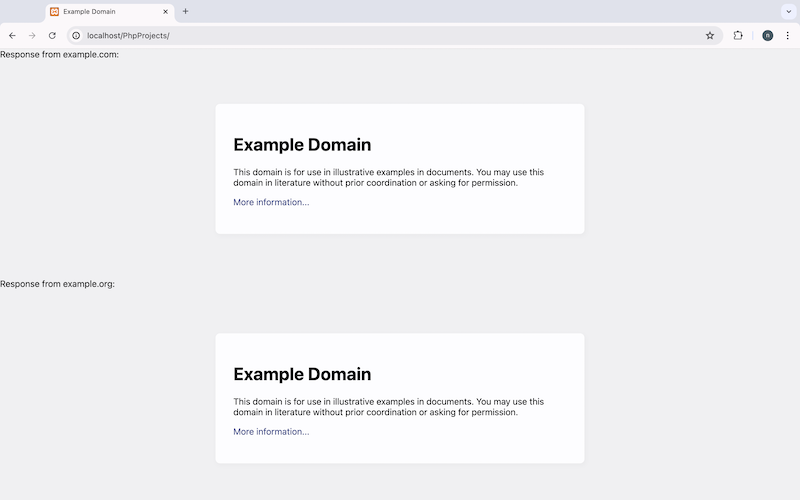
In the below PHP code we will try to use the curl_multi_add_handle() function and add multiple cURL handles to a multi handle and execute them −
<?php
   // Start a cURL multi handle
   $mh = curl_multi_init();

   // Start first cURL handle
   $ch1 = curl_init();
   curl_setopt($ch1, CURLOPT_URL, "https://example.com");
   curl_setopt($ch1, CURLOPT_RETURNTRANSFER, true);

   // Start second cURL handle
   $ch2 = curl_init();
   curl_setopt($ch2, CURLOPT_URL, "https://example.org");
   curl_setopt($ch2, CURLOPT_RETURNTRANSFER, true);

   // Add the cURL handles to the multi handle
   curl_multi_add_handle($mh, $ch1);
   curl_multi_add_handle($mh, $ch2);

   // Execute all queries at the same time
   $running = null;
   do {
       curl_multi_exec($mh, $running);
       curl_multi_select($mh);
   } while ($running > 0);

   // Get the content
   $res1 = curl_multi_getcontent($ch1);
   $res2 = curl_multi_getcontent($ch2);

   // Remove the handles from the multi handle
   curl_multi_remove_handle($mh, $ch1);
   curl_multi_remove_handle($mh, $ch2);

   //Close the handle
   curl_close($ch1);
   curl_close($ch2);

   // Close the multi handle
   curl_multi_close($mh);

   // Output the responses
   echo "Response from example.com: $res1\n";
   echo "Response from example.org: $res2\n";
?>
Output
This will represent the HTML content of the given URLs −
Example 3
The below PHP example shows how to handle errors when we are using the curl_multi_add_handle() function −
<?php
  // Start a cURL multi handle
  $mh = curl_multi_init();

  // Start a cURL handle
  $ch1 = curl_init();
  curl_setopt($ch1, CURLOPT_URL, "https://invalid-url"); // Provide the URL which is not valid
  curl_setopt($ch1, CURLOPT_RETURNTRANSFER, true);

  // Add the cURL handle to the multi handle
  curl_multi_add_handle($mh, $ch1);

  // Execute all queries simultaneously
  $running = null;
  do {
      curl_multi_exec($mh, $running);
      curl_multi_select($mh);
  } while ($running > 0);

  // Check for errors
  if (curl_errno($ch1)) {
      echo 'There is an Error: ' . curl_error($ch1);
  } else {
      // Get the content
      $res1 = curl_multi_getcontent($ch1);
      echo $res1;
  }

  // Remove the handle from the multi handle
  curl_multi_remove_handle($mh, $ch1);
  curl_close($ch1);

  // Close the multi handle
  curl_multi_close($mh);
?>
Output
This will create the below output −
There is an Error: Couldn't resolve host 'invalid-url'
