- MERN Stack - Home
- MERN Stack - Installation
- MERN Stack - MongoDB Setup
- MERN Stack - Node Setup
- MERN Stack - Connect React with Node
- MERN Stack - Folder Structure
- MERN Stack Useful Resources
- MERN Stack - Useful Resources
- MERN Stack - Discussion
MERN STACK Tutorial
The MERN stack is a popular set of technologies that all use JavaScript. In other words, you can build full-stack web applications with only JavaScript. In the MERN stack, you will combine the powerful client-side library of JavaScript i.e., React with server-side technologies like Node, Express, and MongoDB to create real-world full-stack web applications.
In this tutorial, you will learn how to build the back-end of a web application using Node, Express, and MongoDB and integrate it with the front-end, which we create using React and Chakra UI.
Prerequisites of MERN Stack
As an aspiring full-stack web developer, you should have basic knowledge in HTML, CSS, and JavaScript before starting this tutorial. You should be comfortable using ES6 features of JavaScript and have experience in asynchronous programming using async/await and promise-based requests. You should have some understanding and be comfortable using React as a front-end framework.
Why MERN Stack?
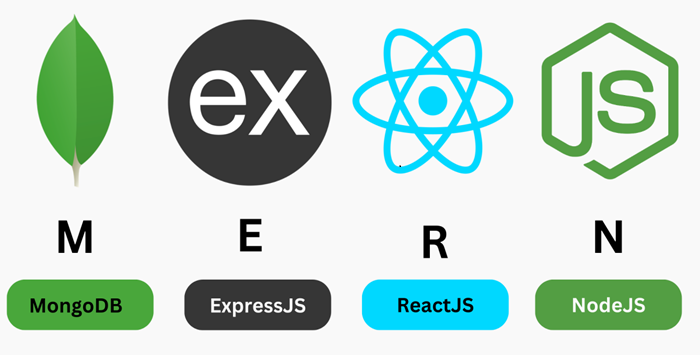
The main point is that if you're an expert in JavaScript, you can become a MERN stack developer because it enables end-to-end javaScript development and combines four powerful technologies: MongoDB, Express.js, React.js, and Node.js. These technologies allow developers to build both frontend and backend using a single language, which is JavaScript.
| Technology | Type | Description |
|---|---|---|
| MongoDB | Database | It is a non-relational database, meaning a NoSQL document-oriented database to store data in a JSON-like format. |
| Express.js | Backend Framework | It is a lightweight Node.js framework to build RestFul APIs and handle routes. |
| React.js | Frontend Library | It is a javaScript library for building interactive user interfaces. |
| Node.js | Runtime Environment | It is a server-side JavaScript runtime used to run backend code. |
Benefits of Using MERN Stack
Following are the key benefits of using mern −
- Single landscape (JavaScript) − Use JavaScript everywhere whether it is frontend & backend.
- Fast Development − Reusable component and built-in APIs speed up development.
- Scalability − Node.js handles concurrent connections efficiently.
- Flexibility − Perfect for building SPAs (Single Page Applications), dashboards, and complex apps.
- JSON Everywhere − MongoDB and Node.js naturally handle JSON data exchange.
- Active Ecosystem − Huge community support and third-party libraries (npm packages).
MERN Stack Architecture
The MERN stack follows a 3 tier architecture. Frontend (React), Backend (Express + Node), and Database (MongoDB). See the below diagram −
Explanation of Architecture Flow
React sends requests (using Axios/Fetch) to the backend. Express and Node handle the incoming requests, process data, and connect to MongoDB. MongoDB stores and retrieves data. The data is then sent back to the frontend (React) and displayed dynamically.
Comparison Table between MERN and MEAN
| Feature | MEAN | MEAN |
|---|---|---|
| Frontend Framework | React.js | Angular |
| Learning Curve | Easy for JS developer | Slightly difficult due to angular |
| Data Binding | One-way (unidirectional) | Two-way data binding |
| Performance | Faster rendering using virtual DOM | Comparatively slower DOM manipulation |
| Best For | SPAs, Dashboard, and scalable apps | Enterprise-level apps |
| Community Support | Very Large (Facebook ecosystem) | Large (Google ecosystem) |
Audience of MERN
This tutorial is for anyone who already knows JavaScript and wants to create full-stack web apps with the JavaScript. This tutorial serves as a basis for getting practical expertise with designing lightning-fast full-stack web apps for real-world use.
Conclusion
The MERN stack required the knowledge of MongoDB, Express, React.js, and Node to create flexible, fast, and dynamic applications like dashboards, e-commerce platforms, or SaaS products.
