
- Effective Delegation - Home
- Effective Delegation - Introduction
- Effective Delegation - Principles
- Effective Delegation - Steps Involved
- Role of Communication
- Effective Delegation - Barriers
- Effective Delegation - Quick Guide
- Effective Delegation - Resources
- Effective Delegation - Discussion
Effective Delegation - Steps Involved
Delegation is one of the most prolific management skills. The previous chapters discussed the meaning, scope and the need for delegation in modern businesses. In this chapter, we shall learn about effective delegation, the steps involved in it and its benefits.
Delegator and Delegatee
Delegation is a two way process and if it is handled competently it becomes a win-win situation for managers, employees and the company as a whole.
In the process of delegation −
The person(s) who delegates the task and the authority to complete the task is called delegator.
The person(s) to whom the task is assigned and who is authorized to complete the task is termed as delegatee.
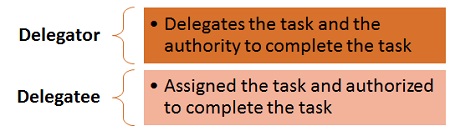
Delegator is the source and the delegatee is the performer. Rightful delegation is pivotal in the process of delegation. Delegator has an uphill task of assigning tasks to the subordinates in such a manner that the real intent of execution of the assignment is achieved.
Managers are required to create time while assigning tasks and duties so as not to give an impression to the employees that delegation is ordinarily a management technique for freeing the superiors time. Flawless explanation is essential when detailing the duty or task that is being delegated creating conducive atmosphere for the employees to ask for any clarification and later continuous follow up is required to share positive feedback.
An individuals aptitude for delegating is as important as their capacity for managing tasks and responsibilities alone.
However, the art of delegation is not as easy as it seems. Managers who delegate certain tasks to employees need to know what is to be delegated and to whom it is to be delegated. They should also have an idea about the skills and expertise of the employees to whom the task is delegated.
What is Effective Delegation?
When the process of delegation completes with a positive outcome that has been expected of it, it is termed as effective delegation. Effective delegation includes all the steps starting from conceiving the idea of delegating a particular task or responsibility till the final outcome. Effective delegation also implies that a manager assigns the power and authority to staff, and that staff are willing and able to take up the responsibility.
Delegation becomes effective when it is carried out with proper planning, effective communication, along with a close understanding and coordination between the delegator and the delegatee.
The fundamental objective of effective delegation is to save time, build team capacity and allow the delegator to concentrate on other important tasks. It helps in the organizational growth. As said earlier, managing responsibilities is as significant as delegating and both require expertise and knowledge on the part of a manager or an executive.
Effective delegation is quite helpful for succession planning (management and leadership succession), personal development and seeking and encouraging promotion. It enables the employees to gain experience to take on higher responsibilities.
Steps to Effective Delegation
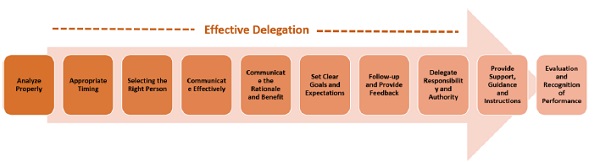
A delegation becomes effective when it is carried out though the following steps −
Analyze Properly
Before delegating any projects or responsibilities, a good leader or manager must think and determine how to allocate responsibilities. In case the projects or the responsibilities are highly demanding, the leader or the manager may consider spreading the work among a group of employees and it is still advisable to designate a group leader to achieve a desired result.
For individual tasks, an appropriate person should be chosen and the manager should judge the employee(s) skill and efficiency personality-wise. This step is crucial in delegating responsibilities as it proves that the leader takes time to understand the staff well enough to determine which workers would serve the project and company at their best.
No Procrastination
The manager should make an effort to delegate the task early to avoid unnecessary pressure. This enables the delegatee to plan the task effectively.
Select the Right Person
The delegator should ensure that the delegatee has the time to take up the responsibility. There is a need to assess the skills and capabilities of the staff and to assign the task to the most appropriate person. It is also necessary to make sure that the person has the requisite training and resources to succeed.
Communicate Effectively
The ability of a manager to express the role-to-be-delegated and all that it entails is one of the finest tests of delegation. If the leader or the manager fails to do so, it can result in a misunderstanding that may lead to improperly completed jobs that jeopardize professional relationships and have a negative financial impact as well.
During the progress of the tasks, management should maintain open communication and hold meetings to ensure that the delegated worker is staying on schedule and meeting important milestones.
Communicate the Rationale and Benefit
The delegator should identify the reason for the task and how it will contribute to the goals of the company or team. The delegatee has the right to know how the delegated task helps in their job, and whether it will help develop a specific skill that is need to get promoted. A routine task to the manager may be a new challenging work to the subordinate.
Set Clear Goals and Expectations
The delegator should be clear and specific on what, why, when, who and where of the task to be performed. The how to about the task may be left to subordinates. The delegator should be prepared to accept the input from subordinates, and confirm and verify the goals and expectations.
Follow-up and Provide Feedback
The selection of team or employees and assigning task to them does not mean that the process of delegation is complete. The delegator should follow-up along with the work being completed to ensure its being done properly as per the specifications.
The delegators may not want to micromanage the work that is delegated, but should monitor the work being carried out and provide timely and appropriate feedback for improvements. They should remain available to all parties to address and resolve any potential questions or problems. It is appropriate to keep communication lines open, regular meetings on large tasks can provide this ongoing feedback.
Delegate Responsibility and Authority
Responsibility must commensurate with appropriate and adequate authority. It is physically not possible to carry out responsibilities without having relevant authority. The delegator should ensure that the subordinate is given the relevant responsibility and authority to complete the task, and let the subordinate complete the task in the manner they choose, as long as the results are as specified. The delegator should also be willing to accept ideas from the subordinate on task fulfillment.
Provide Support, Guidance and Instructions
The delegatees should be provided with the resources, technology and time to complete the task. It is the duty of the delegator to see that all these are ensured to the delegatees.
Evaluation and Recognition of Performance
The delegators should always recognize appreciable performance of the delegatees. They should evaluate the results, and any insufficient or poor performance should be analyzed in order to establish the causes for improvement.
Benefits of Effective Delegation
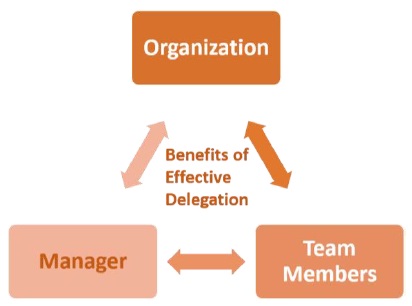
Delegation being the key to growth and progress of an organization is as such unavoidable. Effective delegation has tremendous benefits for the overall productivity and growth of the organization. Some of the important benefits that effective delegation offers to the organization and to the employees are discussed in this section −
Benefits for the Organization
Effective delegation helps the organization to increase and improve its reputation as a preferred employer. Besides, it also offers the following benefits to the organization −
It helps increase the overall productivity.
It ensures continuity through smoother succession planning.
It keeps the vision of the organization on track.
The whole business or organization becomes smoother in functioning.
Enhances the quality of work-life environment. People feel warm and comfortable in the organization and this impacts other areas of their lives.
Human resources are effectively utilized as the level of work being done is at an appropriate level for them.
Benefits for the Team Members
Effective delegation benefits the team members in many ways as given below −
Enhances the skills of team members.
Promotes communication skills and opens up channels of communication.
Increases loyalty as it promotes career growth opportunities.
Decreases delays for those waiting on the manager to make decisions or take actions.
Increases and improves motivation and job satisfaction.
Creates a team partnership in achieving results and thus improves team work. Team-building and relationships are encouraged and strengthened.
Creates a learning community, that is learning through doing.
Recognizes innovation in individuals.
Benefits for the Manager
By effective delegation, the delegator or the manager benefits in many ways as given below −
Increases available time for more strategic thinking and development opportunities for the manager, the team and the organization.
Improves the time management which allows the delegator to focus on more important issues. It also helps in realizing the objective within the stipulated time.
Creates a basis for fair assessment of the delegatees that is based on their ability to achieve tasks.
Understands the capacity of staff leading to suitable interventions for improvement being identified.
Helps the delegator become more effective in evaluating the team.
Improves managers reputation and trustworthiness
Helps with providing feedback in task performance.
Enhances the career progress of the manager.
Thus, delegation in modern businesses is hard to ignore. It involves not only relieving the delegator of the workload, but is also an opportunity for the employees to grown in a remarkable way. Delegation is also essential for being a productive leader and a productive organization. It provides the much-needed opportunity to managers to free them to think, plan and build. As Bill Gates quoted, As we look ahead into the next century, leaders will be those who empower others. A good delegation is about delegation and great leadership is about building by delegating.
Summary
In this chapter, you have learnt the following concepts about steps involved in an effective delegation −
Delegation is a two-way process, that involves two main roles- delegator and delegatee.
When the process of delegation completes with a positive outcome that has been expected of it, it is termed as effective delegation.
A delegator should delegate a task through a series of necessary steps, to make it effective.
Effective delegation benefits the delegator, the delegatee and the organization as a whole.
