
- Effective Delegation - Home
- Effective Delegation - Introduction
- Effective Delegation - Principles
- Effective Delegation - Steps Involved
- Role of Communication
- Effective Delegation - Barriers
- Effective Delegation - Quick Guide
- Effective Delegation - Resources
- Effective Delegation - Discussion
Effective Delegation - Introduction
Leadership mainly involves getting tasks done. As such leaders or managers do not do the tasks themselves, they get them done by others. A successful leader is the one, who with the help of some processes or methods, provides requisite drives and resources to the subordinates to materialize the goals of the organization. One of such processes is Delegation.
Definition and Scope
Delegation is a popular management process of getting tasks done by others by giving them responsibility. It involves assigning certain responsibilities along with the necessary authority by a superior to his subordinates.
Different scholars defined delegation in different ways. Some renowned definitions of delegation are given below −
Delegation means conferring authority by a higher to a lower authority. Mooney
Delegation is the dynamics of management. It is a process a manager follows in dividing the work assigned to him so that he performs that part which only he, because of his unique organizational placement, can perform effectively, and so that he can get other to help him with what remains. Allen
Delegation takes place when one person gives another the right to perform work on his behalf and in his name, and the second person accepts a corresponding duty or obligation to do what is required of him. O.S. Hiner
Delegation means conferring authority from one executive or organizational unit to another. Terry
Delegation refers to a managers ability to share his burden with others. It consists of granting authority or the right to decision making in certain defined areas and charging subordinates with responsibility for carrying through an assigned task. Douglas C. Basil
Delegation of authority means more than simply assigning duties to others in more or less detail. The essence of delegation is to confer discretion upon others, to use their judgement in meeting specific problems within the framework of their duties. Millet
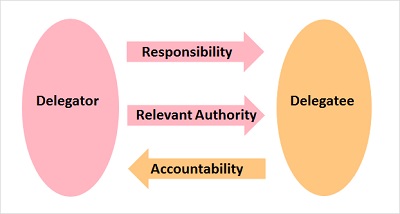
Delegation, thus, involves entrusting a part of ones work to others, that is by a manager or an executive, to the subordinates or by a manager or an executive to another.
Delegating responsibility is always accompanied with appropriate authority to enable the delegatee(s) to carry out such responsibility most effectively. Without rightful authority, responsibility is meaningless.
A delegator may note the following points while delegating a task to a delegatee −
The delegator may not be made accountable for effective performance of the task and ultimate authority should not be given to the delegatee.
Only the required amount of authority, that is necessary to complete the task as per the prescribed norms and objectives, may be delegated.
The real and the overall authority for the task assigned lies with the delegator.
The ultimate responsibility of completing the task lies on the delegator.
Example
Consider an organization that has the following hierarchy.
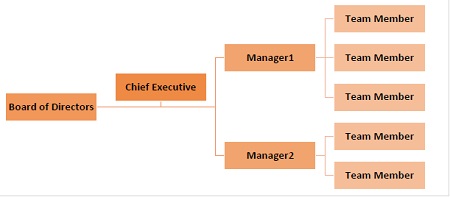
The Board of Directors is the top most authority that takes major decisions related to the functioning of the organization. The Chief Executive is entrusted the responsibility of executing these decisions, who assigns the work to managers. Managers lead or manage a group of team members, to whom they delegate a part of their work. All these are carried out such that the functioning of the organization is not disturbed.
Scope of Delegation
All managerial positions in an organizational hierarchy are vertically tied together through authority-responsibility relationship and these responsibilities are created by the process of delegation of authority. Please note that delegation −
Involves transfer of certain responsibilities to subordinates and giving them requisite authority to discharge them properly.
Is ubiquitous and is common to every organization including businesses and public enterprises.
Seeks meaningful participation and cooperation from the subordinates towards achieving organizational goals.
Reduces routine responsibilities of the delegator. As a result, they can concentrate on more urgent and important matters.
Empowers the employees for higher responsibilities, enhances subordinates efficiency, brings in their wholesome engagement and enables them to lead the organization in future.
Enhances the skills and efficiency of the subordinates. When the subordinates become responsible for certain functions transferred to them, they are spurred to put their best effort to carry out the delegated tasks as effectively as possible. While carrying out the assigned tasks, they learn new skills and sharpen their existing skills.
Facilitates the progressive sharing of management functions or division of labor among the various levels of management in an organization.
Prepares employees at the junior levels of the organizational hierarchy for occupying higher positions in future. Thus, delegation makes a repository of talents for the growth and progress of the organization.
What is Delegation?
Delegation is the division of an assignment or a work among the eligible employees by the manager or an executive, for its effective and fast completion.
The process of delegation encompasses three components as discussed in this section −

Entrustment of Responsibility
This is the foremost part of the process of delegation. Responsibility refers to the work or duties assigned to delegatees by the virtue of their position in the organization. To enable the delegatees to perform the responsibility well, the delegator must clearly explain the task and explicitly tell the former, as to what is expected of them. It confers responsibility upon the delegatee for completing the assigned task more effectively.
Granting of Authority
The responsibility for carrying out an assignment in an organization must commensurate with rightful authority. Authority should be co-extensive with responsibility. Without appropriate authority, it is impossible to carry out any assigned task as desired. In effective delegation, the responsibility of the performance of some task is assigned to someone and they are given adequate authority to make use of the resources and take necessary actions for its accomplishment.
Accountability
Delegatees who accepts an assignment and are granted the necessary authority to complete it, remains accountable for the outcome. Accountability refers to carrying out responsibility and exercising authority in terms of performance standards established by the delegator. In other words, a delegator to whom a duty has been assigned and authority has been delegated becomes accountable or answerable to the delegator for proper performance and proper exercise of the delegated authority.
Why Delegation?
Delegation is one of the most powerful tools of successful business. It has become indispensable for the techno-savvy for expanding business and to ensure smooth functioning of the organization.
Modern day business is often loaded with an increasing number of activities and functions. It has become a necessity to complete so many tasks as fast as possible in order to cope with the changing nature of the business world. Hence, there is need for division of work among the team members which is formally called delegation.
The need for delegation of power arises because of the natural limitations of human beings. The quantity and nature of work performed by managers are decided by their limits, in terms of capacity, knowledge, control and execution.
In view of these limitations, delegation can offer multiple benefits to managers, as discussed below −
When managers delegate their routine tasks with the subordinates, they become less burdened with workload and can spend time effectively on planning and organizing.
Delegation helps managers to learn how to manage and develop their employees.
Delegation makes communication better between the delegator and the delegatee.
It helps to build an efficient team to work in a more collaborative and an effective manner.
It preserves skilled and efficient employees in the managers team.
When to Delegate?
Managers or executives feel the necessity for delegating tasks to the subordinates when −
They are overburdened with work.
They are required to perform more tasks than their routine jobs.
They need to develop their teams to contribute effectively to organizational growth and prosperity.
There is a need to improve the efficiency level of the team members.
There is a need to increase the overall productivity of the team.
They need to devote their time for managerial activities like planning, organizing etc.
Significance of Delegation in Businesses
Delegation has become a necessity owing to the nature and scope of modern businesses. Due to the umpteen innovations in science and technology, transport and communication and globalization, businesses are expanding faster than ever. Modern organization is comprised of numerous activities which become impossible to carry out unless there is a division of labor. Sometimes, the lack of delegation is considered a symptom of poor management.
Case Study: Importance of Delegation
Allen is a talented performer. He was promoted as a manager of a four-member team. With the promotion, the work and concerned responsibilities of Allen increased. However, Allen has a confidence on him that he is capable of performing any task with ease and started doing all the tasks assigned to him on his own, though it took longer working hours. He considered his capabilities to be superior to those of his team members. He ignored delegating tasks to them, and always assigned them their daily routine. After three months of him in that role, one of the team members resigned owing to the lack of challenge and personal growth. And Allen always ended up putting more hours for all the tasks assigned to him.
Absence of delegation means that the manager is unable to empower the team to take up responsibility on some tasks, which will otherwise help the organization succeed.
There are too many tasks for managers to handle on their own. They need to utilize the workforce and maximize their capabilities in order to get the job done and achieve their targeted goals.
Delegation is widely acknowledged as an art of getting best results. It is important to carry on the work systematically in an organization.
Delegation is highly significant to a manager owing to the benefits it offers, as discussed below −

Reduces the Burden
Managers are generally held responsible for more work than they themselves can perform. Delegation, thus, relieves them from performing duties of routine nature which can be safely delegated to subordinates.
Also there are natural limitations to human capacity to work. Delegation of authority relieves managers from the heavy work load and enables them to concentrate on the higher responsibilities of management. According to E.F.L. Brech, "The tasks involved in the management process of a particular enterprise or section thereof are too large for any one particular person to undertake single-handed-too large either because the amount of responsibility, of mental energy and so on, called for are too big for one individual or because the tasks entailed require rather more time than one individual can make available single-handed."
Effective Management
Managers can devote the available time on other important and strategic matters that they are entitled to pass on routine work to the subordinates. The main responsibility of the manager is to get the work done effectively, and by delegating authority and responsibilities for tasks to the subordinates, managers can accomplish what they are expected of.
Develops Subordinates Skills
Due to delegation, managers get more opportunities to utilize their subordinates talents. It allows them to develop those skills that help perform work of complex nature. Delegation of authority encourages confidence and responsibility of taking decisions among the subordinates. They gain experience and expertise in certain complex work, which prepare them to take up higher positions in future.
Saves Time
Time is one of the most valuable resources a business needs in todays world. Effective delegation sets aside considerable time for higher level executives which helps them to concentrate on more complex and technical tasks at hand. It makes the vision for a developed and growing organization realized. Time is money and it is saved when effective delegation become a practice in the management of an organization.
Provides Job Satisfaction and Motivation
In delegation, the delegatees not only develop their inherent skills and innovations but also get highly motivated as they develop the feeling of belongingness and trust which is shown to them by their managers or higher executives. Delegation improves the job satisfaction, motivation and morale of the subordinates. It helps to satisfy their needs for recognition, responsibility and freedom.
Integrates the Organization
Delegation binds the formal organization together. It establishes effective superior-subordinate relationship and provides a basis for efficient running of the organization. It also strengthens the organizational hierarchy and enlivens effective communication among all the concerned.
Delegation yields collective success as the successful accomplishment of the assignment will bring satisfaction for the whole team and not just for one individual member. A collective success will make the personnel feel as an entity with the company. It will lead to the integration of the organization as a whole.
Facilitates Organizational Growth
In the process of delegation, managers pass responsibility and authority for carrying on routine tasks to subordinates. This leads to division of work and specialization which is vital for the growth of the organization.
Fosters Expansion
In the process of delegation, subordinates are requisitely developed to take over the superiors position, the organization can be expanded through diversification. The emerging team will be an asset to the organization which in turn helps in its expansion as a whole.
Achieves Continuity
Due to delegation, executives at lower levels acquire valuable experience and expertise to develop their abilities and can fill higher positions in case there is a need. Delegation overcomes complexity in procedures to carry out any work of high technical nature because of delegation of such work to specialists.
A multinational company operating in various countries cannot function well if it doesnt delegate much of its authority to field heads for effective control and management of the field units.
Summary
This chapter discussed an introduction to effective delegation, which can be summarized as follows −
Delegation is a management process through which delegators get tasks done by delegatees by giving them responsibility and relevant authority, and expect accountability for the task.
Responsibility is always accompanied with requisite authority. However, by delegating a responsibility, the delegator does not surrender the authority.
A delegator is ultimately responsible for completion of the task and possesses ultimate authority over it.
Organizations need to have a hierarchy of delegation such that its functioning goes on undisturbed.
Delegatees need to have a clear idea about what to delegate and when to delegate.
Delegation offers multiple benefits both to the delegator and the delegatee, and to the organization as a whole.
