
- Effective Delegation - Home
- Effective Delegation - Introduction
- Effective Delegation - Principles
- Effective Delegation - Steps Involved
- Role of Communication
- Effective Delegation - Barriers
- Effective Delegation - Quick Guide
- Effective Delegation - Resources
- Effective Delegation - Discussion
Effective Delegation - Principles
The previous chapter discussed in detail about the scope and the importance of delegation. In this chapter, you will learn the principles of effective delegation, span of control, and centralization and de-centralization. This chapter also talks about authority, responsibility and accountability.
Principles of Delegation
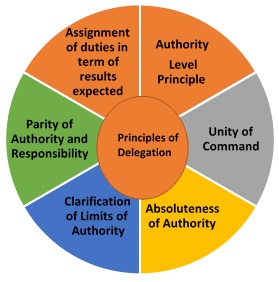
Principles of delegation are a set of guidelines that are to be followed by the delegator to ensure an effective delegation. Koontz ODonnell and Weihrich have enlisted certain principles to be followed as guidelines while delegating authority for completing a given responsibility. Most of these have relevance in the contemporary business. These principles are shown in the following figure −
This section explains these principles in detail.
Assignment of Duties
The delegation of authority should be based on the results expected. This means goals or objectives should be ascertained and plans should be devised, and such objectives and plans are well-understood and accepted by the subordinates, and that assignments or jobs have been made to fit in with them. It is necessary for the subordinates to understand clearly what tasks they must undertake and what is expected of them.
Parity of Authority and Responsibility
According to this principle, the manager should keep a balance between authority and responsibility, with a logical relationship between them. Required authority must be granted to fulfill the responsibility. Such parity of responsibility and authority is not mathematical, but co-extensive and should be maintained to realize an effective delegation.
Clarification of Limits of Authority
This principle says that the authority delegated to the subordinates should be confined to the delegated task only. There is a limit to authority delegated and the limits must be clarified to subordinates so that they may not assume undue authority. It enables the subordinates to work proficiently within the defined limits of authority.
Absoluteness of Authority
The ultimate authority for a delegated responsibility lies with the delegator. In the process of delegation, the superior is finally accountable for the acts, omissions and commissions of the subordinates. The delegators can never escape the responsibility for the activities entrusted to them, merely by delegating the task to their subordinates. The responsibility of the subordinates is also absolute, when they accept an assignment and the authority to execute it.
Unity of Command
According to this principle, every subordinate should have a single superior from whom they get the authority and to whom they are solely accountable. This means the subordinate should get the instructions from a single superior and perform those responsibilities as assigned. In case, if the subordinate is required to report to more than one boss, then there may be a conflict and delay in the managerial operations.
Authority Level Principle
According to this principle, decision-making should remain at the level at which authority is delegated. Managers at each level should make all decisions within their jurisdiction, and not beyond that. The superior should allow the subordinates to take their own decisions as per the authority delegated to them. The delegation of authority will be effective only when it is clear and understandable to subordinates. The subordinates should know the area of their decision-making and should avoid the temptation of referring tasks to the superior. If any matter falls out of their domain, they should report them to their superiors.
Case Study: Importance of Defining Limits of Authority Delegated
John is the head of human resources. He is responsible for taking care of lunch and snack facilities to their staff. He delegated this task to Amelia, who is his subordinate. Amelia assumed ownership of the task differently. Lately, John is receiving complaints about food quality and unexpected changes in the menu. Later, John found out that Amelia revamped the menu and changed the food caterer without informing him.
Span of Control
The word span means the full extent of something. Span of control or span of supervision means the number of subordinates that report to a single manager. It is the maximum numerical size of the subordinates that a manager or any other authority in an organization, can effectively supervise, manage or control in a single manner.
The ideal number of direct reports who can be managed effectively may be varying, though research and theories, most notably those of V. A. Graicunas and Luther Gulick, do exist.
Consider the example of the organization that we discussed in Chapter 1. It is shown in the image given below −
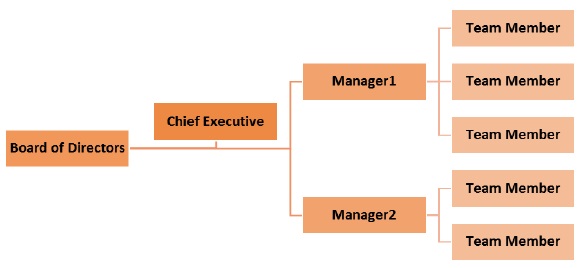
Here the span of control of the Chief Executive is two, that of manager 1 is three, and for manager2, it is two.
The following points are worth notable while discussing about span of control −
A number of direct, group and cross relationship exists between a manager and the subordinates of an organization.
A manager supervising four subordinates is required to deal with four direct relationships and a three times more cross relationship and even more number of group relationships.
Although a perfect ratio of manager and subordinates is an ideal proposition, span of control is pivotal in understanding organizational design and the behaviors within the organization, such as the approaches used to interact with employees and the effectiveness of communication between each level.
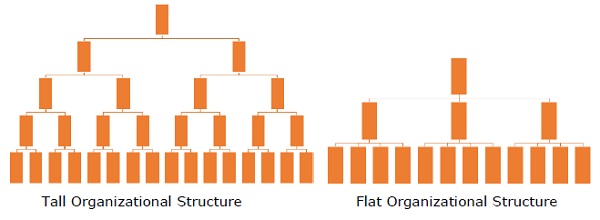
Span of control is indicative of the size of the organizational chart of an organization. A few subordinates reporting to manager results in a taller organizational chart. On the other hand, a higher number of reports to the manager results in a flatter or wider chart.
Factors Influencing Appropriate Span of Control
There are certain factors that influence the span of control in an organization. They are as discussed below −
Organizational Size
Factors like financial resources and spread of the company play a decisive role in span of control. In large organizations, usually, there is a narrow span of control whereas, smaller organizations often have wider span of control.
Organizations stuck in financial crisis tend to increase the span of control; on the other hand, organizations with sound financial health reduce the span of control and inflate its management.
Nature of Work
Matters related to day to day functioning of an organization that require limited skill or only occasional managerial decisions and coaching can give space to wider span of control. On the contrary, matters requiring frequent decisions, or are inherently complicated and loosely defined need to have a narrower span of control.
Skill Level of Workforce
The expertise and experience of the employees to be supervised also affects the size of span of control. A good number of experts and experienced employees can be effectively controlled and supervised by a manager. It results in a wider span of control. On the other hand, new employees need more and frequent attention of the manager. Hence, it leads to a narrow span of control.
Organizational Culture
Prevailing organizational culture affects the size of span of control. An organization having a flexible workplace culture has a wider span of control because employees are given more autonomy and flexibility in carrying out the assigned work.
Geographical Size
In case, the organization has a number of branches spread over a large geographical area, for instance, a state or province, a country or a number of countries, it tends to have narrow span of control. Managers find it difficult to supervise more number of employees who are physically located at a good distance from them.
Capability of the Manager
A manager with experience and expertise in understandings of the tasks will be able to supervise more workers. However, the nature of work assigned to the manager or an executive affects the size of the span of control. If the manager needs to have regular interactions with the employees, write job descriptions and complete appraisal and development plans and deal with day-to-day administrative tasks related to the team, then the span of control should be drastically cut down.
Advantages of Span of Control
In this age of increasing automation in businesses, the fast growing electronic media revolution and the growing number of specialists have changed the whole idea of span of control. It is necessary to choose an appropriate span of control based on the factors discussed above. A well designed span of control offers multiple advantages to the organization as given below −
Increased Managerial Efficiency
Increased Morale among Staff
Better Personal Contact
Better Health and Safety
Centralization and Decentralization
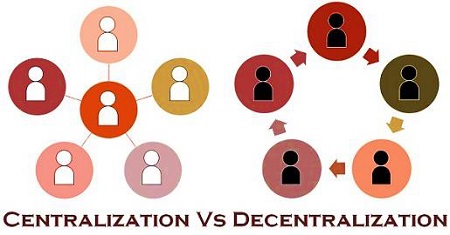
Centralization refers to concentration of authority at the top level of the organizational hierarchy. Decentralization is the dispersal of authority among the lower levels of such hierarchy.
The issue of centralization and decentralization revolves around the location of decision-making authority in an organization.
Merits of Centralization
Centralization offers the following merits to an organization −
It offers maximum control over the entire organization and brings uniformity in its functioning.
It ensures that all the tasks are performed in the same manner and in accordance with the same general policies and principles.
It checks abuses in matters like employment and handling of personnel, purchase and usage of resources.
It makes the top management more effective and powerful, which is helpful in crisis management and provides effective leadership in moving the organization ahead.
It enables maximum utilization of human and material resources in the organization and thus develops a corporate personality.
The leadership provided by a mature top management in a highly centralized organization tends to be of high quality which ultimately brings benefits to the organization.
Demerits of Centralization
Centralization offers the following demerits to an organization −
It leads to the abuse of power, as power is concentrated in a single or few hands.
Due to the centralization of authority, there is a heavy load of managerial work on the top management. It leads to delay in securing actions as no authority is given to lower and middle levels.
Centralized organization often has a weak communication system. Top management tends to remain ignorant of organizational needs and pressures for timely and effective decisions and actions.
A centralized decision-making arrangement inhibits organizational growth as the top management either fails to perceive real opportunities for growth or may not have the confidence to manage growth.
Decentralization
Decentralization is the dispersal of authority for decision making at various levels of organizational operations. However, decentralization is not the same thing as delegation.
Decentralization and Delegation
The following table gives a comparison of decentralization and delegation in detail −
| Decentralization | Delegation |
|---|---|
| It is the delegation and dispersal of authority for decision making in various facets of organizational operations. | It is the conferment of authority upon the subordinates for carrying out certain specified tasks which are formally transferred or assigned to them. |
| Semi-autonomous units exist, which are subject to overall control by central management. | Superior and subordinate relationship is built through the process of delegation. |
| It involves spreading out the total decision making power. | It is task-specific. |
| The top management exercises control in general and delegates much of its authority for control to the executive of the decision making center. | The control and ultimate authority rests entirely with the delegator. |
| Lower level decision making units and their managers are granted semi-autonomous status. | The degree of autonomy enjoyed by the delegatees is limited. |
| Decentralization is optional in the sense that top management may or may not disperse authority. | Delegation is essential for management as subordinates must be given sufficient authority to perform their duties. |
| No decentralization takes place without delegation. | Delegation of authority is possible without decentralization. |
Merits of Decentralization
Decentralization offers the following merits to an organization −
Increases Operational Efficiency
It increases the operational efficiency of the organization by reducing delays, checking red-tapism and encouraging faster actions. The performance of employees improves considerably as they learn different skills by performing different delegated tasks.
Diversifies Activities
It reduces the workload of the head office and thus enables the top executives to concentrate on vital issues like policy formation, examining major problems and so on.
Grooms Employees
It develops resourcefulness and self-respect among the subordinates by enabling them to take decisions with a sense of responsibility. It provides a training ground for the would-be managers.
Improves Management Responsiveness
It makes management more responsive as the field offices act with the knowledge of local conditions and requirements.
Enhances Control and Supervision
Decentralization leads to effective control and supervision. Since concerned managers enjoy full authority to make changes in work assignment, to take disciplinary actions, to change production schedules or to recommend promotions, they are in a position to supervise their subordinates activities.
Boosts Decision-Making
A decentralized organization is able to make decisions faster than one with a centralized structure. A manager often can make a decision without having to wait for it to go up a chain of command, allowing the organization to react quickly to situations where fast action can mean the difference between gaining or losing a customer.
Disadvantages of Decentralization
Decentralization offers the following demerits to an organization −
Requires the services of talented people which may not be available all the time.
Decentralization makes coordination difficult among various units.
Increases expenses by many times.
Leads to a lack of uniformity between the headquarters and the field offices.
Leads to conflicts between the field managers and the headquarters over various aspects like finances and decisions taken.
Authority and Responsibility
In this section, you will learn in detail about authority and responsibility and the interrelation between them.
Authority
Authority means the rights inherent in a managerial position to give orders and expect orders to be obeyed. It is always viewed as the glue that held the organization together. Each management position has specific inherent rights that incumbents acquire from the positions rank.
Authority is vital to the functioning of any organization. Authority refers to the formal power or right, attached to a particular job or designation, to give orders, enforce rules, and make decisions and expect compliance.
Authority is at the base of all formal organizations. The organizational structure is based on location of authority at various levels. It is a binding force in an organizational integration.
The notion of authority is one of the pivotal concepts in an organizational study. Some of the important definitions of authority are as follows −
According to Henri Fayol, "Authority is the right to give orders and the power to extract obedience."
According to Mooney and Reilly, "Authority is the principle at the root of an organization and is so important that it is impossible to conceive an organization at all unless some person or persons are in a position to require action of others."
According to Chester Barnard, Authority is the character of a communication (order) in a formal organization by virtue of which it is accepted by a contributor to or a member of the organization as governing the action of the contributes.
Responsibility
Responsibility refers to the obligation of an individual to perform the duty assigned. Responsibility specifies the duty assigned to a position. The person holding the position has to perform the duty assigned. According to Koontz and ODonnell, Responsibility may be defined as the obligation of a subordinate, to whom duty has been assigned to perform the duty.
Characteristics of Responsibility
The following are some of the characteristics of responsibility −
The essence of responsibility is the obligation of a subordinate to perform the duty assigned.
It always arises from the superior-subordinate relationship.
Responsibility moves upwards, whereas authority flows downwards. By virtue of the superior position, a manager has the authority to get the required work done from the subordinates.
Responsibility may be a continuing obligation or confined to the performance of a single function.
Responsibility is absolute and cannot be delegated.
It is hard to conceive responsibility without any authority.
Responsibility is always upward in which a subordinate is responsible to the superior.
Accountability is derived from responsibility and the two go hand in hand. A person shouldering a responsibility is accountable for the performance.
Relationship between Authority and Responsibility
Authority and Responsibility are the basic functions considered at the primary stage in a management system. They are like two sides of a coin. They are inter-related and commensurate with each other. The following table shows you the comparison of these two −
| Authority | Responsibility |
|---|---|
| It is the right or power of a manager to command his subordinates. | It is the obligation of a subordinate to complete an assigned work. |
| It flows downward. | It flows upward. |
| It can be delegated. | It is indivisible and cannot be delegated. |
| It is the right to give the command, order or an instruction and obtain obedience. | It is the outcome of authority. |
Responsibility is defined as a corollary of authority. It is a natural consequence and an essential counterpart of authority. Responsibility is derived from functions or tasks, authority is derived from responsibility, and accountability is derived from authority and responsibility.
Understanding Accountability
Accountability arises from the responsibility given. In other words, accountability is the obligation to carry out responsibility and exercise authority in terms of performance standards established by the superior. It is the liability for the proper discharge of duties.
Accountability comes into existence the moment responsibility is accepted by a person. Once a subordinate is assigned a duty and given the necessary authority to complete it, they become answerable for the outcome.
Accountability is the answerability for carrying out a duty assigned to a person. The performer has the obligation to give a satisfactory account of their performance and the manner in which they exercise the authority conferred.
The chief aim of accountability is to check wrong and arbitrary decisions or actions and increase efficiency and effectiveness of the functioning of an organization.
Subordinates are responsible for the completion of the task assigned to them and are accountable to their superior for the satisfactory performance of the task.
Summary
In this chapter, you have learnt the following concepts about principles of delegation −
Principles of delegation are a set of guidelines for the delegator to ensure an effective delegation.
Span of control is the number of subordinates that report to a single manager. A well designed span of control offers multiple advantages to the organization.
Centralization and decentralization revolves around the location of decision-making authority in an organization.
Decentralization and delegation are two different concepts and must be chosen accordingly.
Responsibility is a corollary of authority and accountability is derived from authority and responsibility.
