
- Effective Delegation - Home
- Effective Delegation - Introduction
- Effective Delegation - Principles
- Effective Delegation - Steps Involved
- Role of Communication
- Effective Delegation - Barriers
- Effective Delegation - Quick Guide
- Effective Delegation - Resources
- Effective Delegation - Discussion
Effective Delegation - Barriers
Effective delegation can have extensive benefits for the delegator, the delegatee and the organization as a whole. No doubt, delegation is a skill that is not congenial to everyone. Some executives fear that employees will resist delegation. They are fraught with various practical and emotional barriers while delegating.
However, with the emerging need for delegation in modern business, managers, supervisors and the top executives need to overcome challenges that they come across while delegating.
While delegating, the delegator should keep in mind that the responsibility that is delegated should be SMART Specific, Measurable, Appropriate, Reachable, Time-bound.
Delegation is not as easy as it appears. Delegation is not a compulsion, rather it is a necessary choice that a manager opts for professional excellence, in particular and the larger benefits of the organization, in general.
Delegation is a critical skill. However, with proper planning, defined objectives and standards and seeking involvement of the subordinates, delegation can be handled effectively. In today's fast-paced competitive environment, work must be delegated to the lowest organizational level that has the competence to successfully perform it.
Tasks to Avoid while Delegating
Delegation is not easy to carry out if it is not properly planned. There are many tasks a manager or an executive needs to avoid while delegating. They are as discussed in this section.
Avoid delegating tasks that −
Are sensitive and personal in nature
Require a degree of risk and decision making that is unfair to the delegatee
Require the personal expertise of the delegator
Require personal leadership of the delegator
Have legal restrictions
Such inappropriate tasks may include −
Performance feedback
Disciplinary actions
Counseling, disciplining and other confidential personnel matters
Tasks assigned specifically and exclusively to the delegator
Tasks that are the responsibility of another team, department or division
Crisis situations where people are looking for the delegators leadership
New initiatives that require you setting the example and standard
Avoid delegating under the following circumstances −
To people who are already overloaded
To people who have other important, high-priority tasks requiring their attention
To people who lack time to complete the task successfully
To people who lack the skills to complete the task successfully
To people who have successfully completed similar tasks, if there are other candidates for delegation available
Without making sure that you and your employees understand what its successful outcome would look like
Without staying involved to monitor the progress
Reasons for Poor Delegation
One of the significant functions of a competent manager is not to do all the work by self, but to carefully deliver within the given limits of budget and timelines. Hence, the need for delegation arises.
A considerable number of managers fail to make successful delegations. It leads to poor delegation which limits their growth and those of the delegatees. This section discusses the factors that lead to poor delegation, that make delegation so challenging to embrace and that causes delegation to fail in realizing the objectives.
Reasons for Poor Delegation from Delegator Point of View
Poor delegation may occur from delegators or supervisors part due to any of the following reasons −
Indecisiveness of the Delegator
Many managers are very often confused as to what they should delegate. This is where they go wrong in the first place. It is always advised by management experts that except for assignments that are sensitive and absolutely confidential, or the ones which deal with long-term objectives of the organization, most of the tasks with due attentiveness can be effectively delegated.
Lack of Proper Knowledge about the Team Members
Managers are mostly averse to delegating tasks to their subordinates because they lack adequate knowledge about the skills and expertise of their team members. They are unaware about what their people are good at. They should intelligently reserve the tasks suitable to be delegated and hand them over to the appropriate individual at appropriate time.
Procrastination in Assigning Tasks
Another reason for poor delegation is the procrastinating mindset of managers in assigning tasks because they are not sure if their subordinates can deliver as effectively as they can.Delegation is, however, not losing control over any task or assignment; rather it means showing respect for the talents others can bring to the fore.
Scheming Delegated Tasks
Some managers have a tendency to scheme their way into delegating tasks. They make tasks sound simpler and without much work. By doing so, they undervalue the tasks and the persons who have to carry out them.
A better approach is to let the person comprehend the significance of a task, the responsibility it brings and the long-term consequences it comes with. Once they are clear about the task, the ownership comes on its own.
Lack of Clarity of Vision
The managers should have clarity of vision to bring the better out of their team members. Wise managers always share their visions before they share the tasks. It helps to energize and spur the delegatees to perform better because tasks devoid of vision are unexciting and burdensome.
Abdication of Control after Delegation
Managers should not abdicate control after delegating tasks. Abdication of control is equal to denying responsibility for the delegated task which is beyond the purview of delegation. It is of great importance to find the balance between allowing enough space for the people to use their abilities to the best effect and grow, and monitoring and supporting to ensure the work is complete as effectively as expected.
Reasons for Poor Delegation from Delegatees Point of View
Poor delegation may occur from delegatees or subordinates part , when they do not −
Understand the task.
Have the skills to complete the task.
Have the tools or resources needed.
Understand why the task needs to be done.
Know how to deal with an obstacle.
Think that the task is important
Want to complete the task.
Consequences of Poor Delegation
When delegation is carried out in a haphazard and an unplanned manner yielding no result it is termed as poor delegation. Poor delegation damages the business, creates frustration in the delegator, besides demotivating and confusing the delegatees. It has many negative consequences as discussed below −
Adversely affects the overall productivity and morale of the organization.
Fails to deliver the desired result.
Leads to loss of opportunities for all concerned in the process of delegation.
May develop differences within the team.
Both the delegator and the delegatee suffers the consequences of poor or ineffective delegation.
Chaos and inefficiencies frequent the work environment when there is poor delegation as it affects considerably the overall productivity.
Barriers to Effective Delegation
It is a well-acknowledged fact that effective delegation is essential in the functioning of a modern business organization.
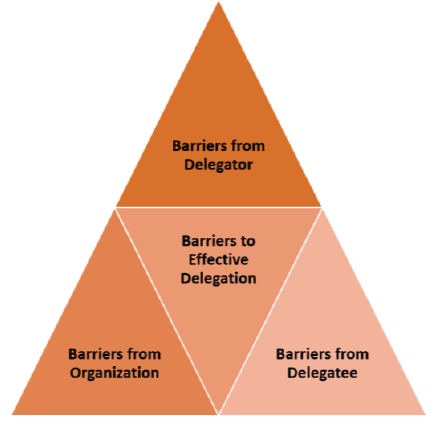
However, in practice, there are several factors that hinder effective delegation. These factors are discussed under the following three categories −
Barriers from the Delegator
Barriers from the Delegatee
Barriers from the Organization
Barriers from the Delegator
In fact, the biggest barriers to delegation come from the superior. The delegator or the superior are not in favor of delegating sufficient authority due the following reasons.
Lure for Authority
Some managers or executives are averse to delegate, because of their temptation for authority. They believe that delegation will lead to reduction of their influence in the organization. They want to retain the entire authority in order to make their presence felt and desire that the subordinates should often come for approval.
Fear of Losing Control
Managers new to delegation feel that while delegating they are abdicating their control of the tasks. They may not be willing to allow a team member to perform a task for which they are ultimately responsible. However, regular and effective communication with those to whom tasks are delegated can help mitigate this feeling and give them some sense of control.
Lack of Willingness
Some managers feel that none can do the job better then they themselves. They think that if they delegate, work will not be completed as it ought to be completed. These managers consider themselves inevitable and dont want to give other peoples ideas a chance. The dominating attitude I can do it better myself hinders delegation to a great extent.
Fear of Being Exposed
Some incompetent manager resists delegation because they think that they will delegate themselves out their job. They are always afraid of their subordinates outshining and overcoming them and proving more efficient than them. They are therefore very careful about delegating, because they fear that their incompetency may be exposed.
Scarcity in Time
A perceived lack of time is the most visible reason for failure to delegate. Delegation takes time to choose people, prepare them and get them started. When the manager is burdened with workload, they may not have the time to delegate.
Lack of Confidence in Team Members
Some leaders resist delegation because they do not have faith in their team members. It is the doubt of the manager in the ability of subordinates that hinders effective delegation. By not seeing the potential of the team members, the manager fails to contribute substantially towards achieving efficiency in the organization.
They should learn to see the potentials in their team and make sure that they have adequately prepared their team members for the task
Barriers from Subordinates
Subordinates or delegatees at times show disinclination towards accepting delegated tasks and do not like to shoulder responsibility for many reasons. Some important reasons for this aversion of the subordinates are as follows −
Lack of knowledge
The subordinates may lack knowledge about the benefits in delegation. The managers can help them realize the benefits. When they realize them, they begin to succeed and they will be more willing to take on additional responsibilities that the manager delegates.
Lack of Time
Employees in a team often feel that they are already putting their best available time and effort for the organization. So, they dont like to shoulder extra responsibility for the delegated task. Hence, managers should ensure a fair division of tasks between them and the team members. When everyone feels overworked, the manager needs to explain that in order to get the job done, all members need to put forth the extra effort.
Unwillingness to Shoulder Responsibility
Very often, the subordinates are not willing to shoulder responsibility for the delegated task(s) and find it easier to consult the boss than to decide by themselves as to how to deals with a particular issue.
Fear of Criticism
The subordinates sometimes refuse to accept authority because of their fear of criticism by their superior in case they commit mistakes in taking decisions and executing assignments.
Lack of Self-confidence
The subordinates may lack self-confidence and initiative and this may also be the reason for their unwillingness to accept authority.
Fear of Failure
Sometimes team members are afraid that they will fail to accomplish the delegated tasks. This may be due to the lack of adequate support and encouragement from the delegator.
Absence of Incentives
The team members or the subordinates avoid accepting any authority because there are no positive personal gains through incentives to them for assuming extra responsibility and authority.
Pressure of work
An excessive workload is also an obstacle towards acceptance of extra responsibility by the subordinates.
Additionally, prevailing situations may hinder delegation. This may be due to lack of adequate resources and unclear hierarchy. Lack of resources is a big concern for most organizations. In some organizations it is difficult to comprehend the lines of authority and responsibility. This too hinders effective delegation.
Barriers from Organization
Organizations may pose the following barriers for a successful delegation −
Lack of well-established organizational methods, procedures and rules.
Unstable and non-repetitive character of work.
Lack of effective means of internal communication and coordination.
Centralization requirements of special program.
Smaller size and narrower geographic coverage of the organization.
Lack of well-defined positions in terms of responsibility and authority.
Incompetency and low caliber of lower level personnel.
Lack of few precedents of effective delegated assignments.
Corporate, legal and situational restrictions.
Lack of effective means to work control.
Dealing with Barriers of Effective Delegation
Considering the significance of effective delegation, it is essential to prepare a blueprint for effectively dealing with the barriers of effective delegation. The following are some important measures towards securing a barrier-free delegation −
Compatibility
It is necessary that there is a match between the aptitude and abilities of the subordinates and the task entrusted to them. The principle of compatibility of jobs to the individual should be followed.
Defined Assignment
The second most important way to deal with barriers to effective delegation is to have a well-defined and comprehensive assignment. It will bring in the desired result.
Time Management
A perceived lack of time is the most visible reason for failing to delegate. To overcome the time problem, it is necessary to accept the fact that the time required to delegate effectively is an investment on which returns are productive, though not immediate.
Knowledge and Planning of Work
The delegating managers should know the nature of tasks and functions which they themselves should handle and which cannot be delegated. Delegation should be properly planned and delegating without knowing the nature of work is often hazardous.
Authority Proportionate to Responsibility
The delegator should see that authority is assigned proportionate to the tasks. Authority and responsibility should be coterminous and coequal.
Positive Incentives
The delegating manager should make sure that the subordinates to whom the task is delegated are given positive incentives for accepting responsibility. It will spur them to carry out the delegated tasks as effectively as desired.
Amiable Work Environment
A work environment free from fear and frustration is necessary for making delegation effective. Unless the employees find the work environment and work culture conducive, they cannot be motivated to shoulder extra responsibilities.
Proper Training and Skill Development
Subordinates should be provided with adequate training for proper use of delegated authority. Skills pertaining to the delegated task(s), if necessary, should be developed among the delegatees in order to enable them to execute the delegated task effectively.
Proper Control Mechanism
There should be proper control techniques to ensure that authority is properly used by subordinates.
Free and Open Communication System
The communication system should be kept free and open, and systematic reporting system should be maintained. It enables the subordinates to get the help of the superior in discharging their duties. Sound communication enables the delegator to be in regular touch with their subordinates.
Needful Resources
The delegator should ensure adequate and needful resources to the delegatees to enable them to carrying out the delegated tasks effectively.
Performance Appraisal System
Delegation should be followed by a performance appraisal system. It will enable the persons concerned to know what went wrong if the delegation failed and if there are any improvement needed in the process of delegation.
Summary
In this chapter, you have learnt the following concepts about barriers to effective delegation −
The delegator should carefully delegate tasks considering many factors and circumstances.
Poor delegation may be due to many reasons and delegator need to identify the appropriate cause and act accordingly to avoid its consequences.
Barriers to poor delegation may arise from any factor: delegator, delegatee or organization.
The delegator should know how to deal with barriers and design a blueprint to handle them effectively.
