
- Effective Delegation - Home
- Effective Delegation - Introduction
- Effective Delegation - Principles
- Effective Delegation - Steps Involved
- Role of Communication
- Effective Delegation - Barriers
- Effective Delegation - Quick Guide
- Effective Delegation - Resources
- Effective Delegation - Discussion
Effective Delegation - Quick Guide
Effective Delegation - Introduction
Leadership mainly involves getting tasks done. As such leaders or managers do not do the tasks themselves, they get them done by others. A successful leader is the one, who with the help of some processes or methods, provides requisite drives and resources to the subordinates to materialize the goals of the organization. One of such processes is Delegation.
Definition and Scope
Delegation is a popular management process of getting tasks done by others by giving them responsibility. It involves assigning certain responsibilities along with the necessary authority by a superior to his subordinates.
Different scholars defined delegation in different ways. Some renowned definitions of delegation are given below −
Delegation means conferring authority by a higher to a lower authority. Mooney
Delegation is the dynamics of management. It is a process a manager follows in dividing the work assigned to him so that he performs that part which only he, because of his unique organizational placement, can perform effectively, and so that he can get other to help him with what remains. Allen
Delegation takes place when one person gives another the right to perform work on his behalf and in his name, and the second person accepts a corresponding duty or obligation to do what is required of him. O.S. Hiner
Delegation means conferring authority from one executive or organizational unit to another. Terry
Delegation refers to a managers ability to share his burden with others. It consists of granting authority or the right to decision making in certain defined areas and charging subordinates with responsibility for carrying through an assigned task. Douglas C. Basil
Delegation of authority means more than simply assigning duties to others in more or less detail. The essence of delegation is to confer discretion upon others, to use their judgement in meeting specific problems within the framework of their duties. Millet
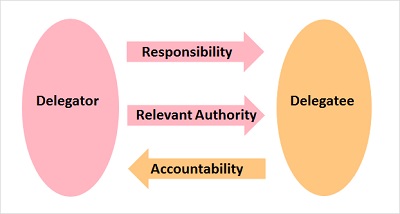
Delegation, thus, involves entrusting a part of ones work to others, that is by a manager or an executive, to the subordinates or by a manager or an executive to another.
Delegating responsibility is always accompanied with appropriate authority to enable the delegatee(s) to carry out such responsibility most effectively. Without rightful authority, responsibility is meaningless.
A delegator may note the following points while delegating a task to a delegatee −
The delegator may not be made accountable for effective performance of the task and ultimate authority should not be given to the delegatee.
Only the required amount of authority, that is necessary to complete the task as per the prescribed norms and objectives, may be delegated.
The real and the overall authority for the task assigned lies with the delegator.
The ultimate responsibility of completing the task lies on the delegator.
Example
Consider an organization that has the following hierarchy.
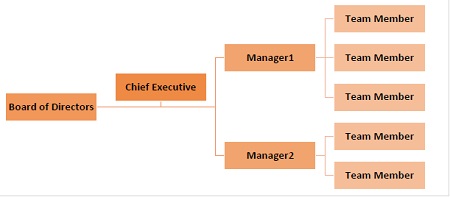
The Board of Directors is the top most authority that takes major decisions related to the functioning of the organization. The Chief Executive is entrusted the responsibility of executing these decisions, who assigns the work to managers. Managers lead or manage a group of team members, to whom they delegate a part of their work. All these are carried out such that the functioning of the organization is not disturbed.
Scope of Delegation
All managerial positions in an organizational hierarchy are vertically tied together through authority-responsibility relationship and these responsibilities are created by the process of delegation of authority. Please note that delegation −
Involves transfer of certain responsibilities to subordinates and giving them requisite authority to discharge them properly.
Is ubiquitous and is common to every organization including businesses and public enterprises.
Seeks meaningful participation and cooperation from the subordinates towards achieving organizational goals.
Reduces routine responsibilities of the delegator. As a result, they can concentrate on more urgent and important matters.
Empowers the employees for higher responsibilities, enhances subordinates efficiency, brings in their wholesome engagement and enables them to lead the organization in future.
Enhances the skills and efficiency of the subordinates. When the subordinates become responsible for certain functions transferred to them, they are spurred to put their best effort to carry out the delegated tasks as effectively as possible. While carrying out the assigned tasks, they learn new skills and sharpen their existing skills.
Facilitates the progressive sharing of management functions or division of labor among the various levels of management in an organization.
Prepares employees at the junior levels of the organizational hierarchy for occupying higher positions in future. Thus, delegation makes a repository of talents for the growth and progress of the organization.
What is Delegation?
Delegation is the division of an assignment or a work among the eligible employees by the manager or an executive, for its effective and fast completion.
The process of delegation encompasses three components as discussed in this section −
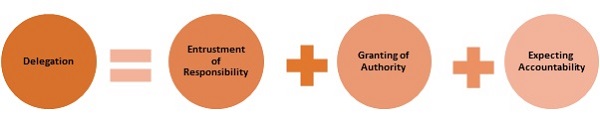
Entrustment of Responsibility
This is the foremost part of the process of delegation. Responsibility refers to the work or duties assigned to delegatees by the virtue of their position in the organization. To enable the delegatees to perform the responsibility well, the delegator must clearly explain the task and explicitly tell the former, as to what is expected of them. It confers responsibility upon the delegatee for completing the assigned task more effectively.
Granting of Authority
The responsibility for carrying out an assignment in an organization must commensurate with rightful authority. Authority should be co-extensive with responsibility. Without appropriate authority, it is impossible to carry out any assigned task as desired. In effective delegation, the responsibility of the performance of some task is assigned to someone and they are given adequate authority to make use of the resources and take necessary actions for its accomplishment.
Accountability
Delegatees who accepts an assignment and are granted the necessary authority to complete it, remains accountable for the outcome. Accountability refers to carrying out responsibility and exercising authority in terms of performance standards established by the delegator. In other words, a delegator to whom a duty has been assigned and authority has been delegated becomes accountable or answerable to the delegator for proper performance and proper exercise of the delegated authority.
Why Delegation?
Delegation is one of the most powerful tools of successful business. It has become indispensable for the techno-savvy for expanding business and to ensure smooth functioning of the organization.
Modern day business is often loaded with an increasing number of activities and functions. It has become a necessity to complete so many tasks as fast as possible in order to cope with the changing nature of the business world. Hence, there is need for division of work among the team members which is formally called delegation.
The need for delegation of power arises because of the natural limitations of human beings. The quantity and nature of work performed by managers are decided by their limits, in terms of capacity, knowledge, control and execution.
In view of these limitations, delegation can offer multiple benefits to managers, as discussed below −
When managers delegate their routine tasks with the subordinates, they become less burdened with workload and can spend time effectively on planning and organizing.
Delegation helps managers to learn how to manage and develop their employees.
Delegation makes communication better between the delegator and the delegatee.
It helps to build an efficient team to work in a more collaborative and an effective manner.
It preserves skilled and efficient employees in the managers team.
When to Delegate?
Managers or executives feel the necessity for delegating tasks to the subordinates when −
They are overburdened with work.
They are required to perform more tasks than their routine jobs.
They need to develop their teams to contribute effectively to organizational growth and prosperity.
There is a need to improve the efficiency level of the team members.
There is a need to increase the overall productivity of the team.
They need to devote their time for managerial activities like planning, organizing etc.
Significance of Delegation in Businesses
Delegation has become a necessity owing to the nature and scope of modern businesses. Due to the umpteen innovations in science and technology, transport and communication and globalization, businesses are expanding faster than ever. Modern organization is comprised of numerous activities which become impossible to carry out unless there is a division of labor. Sometimes, the lack of delegation is considered a symptom of poor management.
Case Study: Importance of Delegation
Allen is a talented performer. He was promoted as a manager of a four-member team. With the promotion, the work and concerned responsibilities of Allen increased. However, Allen has a confidence on him that he is capable of performing any task with ease and started doing all the tasks assigned to him on his own, though it took longer working hours. He considered his capabilities to be superior to those of his team members. He ignored delegating tasks to them, and always assigned them their daily routine. After three months of him in that role, one of the team members resigned owing to the lack of challenge and personal growth. And Allen always ended up putting more hours for all the tasks assigned to him.
Absence of delegation means that the manager is unable to empower the team to take up responsibility on some tasks, which will otherwise help the organization succeed.
There are too many tasks for managers to handle on their own. They need to utilize the workforce and maximize their capabilities in order to get the job done and achieve their targeted goals.
Delegation is widely acknowledged as an art of getting best results. It is important to carry on the work systematically in an organization.
Delegation is highly significant to a manager owing to the benefits it offers, as discussed below −

Reduces the Burden
Managers are generally held responsible for more work than they themselves can perform. Delegation, thus, relieves them from performing duties of routine nature which can be safely delegated to subordinates.
Also there are natural limitations to human capacity to work. Delegation of authority relieves managers from the heavy work load and enables them to concentrate on the higher responsibilities of management. According to E.F.L. Brech, "The tasks involved in the management process of a particular enterprise or section thereof are too large for any one particular person to undertake single-handed-too large either because the amount of responsibility, of mental energy and so on, called for are too big for one individual or because the tasks entailed require rather more time than one individual can make available single-handed."
Effective Management
Managers can devote the available time on other important and strategic matters that they are entitled to pass on routine work to the subordinates. The main responsibility of the manager is to get the work done effectively, and by delegating authority and responsibilities for tasks to the subordinates, managers can accomplish what they are expected of.
Develops Subordinates Skills
Due to delegation, managers get more opportunities to utilize their subordinates talents. It allows them to develop those skills that help perform work of complex nature. Delegation of authority encourages confidence and responsibility of taking decisions among the subordinates. They gain experience and expertise in certain complex work, which prepare them to take up higher positions in future.
Saves Time
Time is one of the most valuable resources a business needs in todays world. Effective delegation sets aside considerable time for higher level executives which helps them to concentrate on more complex and technical tasks at hand. It makes the vision for a developed and growing organization realized. Time is money and it is saved when effective delegation become a practice in the management of an organization.
Provides Job Satisfaction and Motivation
In delegation, the delegatees not only develop their inherent skills and innovations but also get highly motivated as they develop the feeling of belongingness and trust which is shown to them by their managers or higher executives. Delegation improves the job satisfaction, motivation and morale of the subordinates. It helps to satisfy their needs for recognition, responsibility and freedom.
Integrates the Organization
Delegation binds the formal organization together. It establishes effective superior-subordinate relationship and provides a basis for efficient running of the organization. It also strengthens the organizational hierarchy and enlivens effective communication among all the concerned.
Delegation yields collective success as the successful accomplishment of the assignment will bring satisfaction for the whole team and not just for one individual member. A collective success will make the personnel feel as an entity with the company. It will lead to the integration of the organization as a whole.
Facilitates Organizational Growth
In the process of delegation, managers pass responsibility and authority for carrying on routine tasks to subordinates. This leads to division of work and specialization which is vital for the growth of the organization.
Fosters Expansion
In the process of delegation, subordinates are requisitely developed to take over the superiors position, the organization can be expanded through diversification. The emerging team will be an asset to the organization which in turn helps in its expansion as a whole.
Achieves Continuity
Due to delegation, executives at lower levels acquire valuable experience and expertise to develop their abilities and can fill higher positions in case there is a need. Delegation overcomes complexity in procedures to carry out any work of high technical nature because of delegation of such work to specialists.
A multinational company operating in various countries cannot function well if it doesnt delegate much of its authority to field heads for effective control and management of the field units.
Summary
This chapter discussed an introduction to effective delegation, which can be summarized as follows −
Delegation is a management process through which delegators get tasks done by delegatees by giving them responsibility and relevant authority, and expect accountability for the task.
Responsibility is always accompanied with requisite authority. However, by delegating a responsibility, the delegator does not surrender the authority.
A delegator is ultimately responsible for completion of the task and possesses ultimate authority over it.
Organizations need to have a hierarchy of delegation such that its functioning goes on undisturbed.
Delegatees need to have a clear idea about what to delegate and when to delegate.
Delegation offers multiple benefits both to the delegator and the delegatee, and to the organization as a whole.
Effective Delegation - Principles
The previous chapter discussed in detail about the scope and the importance of delegation. In this chapter, you will learn the principles of effective delegation, span of control, and centralization and de-centralization. This chapter also talks about authority, responsibility and accountability.
Principles of Delegation
Principles of delegation are a set of guidelines that are to be followed by the delegator to ensure an effective delegation. Koontz ODonnell and Weihrich have enlisted certain principles to be followed as guidelines while delegating authority for completing a given responsibility. Most of these have relevance in the contemporary business. These principles are shown in the following figure −
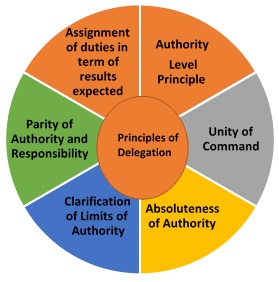
This section explains these principles in detail.
Assignment of Duties
The delegation of authority should be based on the results expected. This means goals or objectives should be ascertained and plans should be devised, and such objectives and plans are well-understood and accepted by the subordinates, and that assignments or jobs have been made to fit in with them. It is necessary for the subordinates to understand clearly what tasks they must undertake and what is expected of them.
Parity of Authority and Responsibility
According to this principle, the manager should keep a balance between authority and responsibility, with a logical relationship between them. Required authority must be granted to fulfill the responsibility. Such parity of responsibility and authority is not mathematical, but co-extensive and should be maintained to realize an effective delegation.
Clarification of Limits of Authority
This principle says that the authority delegated to the subordinates should be confined to the delegated task only. There is a limit to authority delegated and the limits must be clarified to subordinates so that they may not assume undue authority. It enables the subordinates to work proficiently within the defined limits of authority.
Absoluteness of Authority
The ultimate authority for a delegated responsibility lies with the delegator. In the process of delegation, the superior is finally accountable for the acts, omissions and commissions of the subordinates. The delegators can never escape the responsibility for the activities entrusted to them, merely by delegating the task to their subordinates. The responsibility of the subordinates is also absolute, when they accept an assignment and the authority to execute it.
Unity of Command
According to this principle, every subordinate should have a single superior from whom they get the authority and to whom they are solely accountable. This means the subordinate should get the instructions from a single superior and perform those responsibilities as assigned. In case, if the subordinate is required to report to more than one boss, then there may be a conflict and delay in the managerial operations.
Authority Level Principle
According to this principle, decision-making should remain at the level at which authority is delegated. Managers at each level should make all decisions within their jurisdiction, and not beyond that. The superior should allow the subordinates to take their own decisions as per the authority delegated to them. The delegation of authority will be effective only when it is clear and understandable to subordinates. The subordinates should know the area of their decision-making and should avoid the temptation of referring tasks to the superior. If any matter falls out of their domain, they should report them to their superiors.
Case Study: Importance of Defining Limits of Authority Delegated
John is the head of human resources. He is responsible for taking care of lunch and snack facilities to their staff. He delegated this task to Amelia, who is his subordinate. Amelia assumed ownership of the task differently. Lately, John is receiving complaints about food quality and unexpected changes in the menu. Later, John found out that Amelia revamped the menu and changed the food caterer without informing him.
Span of Control
The word span means the full extent of something. Span of control or span of supervision means the number of subordinates that report to a single manager. It is the maximum numerical size of the subordinates that a manager or any other authority in an organization, can effectively supervise, manage or control in a single manner.
The ideal number of direct reports who can be managed effectively may be varying, though research and theories, most notably those of V. A. Graicunas and Luther Gulick, do exist.
Consider the example of the organization that we discussed in Chapter 1. It is shown in the image given below −
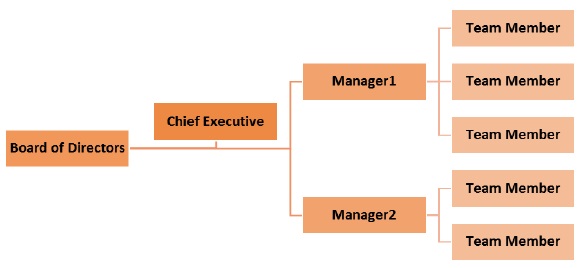
Here the span of control of the Chief Executive is two, that of manager 1 is three, and for manager2, it is two.
The following points are worth notable while discussing about span of control −
A number of direct, group and cross relationship exists between a manager and the subordinates of an organization.
A manager supervising four subordinates is required to deal with four direct relationships and a three times more cross relationship and even more number of group relationships.
Although a perfect ratio of manager and subordinates is an ideal proposition, span of control is pivotal in understanding organizational design and the behaviors within the organization, such as the approaches used to interact with employees and the effectiveness of communication between each level.
Span of control is indicative of the size of the organizational chart of an organization. A few subordinates reporting to manager results in a taller organizational chart. On the other hand, a higher number of reports to the manager results in a flatter or wider chart.
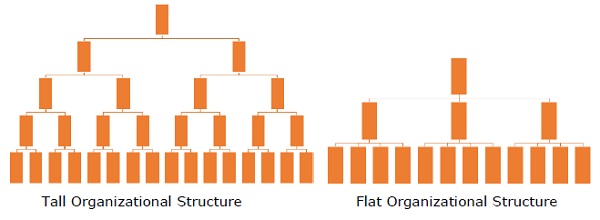
Factors Influencing Appropriate Span of Control
There are certain factors that influence the span of control in an organization. They are as discussed below −
Organizational Size
Factors like financial resources and spread of the company play a decisive role in span of control. In large organizations, usually, there is a narrow span of control whereas, smaller organizations often have wider span of control.
Organizations stuck in financial crisis tend to increase the span of control; on the other hand, organizations with sound financial health reduce the span of control and inflate its management.
Nature of Work
Matters related to day to day functioning of an organization that require limited skill or only occasional managerial decisions and coaching can give space to wider span of control. On the contrary, matters requiring frequent decisions, or are inherently complicated and loosely defined need to have a narrower span of control.
Skill Level of Workforce
The expertise and experience of the employees to be supervised also affects the size of span of control. A good number of experts and experienced employees can be effectively controlled and supervised by a manager. It results in a wider span of control. On the other hand, new employees need more and frequent attention of the manager. Hence, it leads to a narrow span of control.
Organizational Culture
Prevailing organizational culture affects the size of span of control. An organization having a flexible workplace culture has a wider span of control because employees are given more autonomy and flexibility in carrying out the assigned work.
Geographical Size
In case, the organization has a number of branches spread over a large geographical area, for instance, a state or province, a country or a number of countries, it tends to have narrow span of control. Managers find it difficult to supervise more number of employees who are physically located at a good distance from them.
Capability of the Manager
A manager with experience and expertise in understandings of the tasks will be able to supervise more workers. However, the nature of work assigned to the manager or an executive affects the size of the span of control. If the manager needs to have regular interactions with the employees, write job descriptions and complete appraisal and development plans and deal with day-to-day administrative tasks related to the team, then the span of control should be drastically cut down.
Advantages of Span of Control
In this age of increasing automation in businesses, the fast growing electronic media revolution and the growing number of specialists have changed the whole idea of span of control. It is necessary to choose an appropriate span of control based on the factors discussed above. A well designed span of control offers multiple advantages to the organization as given below −
Increased Managerial Efficiency
Increased Morale among Staff
Better Personal Contact
Better Health and Safety
Centralization and Decentralization
Centralization refers to concentration of authority at the top level of the organizational hierarchy. Decentralization is the dispersal of authority among the lower levels of such hierarchy.
The issue of centralization and decentralization revolves around the location of decision-making authority in an organization.

Merits of Centralization
Centralization offers the following merits to an organization −
It offers maximum control over the entire organization and brings uniformity in its functioning.
It ensures that all the tasks are performed in the same manner and in accordance with the same general policies and principles.
It checks abuses in matters like employment and handling of personnel, purchase and usage of resources.
It makes the top management more effective and powerful, which is helpful in crisis management and provides effective leadership in moving the organization ahead.
It enables maximum utilization of human and material resources in the organization and thus develops a corporate personality.
The leadership provided by a mature top management in a highly centralized organization tends to be of high quality which ultimately brings benefits to the organization.
Demerits of Centralization
Centralization offers the following demerits to an organization −
It leads to the abuse of power, as power is concentrated in a single or few hands.
Due to the centralization of authority, there is a heavy load of managerial work on the top management. It leads to delay in securing actions as no authority is given to lower and middle levels.
Centralized organization often has a weak communication system. Top management tends to remain ignorant of organizational needs and pressures for timely and effective decisions and actions.
A centralized decision-making arrangement inhibits organizational growth as the top management either fails to perceive real opportunities for growth or may not have the confidence to manage growth.
Decentralization
Decentralization is the dispersal of authority for decision making at various levels of organizational operations. However, decentralization is not the same thing as delegation.
Decentralization and Delegation
The following table gives a comparison of decentralization and delegation in detail −
| Decentralization | Delegation |
|---|---|
| It is the delegation and dispersal of authority for decision making in various facets of organizational operations. | It is the conferment of authority upon the subordinates for carrying out certain specified tasks which are formally transferred or assigned to them. |
| Semi-autonomous units exist, which are subject to overall control by central management. | Superior and subordinate relationship is built through the process of delegation. |
| It involves spreading out the total decision making power. | It is task-specific. |
| The top management exercises control in general and delegates much of its authority for control to the executive of the decision making center. | The control and ultimate authority rests entirely with the delegator. |
| Lower level decision making units and their managers are granted semi-autonomous status. | The degree of autonomy enjoyed by the delegatees is limited. |
| Decentralization is optional in the sense that top management may or may not disperse authority. | Delegation is essential for management as subordinates must be given sufficient authority to perform their duties. |
| No decentralization takes place without delegation. | Delegation of authority is possible without decentralization. |
Merits of Decentralization
Decentralization offers the following merits to an organization −
Increases Operational Efficiency
It increases the operational efficiency of the organization by reducing delays, checking red-tapism and encouraging faster actions. The performance of employees improves considerably as they learn different skills by performing different delegated tasks.
Diversifies Activities
It reduces the workload of the head office and thus enables the top executives to concentrate on vital issues like policy formation, examining major problems and so on.
Grooms Employees
It develops resourcefulness and self-respect among the subordinates by enabling them to take decisions with a sense of responsibility. It provides a training ground for the would-be managers.
Improves Management Responsiveness
It makes management more responsive as the field offices act with the knowledge of local conditions and requirements.
Enhances Control and Supervision
Decentralization leads to effective control and supervision. Since concerned managers enjoy full authority to make changes in work assignment, to take disciplinary actions, to change production schedules or to recommend promotions, they are in a position to supervise their subordinates activities.
Boosts Decision-Making
A decentralized organization is able to make decisions faster than one with a centralized structure. A manager often can make a decision without having to wait for it to go up a chain of command, allowing the organization to react quickly to situations where fast action can mean the difference between gaining or losing a customer.
Disadvantages of Decentralization
Decentralization offers the following demerits to an organization −
Requires the services of talented people which may not be available all the time.
Decentralization makes coordination difficult among various units.
Increases expenses by many times.
Leads to a lack of uniformity between the headquarters and the field offices.
Leads to conflicts between the field managers and the headquarters over various aspects like finances and decisions taken.
Authority and Responsibility
In this section, you will learn in detail about authority and responsibility and the interrelation between them.
Authority
Authority means the rights inherent in a managerial position to give orders and expect orders to be obeyed. It is always viewed as the glue that held the organization together. Each management position has specific inherent rights that incumbents acquire from the positions rank.
Authority is vital to the functioning of any organization. Authority refers to the formal power or right, attached to a particular job or designation, to give orders, enforce rules, and make decisions and expect compliance.
Authority is at the base of all formal organizations. The organizational structure is based on location of authority at various levels. It is a binding force in an organizational integration.
The notion of authority is one of the pivotal concepts in an organizational study. Some of the important definitions of authority are as follows −
According to Henri Fayol, "Authority is the right to give orders and the power to extract obedience."
According to Mooney and Reilly, "Authority is the principle at the root of an organization and is so important that it is impossible to conceive an organization at all unless some person or persons are in a position to require action of others."
According to Chester Barnard, Authority is the character of a communication (order) in a formal organization by virtue of which it is accepted by a contributor to or a member of the organization as governing the action of the contributes.
Responsibility
Responsibility refers to the obligation of an individual to perform the duty assigned. Responsibility specifies the duty assigned to a position. The person holding the position has to perform the duty assigned. According to Koontz and ODonnell, Responsibility may be defined as the obligation of a subordinate, to whom duty has been assigned to perform the duty.
Characteristics of Responsibility
The following are some of the characteristics of responsibility −
The essence of responsibility is the obligation of a subordinate to perform the duty assigned.
It always arises from the superior-subordinate relationship.
Responsibility moves upwards, whereas authority flows downwards. By virtue of the superior position, a manager has the authority to get the required work done from the subordinates.
Responsibility may be a continuing obligation or confined to the performance of a single function.
Responsibility is absolute and cannot be delegated.
It is hard to conceive responsibility without any authority.
Responsibility is always upward in which a subordinate is responsible to the superior.
Accountability is derived from responsibility and the two go hand in hand. A person shouldering a responsibility is accountable for the performance.
Relationship between Authority and Responsibility
Authority and Responsibility are the basic functions considered at the primary stage in a management system. They are like two sides of a coin. They are inter-related and commensurate with each other. The following table shows you the comparison of these two −
| Authority | Responsibility |
|---|---|
| It is the right or power of a manager to command his subordinates. | It is the obligation of a subordinate to complete an assigned work. |
| It flows downward. | It flows upward. |
| It can be delegated. | It is indivisible and cannot be delegated. |
| It is the right to give the command, order or an instruction and obtain obedience. | It is the outcome of authority. |
Responsibility is defined as a corollary of authority. It is a natural consequence and an essential counterpart of authority. Responsibility is derived from functions or tasks, authority is derived from responsibility, and accountability is derived from authority and responsibility.
Understanding Accountability
Accountability arises from the responsibility given. In other words, accountability is the obligation to carry out responsibility and exercise authority in terms of performance standards established by the superior. It is the liability for the proper discharge of duties.
Accountability comes into existence the moment responsibility is accepted by a person. Once a subordinate is assigned a duty and given the necessary authority to complete it, they become answerable for the outcome.
Accountability is the answerability for carrying out a duty assigned to a person. The performer has the obligation to give a satisfactory account of their performance and the manner in which they exercise the authority conferred.
The chief aim of accountability is to check wrong and arbitrary decisions or actions and increase efficiency and effectiveness of the functioning of an organization.
Subordinates are responsible for the completion of the task assigned to them and are accountable to their superior for the satisfactory performance of the task.
Summary
In this chapter, you have learnt the following concepts about principles of delegation −
Principles of delegation are a set of guidelines for the delegator to ensure an effective delegation.
Span of control is the number of subordinates that report to a single manager. A well designed span of control offers multiple advantages to the organization.
Centralization and decentralization revolves around the location of decision-making authority in an organization.
Decentralization and delegation are two different concepts and must be chosen accordingly.
Responsibility is a corollary of authority and accountability is derived from authority and responsibility.
Effective Delegation - Steps Involved
Delegation is one of the most prolific management skills. The previous chapters discussed the meaning, scope and the need for delegation in modern businesses. In this chapter, we shall learn about effective delegation, the steps involved in it and its benefits.
Delegator and Delegatee
Delegation is a two way process and if it is handled competently it becomes a win-win situation for managers, employees and the company as a whole.
In the process of delegation −
The person(s) who delegates the task and the authority to complete the task is called delegator.
The person(s) to whom the task is assigned and who is authorized to complete the task is termed as delegatee.
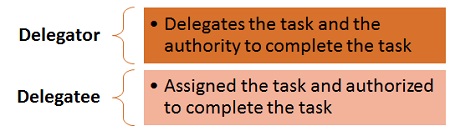
Delegator is the source and the delegatee is the performer. Rightful delegation is pivotal in the process of delegation. Delegator has an uphill task of assigning tasks to the subordinates in such a manner that the real intent of execution of the assignment is achieved.
Managers are required to create time while assigning tasks and duties so as not to give an impression to the employees that delegation is ordinarily a management technique for freeing the superiors time. Flawless explanation is essential when detailing the duty or task that is being delegated creating conducive atmosphere for the employees to ask for any clarification and later continuous follow up is required to share positive feedback.
An individuals aptitude for delegating is as important as their capacity for managing tasks and responsibilities alone.
However, the art of delegation is not as easy as it seems. Managers who delegate certain tasks to employees need to know what is to be delegated and to whom it is to be delegated. They should also have an idea about the skills and expertise of the employees to whom the task is delegated.
What is Effective Delegation?
When the process of delegation completes with a positive outcome that has been expected of it, it is termed as effective delegation. Effective delegation includes all the steps starting from conceiving the idea of delegating a particular task or responsibility till the final outcome. Effective delegation also implies that a manager assigns the power and authority to staff, and that staff are willing and able to take up the responsibility.
Delegation becomes effective when it is carried out with proper planning, effective communication, along with a close understanding and coordination between the delegator and the delegatee.
The fundamental objective of effective delegation is to save time, build team capacity and allow the delegator to concentrate on other important tasks. It helps in the organizational growth. As said earlier, managing responsibilities is as significant as delegating and both require expertise and knowledge on the part of a manager or an executive.
Effective delegation is quite helpful for succession planning (management and leadership succession), personal development and seeking and encouraging promotion. It enables the employees to gain experience to take on higher responsibilities.
Steps to Effective Delegation
A delegation becomes effective when it is carried out though the following steps −
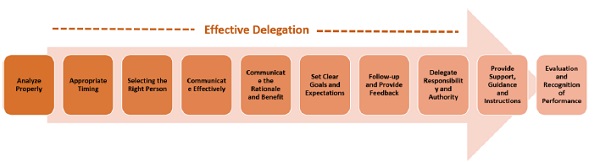
Analyze Properly
Before delegating any projects or responsibilities, a good leader or manager must think and determine how to allocate responsibilities. In case the projects or the responsibilities are highly demanding, the leader or the manager may consider spreading the work among a group of employees and it is still advisable to designate a group leader to achieve a desired result.
For individual tasks, an appropriate person should be chosen and the manager should judge the employee(s) skill and efficiency personality-wise. This step is crucial in delegating responsibilities as it proves that the leader takes time to understand the staff well enough to determine which workers would serve the project and company at their best.
No Procrastination
The manager should make an effort to delegate the task early to avoid unnecessary pressure. This enables the delegatee to plan the task effectively.
Select the Right Person
The delegator should ensure that the delegatee has the time to take up the responsibility. There is a need to assess the skills and capabilities of the staff and to assign the task to the most appropriate person. It is also necessary to make sure that the person has the requisite training and resources to succeed.
Communicate Effectively
The ability of a manager to express the role-to-be-delegated and all that it entails is one of the finest tests of delegation. If the leader or the manager fails to do so, it can result in a misunderstanding that may lead to improperly completed jobs that jeopardize professional relationships and have a negative financial impact as well.
During the progress of the tasks, management should maintain open communication and hold meetings to ensure that the delegated worker is staying on schedule and meeting important milestones.
Communicate the Rationale and Benefit
The delegator should identify the reason for the task and how it will contribute to the goals of the company or team. The delegatee has the right to know how the delegated task helps in their job, and whether it will help develop a specific skill that is need to get promoted. A routine task to the manager may be a new challenging work to the subordinate.
Set Clear Goals and Expectations
The delegator should be clear and specific on what, why, when, who and where of the task to be performed. The how to about the task may be left to subordinates. The delegator should be prepared to accept the input from subordinates, and confirm and verify the goals and expectations.
Follow-up and Provide Feedback
The selection of team or employees and assigning task to them does not mean that the process of delegation is complete. The delegator should follow-up along with the work being completed to ensure its being done properly as per the specifications.
The delegators may not want to micromanage the work that is delegated, but should monitor the work being carried out and provide timely and appropriate feedback for improvements. They should remain available to all parties to address and resolve any potential questions or problems. It is appropriate to keep communication lines open, regular meetings on large tasks can provide this ongoing feedback.
Delegate Responsibility and Authority
Responsibility must commensurate with appropriate and adequate authority. It is physically not possible to carry out responsibilities without having relevant authority. The delegator should ensure that the subordinate is given the relevant responsibility and authority to complete the task, and let the subordinate complete the task in the manner they choose, as long as the results are as specified. The delegator should also be willing to accept ideas from the subordinate on task fulfillment.
Provide Support, Guidance and Instructions
The delegatees should be provided with the resources, technology and time to complete the task. It is the duty of the delegator to see that all these are ensured to the delegatees.
Evaluation and Recognition of Performance
The delegators should always recognize appreciable performance of the delegatees. They should evaluate the results, and any insufficient or poor performance should be analyzed in order to establish the causes for improvement.
Benefits of Effective Delegation
Delegation being the key to growth and progress of an organization is as such unavoidable. Effective delegation has tremendous benefits for the overall productivity and growth of the organization. Some of the important benefits that effective delegation offers to the organization and to the employees are discussed in this section −
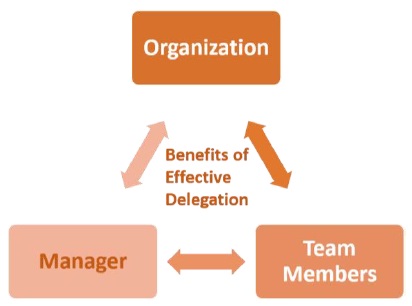
Benefits for the Organization
Effective delegation helps the organization to increase and improve its reputation as a preferred employer. Besides, it also offers the following benefits to the organization −
It helps increase the overall productivity.
It ensures continuity through smoother succession planning.
It keeps the vision of the organization on track.
The whole business or organization becomes smoother in functioning.
Enhances the quality of work-life environment. People feel warm and comfortable in the organization and this impacts other areas of their lives.
Human resources are effectively utilized as the level of work being done is at an appropriate level for them.
Benefits for the Team Members
Effective delegation benefits the team members in many ways as given below −
Enhances the skills of team members.
Promotes communication skills and opens up channels of communication.
Increases loyalty as it promotes career growth opportunities.
Decreases delays for those waiting on the manager to make decisions or take actions.
Increases and improves motivation and job satisfaction.
Creates a team partnership in achieving results and thus improves team work. Team-building and relationships are encouraged and strengthened.
Creates a learning community, that is learning through doing.
Recognizes innovation in individuals.
Benefits for the Manager
By effective delegation, the delegator or the manager benefits in many ways as given below −
Increases available time for more strategic thinking and development opportunities for the manager, the team and the organization.
Improves the time management which allows the delegator to focus on more important issues. It also helps in realizing the objective within the stipulated time.
Creates a basis for fair assessment of the delegatees that is based on their ability to achieve tasks.
Understands the capacity of staff leading to suitable interventions for improvement being identified.
Helps the delegator become more effective in evaluating the team.
Improves managers reputation and trustworthiness
Helps with providing feedback in task performance.
Enhances the career progress of the manager.
Thus, delegation in modern businesses is hard to ignore. It involves not only relieving the delegator of the workload, but is also an opportunity for the employees to grown in a remarkable way. Delegation is also essential for being a productive leader and a productive organization. It provides the much-needed opportunity to managers to free them to think, plan and build. As Bill Gates quoted, As we look ahead into the next century, leaders will be those who empower others. A good delegation is about delegation and great leadership is about building by delegating.
Summary
In this chapter, you have learnt the following concepts about steps involved in an effective delegation −
Delegation is a two-way process, that involves two main roles- delegator and delegatee.
When the process of delegation completes with a positive outcome that has been expected of it, it is termed as effective delegation.
A delegator should delegate a task through a series of necessary steps, to make it effective.
Effective delegation benefits the delegator, the delegatee and the organization as a whole.
Effective Delegation - Role of Communication
Communication is the lifeline of any organization. An effective communication system, both vertical and horizontal, makes the organization move forward. As Herbert Simon, noted American economist and sociologist said, Without communication there can be no organization, for there is no possibility then of the group influencing the behavior of the individual.
Communication is pivotal to delegation. The delegated tasks are effectively communicated to the subordinates who, then, perform the given tasks on the line of prescribed norms and objectives. If the delegated tasks are not properly communicated, they the result may be a failure. The real purpose of delegation is to ensure that the delegated task(s) is effectively completed.
Communication is pivotal at various stages of delegation such as monitoring the delegated tasks, providing feedback to team members, reviewing the delegation process and providing good task briefs. This chapter discusses all these aspects of delegation in brief.
Monitor Delegated Tasks
An important characteristic of delegation is that the ultimate authority for effective completion of the delegated task rests with the delegator. It makes virtually inevitable on the part of the manager to oversee the execution of the delegated tasks.
Delegating tasks and monitoring their progress is a sign of an effective leader. Delegation is not micromanaging wherein the manager would have to check on the progress every once in a while.
Delegation being a core management leadership concept does not end with the assignment of tasks since the delegator remains accountable for its outcome, even if, the delegated tasks are performed by some other person.
There are many advantages of monitoring the delegated tasks. They are discussed in this section as follows −
Knowledge about the Progress of the Delegated Task(s)
Monitoring is very significant as at this stage the delegator keeps abreast of the progress of the delegated tasks as desired. The real benefits of delegation are not going to be realized unless −
The performance of the delegatee is monitored
Feedback is provided to the delegatee
After delegating a task, it becomes a duty of the delegator to ensure that the delegatees performance is monitored to ascertain the successful completion of the task.
Confirmation about Time, Standard and Cost
When the delegator monitors the delegatees performance, it should be confirmed that the task is completed on time, to an acceptable standard and within the available cost. The performance of delegatees should be recorded for use during the delegatee's performance appraisal.
Provide Feedback To The Team Members
Monitoring the delegated tasks enables the delegator to provide feedback to the delegatee. It helps to ensure that the delegatee learns from their actions and become satisfied with their progress. Successful completion of delegated tasks proves that the leadership skills of a team leader are improved and the team communication is enhanced.
After delegating tasks, the manager happens to read regular reports and ensure that the deadline is met. The manager needs to have willingness to be objective when facts are reported and to support the delegatee.
The delegator is required to show openness during the regular review sessions by paying an honest listening to the delegatees and by identifying the underperformers. Such openness can be established when the delegator exchanges a brief by asking for the delegatees consent to its contents and offering them this initial opportunity to feed back to the delegator any concerns or issues they can see that may cause problems as the task progresses.
By showing the willingness to receive feedback, the delegator signals that they want an open and sincere exchange to be an integral part of the delegated process.
There are various tools used for monitoring during the delegation process. They are shown in the following diagram −
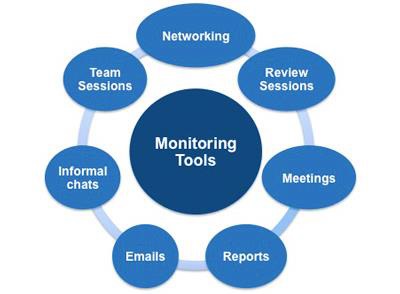
Feedback is an essential part of the delegation and this must be a two-way process, where questioning and listening are key aspects to ensure the communication is open and supportive. However, the delegator should be cognizant of over-reporting by the subordinates. The best way to avoid over-reporting is to implement objective measures of progress, rather than asking for a subjective estimate.
Reviewing the Delegation Process
Delegation is neither abdication of responsibility nor micromanaging. Effective delegation requires a balancing act between the two. Hence, there is a need for reviewing and monitoring the progress of the delegated task.
Why Reviewing is Important?
Reviewing the tasks delegated to subordinates is important as it helps a delegator to −
Ensure that the delegatee has all resources needed to perform the task.
Identify whether the delegatee can learn how the task is being executed and identify potential problems, if any.
Confirm that the task will be completed successfully by providing additional support and showing appreciation.
Handle any issues faced by the team, that are beyond their control and level of authority.
Boost confidence and inspire team members to work more effectively.
Reviewing can be conducted by using open-ended questions to the delegatees in order to get detailed information the delegator needs. During this time the delegator inquires if the delegatees face any problems and if they need additional resources to carry on the delegated work.
However, the delegator will have to remember the following points while reviewing the delegated tasks −
It is not a good practice to interferes into the execution of the work every now and then.
Allow the delegatees to decide the best way to carry out the task. This makes delegation effective.
Focus on the outcome, not the method. Give enough freedom to the delegatee, as practicable, to decide how to execute the tasks delegated to them.
Do Not Micromanage
The lexical meaning of micromanage is to manage with great control or attention to detail. In business management, micromanagement refers to a style of managing affairs whereby a manager or an executive closely observes or controls the work of subordinates or employees. Micromanagement has a negative undertone.
In delegation or during the execution of a delegated task, it is of utmost importance to see that the delegatees are provided with an appropriate authority and requisite freedom.
Delegation is about setting the right outcomes and giving autonomy to achieve them. Micromanaging is the controlling of minute details of the work in progress. It hampers the effectiveness of the work being carried out.
Micromanaging shows lack of trust, lowers morale and de-motivates people. Micromanagers are not true leaders; rather they are parallel to effective leadership.
Although micromanaging is necessary at certain stages of organizational management like during occurrence of crises and managing unskilled employees, it is not suited in delegation process. Recognizing when to delegate is one of the primary skills of managersand the greatest shortcoming of micromanagers. Delegation is the first step towards giving the employees the opportunity to excel professionally ad help business flourish.
The attributes of micromanagement are demonstrating the employees how to perform a task correctly every now and then, being irritated at the decision taken by the subordinates without consulting the manager etc. These attributes have damaging effect on overall productivity of the organization.
To summarize, micromanagement impacts in the following ways −
Inhibits employees development and affects their efficiency.
Creates fear factor among the employees because of the unnecessary interference by the manager or the executive.
Reveals managers insecurities and lack of abilities to create management structure and systems for the organization.
Creates dissatisfaction and disengagement in work among the employees.
Results in failing to delegate tasks properly and responsibly which often results in high employee turnover, longer (and less efficient) workdays and lower work quality.
Limits career growth of both the managers and the employees; talented employees feel underappreciated or unrecognized and often tend to leave the organization.
Demotivates employees as there is no delegation of responsibility coupled with authority.
Leads to the deterioration of organizational productivity and capacity to progress.
Presents managers in a poor light because productivity of their team is not encouraging.
Managers with effective leadership qualities do not micromanage, rather they delegate the routine task to the subordinates equipped to handle on their own, to make time to focus on big issues useful for the growth and progress of the organization. It is no surprise that delegation is cited as one of the most challenging aspects to being a successful manager.
Provide Good Task Briefs
It is the responsibility of the manager to provide the team members with all the information they need to understand exactly what is expected of them and to perform their tasks successfully. The brief provided by the delegator or the manager should provide a clear understanding of the important characteristics of the task.
Managers should ensure that the delegatee has sufficient time within the workload to brief and explain exactly what is required to be done. They must also ensure that no unpleasant or inappropriate task(s) is delegated to the delegatees.
The delegatee must understand clearly what activities they must undertake and what results they must show. This will also help the subordinates to know by what standards their performance will be judged.
Limits of authority should be clarified to the subordinates so as to enable them to assume such authority that is required to perform the delegated tasks.
All these happen when the delegator provides good task briefs to the delegatees.
Delegators should clearly define in their brief what they expect from the job they are delegating and whether this meets the prescribed criteria. It should also include how the successes of both the delegator and the delegatee are measured. With this knowledge, the delegatee can clearly understand what the goal is, as well as what the delegator expects from them.
The delegatees should be allowed to ask questions and then the delegator needs to reframe or rephrase the task description in a way that gives them its ownership and a confidence that they fully understand it.

Thus, providing an intelligible brief about the delegated task is a necessary precondition for realizing the objective of delegation.
Summary
In this chapter, you have learnt the following concepts about role of communication in delegation −
Communication is pivotal to obtain desired results of delegation.
Monitoring the progress of tasks helps in evaluating the delegatee and the cost and time involved in completing the task.
Providing feedback as a part of communication helps delegatees to learn from their actions and gives them a chance to better their performance.
Micromanaging is not suggested, as it hampers the positive outcome of delegation.
The delegator should give good task briefs to the team to make tasks clear.
Effective Delegation - Barriers
Effective delegation can have extensive benefits for the delegator, the delegatee and the organization as a whole. No doubt, delegation is a skill that is not congenial to everyone. Some executives fear that employees will resist delegation. They are fraught with various practical and emotional barriers while delegating.
However, with the emerging need for delegation in modern business, managers, supervisors and the top executives need to overcome challenges that they come across while delegating.
While delegating, the delegator should keep in mind that the responsibility that is delegated should be SMART Specific, Measurable, Appropriate, Reachable, Time-bound.
Delegation is not as easy as it appears. Delegation is not a compulsion, rather it is a necessary choice that a manager opts for professional excellence, in particular and the larger benefits of the organization, in general.
Delegation is a critical skill. However, with proper planning, defined objectives and standards and seeking involvement of the subordinates, delegation can be handled effectively. In today's fast-paced competitive environment, work must be delegated to the lowest organizational level that has the competence to successfully perform it.
Tasks to Avoid while Delegating
Delegation is not easy to carry out if it is not properly planned. There are many tasks a manager or an executive needs to avoid while delegating. They are as discussed in this section.
Avoid delegating tasks that −
Are sensitive and personal in nature
Require a degree of risk and decision making that is unfair to the delegatee
Require the personal expertise of the delegator
Require personal leadership of the delegator
Have legal restrictions
Such inappropriate tasks may include −
Performance feedback
Disciplinary actions
Counseling, disciplining and other confidential personnel matters
Tasks assigned specifically and exclusively to the delegator
Tasks that are the responsibility of another team, department or division
Crisis situations where people are looking for the delegators leadership
New initiatives that require you setting the example and standard
Avoid delegating under the following circumstances −
To people who are already overloaded
To people who have other important, high-priority tasks requiring their attention
To people who lack time to complete the task successfully
To people who lack the skills to complete the task successfully
To people who have successfully completed similar tasks, if there are other candidates for delegation available
Without making sure that you and your employees understand what its successful outcome would look like
Without staying involved to monitor the progress
Reasons for Poor Delegation
One of the significant functions of a competent manager is not to do all the work by self, but to carefully deliver within the given limits of budget and timelines. Hence, the need for delegation arises.
A considerable number of managers fail to make successful delegations. It leads to poor delegation which limits their growth and those of the delegatees. This section discusses the factors that lead to poor delegation, that make delegation so challenging to embrace and that causes delegation to fail in realizing the objectives.
Reasons for Poor Delegation from Delegator Point of View
Poor delegation may occur from delegators or supervisors part due to any of the following reasons −
Indecisiveness of the Delegator
Many managers are very often confused as to what they should delegate. This is where they go wrong in the first place. It is always advised by management experts that except for assignments that are sensitive and absolutely confidential, or the ones which deal with long-term objectives of the organization, most of the tasks with due attentiveness can be effectively delegated.
Lack of Proper Knowledge about the Team Members
Managers are mostly averse to delegating tasks to their subordinates because they lack adequate knowledge about the skills and expertise of their team members. They are unaware about what their people are good at. They should intelligently reserve the tasks suitable to be delegated and hand them over to the appropriate individual at appropriate time.
Procrastination in Assigning Tasks
Another reason for poor delegation is the procrastinating mindset of managers in assigning tasks because they are not sure if their subordinates can deliver as effectively as they can.Delegation is, however, not losing control over any task or assignment; rather it means showing respect for the talents others can bring to the fore.
Scheming Delegated Tasks
Some managers have a tendency to scheme their way into delegating tasks. They make tasks sound simpler and without much work. By doing so, they undervalue the tasks and the persons who have to carry out them.
A better approach is to let the person comprehend the significance of a task, the responsibility it brings and the long-term consequences it comes with. Once they are clear about the task, the ownership comes on its own.
Lack of Clarity of Vision
The managers should have clarity of vision to bring the better out of their team members. Wise managers always share their visions before they share the tasks. It helps to energize and spur the delegatees to perform better because tasks devoid of vision are unexciting and burdensome.
Abdication of Control after Delegation
Managers should not abdicate control after delegating tasks. Abdication of control is equal to denying responsibility for the delegated task which is beyond the purview of delegation. It is of great importance to find the balance between allowing enough space for the people to use their abilities to the best effect and grow, and monitoring and supporting to ensure the work is complete as effectively as expected.
Reasons for Poor Delegation from Delegatees Point of View
Poor delegation may occur from delegatees or subordinates part , when they do not −
Understand the task.
Have the skills to complete the task.
Have the tools or resources needed.
Understand why the task needs to be done.
Know how to deal with an obstacle.
Think that the task is important
Want to complete the task.
Consequences of Poor Delegation
When delegation is carried out in a haphazard and an unplanned manner yielding no result it is termed as poor delegation. Poor delegation damages the business, creates frustration in the delegator, besides demotivating and confusing the delegatees. It has many negative consequences as discussed below −
Adversely affects the overall productivity and morale of the organization.
Fails to deliver the desired result.
Leads to loss of opportunities for all concerned in the process of delegation.
May develop differences within the team.
Both the delegator and the delegatee suffers the consequences of poor or ineffective delegation.
Chaos and inefficiencies frequent the work environment when there is poor delegation as it affects considerably the overall productivity.
Barriers to Effective Delegation
It is a well-acknowledged fact that effective delegation is essential in the functioning of a modern business organization.
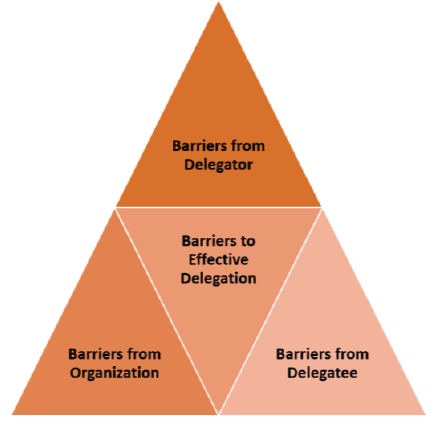
However, in practice, there are several factors that hinder effective delegation. These factors are discussed under the following three categories −
Barriers from the Delegator
Barriers from the Delegatee
Barriers from the Organization
Barriers from the Delegator
In fact, the biggest barriers to delegation come from the superior. The delegator or the superior are not in favor of delegating sufficient authority due the following reasons.
Lure for Authority
Some managers or executives are averse to delegate, because of their temptation for authority. They believe that delegation will lead to reduction of their influence in the organization. They want to retain the entire authority in order to make their presence felt and desire that the subordinates should often come for approval.
Fear of Losing Control
Managers new to delegation feel that while delegating they are abdicating their control of the tasks. They may not be willing to allow a team member to perform a task for which they are ultimately responsible. However, regular and effective communication with those to whom tasks are delegated can help mitigate this feeling and give them some sense of control.
Lack of Willingness
Some managers feel that none can do the job better then they themselves. They think that if they delegate, work will not be completed as it ought to be completed. These managers consider themselves inevitable and dont want to give other peoples ideas a chance. The dominating attitude I can do it better myself hinders delegation to a great extent.
Fear of Being Exposed
Some incompetent manager resists delegation because they think that they will delegate themselves out their job. They are always afraid of their subordinates outshining and overcoming them and proving more efficient than them. They are therefore very careful about delegating, because they fear that their incompetency may be exposed.
Scarcity in Time
A perceived lack of time is the most visible reason for failure to delegate. Delegation takes time to choose people, prepare them and get them started. When the manager is burdened with workload, they may not have the time to delegate.
Lack of Confidence in Team Members
Some leaders resist delegation because they do not have faith in their team members. It is the doubt of the manager in the ability of subordinates that hinders effective delegation. By not seeing the potential of the team members, the manager fails to contribute substantially towards achieving efficiency in the organization.
They should learn to see the potentials in their team and make sure that they have adequately prepared their team members for the task
Barriers from Subordinates
Subordinates or delegatees at times show disinclination towards accepting delegated tasks and do not like to shoulder responsibility for many reasons. Some important reasons for this aversion of the subordinates are as follows −
Lack of knowledge
The subordinates may lack knowledge about the benefits in delegation. The managers can help them realize the benefits. When they realize them, they begin to succeed and they will be more willing to take on additional responsibilities that the manager delegates.
Lack of Time
Employees in a team often feel that they are already putting their best available time and effort for the organization. So, they dont like to shoulder extra responsibility for the delegated task. Hence, managers should ensure a fair division of tasks between them and the team members. When everyone feels overworked, the manager needs to explain that in order to get the job done, all members need to put forth the extra effort.
Unwillingness to Shoulder Responsibility
Very often, the subordinates are not willing to shoulder responsibility for the delegated task(s) and find it easier to consult the boss than to decide by themselves as to how to deals with a particular issue.
Fear of Criticism
The subordinates sometimes refuse to accept authority because of their fear of criticism by their superior in case they commit mistakes in taking decisions and executing assignments.
Lack of Self-confidence
The subordinates may lack self-confidence and initiative and this may also be the reason for their unwillingness to accept authority.
Fear of Failure
Sometimes team members are afraid that they will fail to accomplish the delegated tasks. This may be due to the lack of adequate support and encouragement from the delegator.
Absence of Incentives
The team members or the subordinates avoid accepting any authority because there are no positive personal gains through incentives to them for assuming extra responsibility and authority.
Pressure of work
An excessive workload is also an obstacle towards acceptance of extra responsibility by the subordinates.
Additionally, prevailing situations may hinder delegation. This may be due to lack of adequate resources and unclear hierarchy. Lack of resources is a big concern for most organizations. In some organizations it is difficult to comprehend the lines of authority and responsibility. This too hinders effective delegation.
Barriers from Organization
Organizations may pose the following barriers for a successful delegation −
Lack of well-established organizational methods, procedures and rules.
Unstable and non-repetitive character of work.
Lack of effective means of internal communication and coordination.
Centralization requirements of special program.
Smaller size and narrower geographic coverage of the organization.
Lack of well-defined positions in terms of responsibility and authority.
Incompetency and low caliber of lower level personnel.
Lack of few precedents of effective delegated assignments.
Corporate, legal and situational restrictions.
Lack of effective means to work control.
Dealing with Barriers of Effective Delegation
Considering the significance of effective delegation, it is essential to prepare a blueprint for effectively dealing with the barriers of effective delegation. The following are some important measures towards securing a barrier-free delegation −
Compatibility
It is necessary that there is a match between the aptitude and abilities of the subordinates and the task entrusted to them. The principle of compatibility of jobs to the individual should be followed.
Defined Assignment
The second most important way to deal with barriers to effective delegation is to have a well-defined and comprehensive assignment. It will bring in the desired result.
Time Management
A perceived lack of time is the most visible reason for failing to delegate. To overcome the time problem, it is necessary to accept the fact that the time required to delegate effectively is an investment on which returns are productive, though not immediate.
Knowledge and Planning of Work
The delegating managers should know the nature of tasks and functions which they themselves should handle and which cannot be delegated. Delegation should be properly planned and delegating without knowing the nature of work is often hazardous.
Authority Proportionate to Responsibility
The delegator should see that authority is assigned proportionate to the tasks. Authority and responsibility should be coterminous and coequal.
Positive Incentives
The delegating manager should make sure that the subordinates to whom the task is delegated are given positive incentives for accepting responsibility. It will spur them to carry out the delegated tasks as effectively as desired.
Amiable Work Environment
A work environment free from fear and frustration is necessary for making delegation effective. Unless the employees find the work environment and work culture conducive, they cannot be motivated to shoulder extra responsibilities.
Proper Training and Skill Development
Subordinates should be provided with adequate training for proper use of delegated authority. Skills pertaining to the delegated task(s), if necessary, should be developed among the delegatees in order to enable them to execute the delegated task effectively.
Proper Control Mechanism
There should be proper control techniques to ensure that authority is properly used by subordinates.
Free and Open Communication System
The communication system should be kept free and open, and systematic reporting system should be maintained. It enables the subordinates to get the help of the superior in discharging their duties. Sound communication enables the delegator to be in regular touch with their subordinates.
Needful Resources
The delegator should ensure adequate and needful resources to the delegatees to enable them to carrying out the delegated tasks effectively.
Performance Appraisal System
Delegation should be followed by a performance appraisal system. It will enable the persons concerned to know what went wrong if the delegation failed and if there are any improvement needed in the process of delegation.
Summary
In this chapter, you have learnt the following concepts about barriers to effective delegation −
The delegator should carefully delegate tasks considering many factors and circumstances.
Poor delegation may be due to many reasons and delegator need to identify the appropriate cause and act accordingly to avoid its consequences.
Barriers to poor delegation may arise from any factor: delegator, delegatee or organization.
The delegator should know how to deal with barriers and design a blueprint to handle them effectively.
