
- Effective Delegation - Home
- Effective Delegation - Introduction
- Effective Delegation - Principles
- Effective Delegation - Steps Involved
- Role of Communication
- Effective Delegation - Barriers
- Effective Delegation - Quick Guide
- Effective Delegation - Resources
- Effective Delegation - Discussion
Effective Delegation - Role of Communication
Communication is the lifeline of any organization. An effective communication system, both vertical and horizontal, makes the organization move forward. As Herbert Simon, noted American economist and sociologist said, Without communication there can be no organization, for there is no possibility then of the group influencing the behavior of the individual.
Communication is pivotal to delegation. The delegated tasks are effectively communicated to the subordinates who, then, perform the given tasks on the line of prescribed norms and objectives. If the delegated tasks are not properly communicated, they the result may be a failure. The real purpose of delegation is to ensure that the delegated task(s) is effectively completed.
Communication is pivotal at various stages of delegation such as monitoring the delegated tasks, providing feedback to team members, reviewing the delegation process and providing good task briefs. This chapter discusses all these aspects of delegation in brief.
Monitor Delegated Tasks
An important characteristic of delegation is that the ultimate authority for effective completion of the delegated task rests with the delegator. It makes virtually inevitable on the part of the manager to oversee the execution of the delegated tasks.
Delegating tasks and monitoring their progress is a sign of an effective leader. Delegation is not micromanaging wherein the manager would have to check on the progress every once in a while.
Delegation being a core management leadership concept does not end with the assignment of tasks since the delegator remains accountable for its outcome, even if, the delegated tasks are performed by some other person.
There are many advantages of monitoring the delegated tasks. They are discussed in this section as follows −
Knowledge about the Progress of the Delegated Task(s)
Monitoring is very significant as at this stage the delegator keeps abreast of the progress of the delegated tasks as desired. The real benefits of delegation are not going to be realized unless −
The performance of the delegatee is monitored
Feedback is provided to the delegatee
After delegating a task, it becomes a duty of the delegator to ensure that the delegatees performance is monitored to ascertain the successful completion of the task.
Confirmation about Time, Standard and Cost
When the delegator monitors the delegatees performance, it should be confirmed that the task is completed on time, to an acceptable standard and within the available cost. The performance of delegatees should be recorded for use during the delegatee's performance appraisal.
Provide Feedback To The Team Members
Monitoring the delegated tasks enables the delegator to provide feedback to the delegatee. It helps to ensure that the delegatee learns from their actions and become satisfied with their progress. Successful completion of delegated tasks proves that the leadership skills of a team leader are improved and the team communication is enhanced.
After delegating tasks, the manager happens to read regular reports and ensure that the deadline is met. The manager needs to have willingness to be objective when facts are reported and to support the delegatee.
The delegator is required to show openness during the regular review sessions by paying an honest listening to the delegatees and by identifying the underperformers. Such openness can be established when the delegator exchanges a brief by asking for the delegatees consent to its contents and offering them this initial opportunity to feed back to the delegator any concerns or issues they can see that may cause problems as the task progresses.
By showing the willingness to receive feedback, the delegator signals that they want an open and sincere exchange to be an integral part of the delegated process.
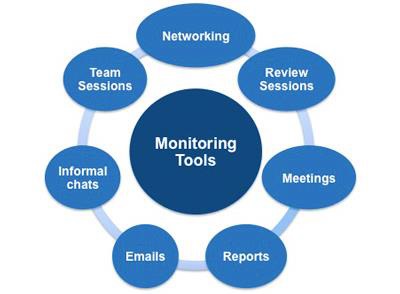
There are various tools used for monitoring during the delegation process. They are shown in the following diagram −
Feedback is an essential part of the delegation and this must be a two-way process, where questioning and listening are key aspects to ensure the communication is open and supportive. However, the delegator should be cognizant of over-reporting by the subordinates. The best way to avoid over-reporting is to implement objective measures of progress, rather than asking for a subjective estimate.
Reviewing the Delegation Process
Delegation is neither abdication of responsibility nor micromanaging. Effective delegation requires a balancing act between the two. Hence, there is a need for reviewing and monitoring the progress of the delegated task.
Why Reviewing is Important?
Reviewing the tasks delegated to subordinates is important as it helps a delegator to −
Ensure that the delegatee has all resources needed to perform the task.
Identify whether the delegatee can learn how the task is being executed and identify potential problems, if any.
Confirm that the task will be completed successfully by providing additional support and showing appreciation.
Handle any issues faced by the team, that are beyond their control and level of authority.
Boost confidence and inspire team members to work more effectively.
Reviewing can be conducted by using open-ended questions to the delegatees in order to get detailed information the delegator needs. During this time the delegator inquires if the delegatees face any problems and if they need additional resources to carry on the delegated work.
However, the delegator will have to remember the following points while reviewing the delegated tasks −
It is not a good practice to interferes into the execution of the work every now and then.
Allow the delegatees to decide the best way to carry out the task. This makes delegation effective.
Focus on the outcome, not the method. Give enough freedom to the delegatee, as practicable, to decide how to execute the tasks delegated to them.
Do Not Micromanage
The lexical meaning of micromanage is to manage with great control or attention to detail. In business management, micromanagement refers to a style of managing affairs whereby a manager or an executive closely observes or controls the work of subordinates or employees. Micromanagement has a negative undertone.
In delegation or during the execution of a delegated task, it is of utmost importance to see that the delegatees are provided with an appropriate authority and requisite freedom.
Delegation is about setting the right outcomes and giving autonomy to achieve them. Micromanaging is the controlling of minute details of the work in progress. It hampers the effectiveness of the work being carried out.
Micromanaging shows lack of trust, lowers morale and de-motivates people. Micromanagers are not true leaders; rather they are parallel to effective leadership.
Although micromanaging is necessary at certain stages of organizational management like during occurrence of crises and managing unskilled employees, it is not suited in delegation process. Recognizing when to delegate is one of the primary skills of managersand the greatest shortcoming of micromanagers. Delegation is the first step towards giving the employees the opportunity to excel professionally ad help business flourish.
The attributes of micromanagement are demonstrating the employees how to perform a task correctly every now and then, being irritated at the decision taken by the subordinates without consulting the manager etc. These attributes have damaging effect on overall productivity of the organization.
To summarize, micromanagement impacts in the following ways −
Inhibits employees development and affects their efficiency.
Creates fear factor among the employees because of the unnecessary interference by the manager or the executive.
Reveals managers insecurities and lack of abilities to create management structure and systems for the organization.
Creates dissatisfaction and disengagement in work among the employees.
Results in failing to delegate tasks properly and responsibly which often results in high employee turnover, longer (and less efficient) workdays and lower work quality.
Limits career growth of both the managers and the employees; talented employees feel underappreciated or unrecognized and often tend to leave the organization.
Demotivates employees as there is no delegation of responsibility coupled with authority.
Leads to the deterioration of organizational productivity and capacity to progress.
Presents managers in a poor light because productivity of their team is not encouraging.
Managers with effective leadership qualities do not micromanage, rather they delegate the routine task to the subordinates equipped to handle on their own, to make time to focus on big issues useful for the growth and progress of the organization. It is no surprise that delegation is cited as one of the most challenging aspects to being a successful manager.
Provide Good Task Briefs
It is the responsibility of the manager to provide the team members with all the information they need to understand exactly what is expected of them and to perform their tasks successfully. The brief provided by the delegator or the manager should provide a clear understanding of the important characteristics of the task.
Managers should ensure that the delegatee has sufficient time within the workload to brief and explain exactly what is required to be done. They must also ensure that no unpleasant or inappropriate task(s) is delegated to the delegatees.
The delegatee must understand clearly what activities they must undertake and what results they must show. This will also help the subordinates to know by what standards their performance will be judged.
Limits of authority should be clarified to the subordinates so as to enable them to assume such authority that is required to perform the delegated tasks.
All these happen when the delegator provides good task briefs to the delegatees.
Delegators should clearly define in their brief what they expect from the job they are delegating and whether this meets the prescribed criteria. It should also include how the successes of both the delegator and the delegatee are measured. With this knowledge, the delegatee can clearly understand what the goal is, as well as what the delegator expects from them.
The delegatees should be allowed to ask questions and then the delegator needs to reframe or rephrase the task description in a way that gives them its ownership and a confidence that they fully understand it.

Thus, providing an intelligible brief about the delegated task is a necessary precondition for realizing the objective of delegation.
Summary
In this chapter, you have learnt the following concepts about role of communication in delegation −
Communication is pivotal to obtain desired results of delegation.
Monitoring the progress of tasks helps in evaluating the delegatee and the cost and time involved in completing the task.
Providing feedback as a part of communication helps delegatees to learn from their actions and gives them a chance to better their performance.
Micromanaging is not suggested, as it hampers the positive outcome of delegation.
The delegator should give good task briefs to the team to make tasks clear.
