
- Java Microservices Tutorial
- Java Microservices - Home
- Microservices - Introduction
- Microservices vs Monolith vs SOA
- Java Microservices - Environment Setup
- Java Microservices - Advantages of Spring Boot
- Java Microservices - Design Patterns
- Java Microservices - Domain Driven Design
- Java Microservices - Decomposition by Business Capability
- Java Microservices - Decomposition by Subdomain
- Java Microservices - Backend for Frontend
- Java Microservices - The Strangler Pattern
- Java Microservices - Synchronous Communication
- Java Microservices - Asynchronous Communication
- Java Microservices - Saga Pattern
- Java Microservices - Centralized Logging (ELK Stack)
- Java Microservices - Event Sourcing
- Java Microservices - CQRS Pattern
- Java Microservices - Sidecar Pattern
- Java Microservices - Service Mesh Pattern
- Java Microservices - Circuit Breaker Pattern
- Java Microservices - Distributed Tracing
- Java Microservices - Control Loop Pattern
- Java Microservices - Database Per Service
- Java Microservices - Bulkhead Pattern
- Java Microservices - Health Check API
- Java Microservices - Retry Pattern
- Java Microservices - Fallback Pattern
- Java Microservices Useful Resources
- Java Microservices Quick Guide
- Java Microservices Useful Resources
- Java Microservices Discussion
Java Microservices - The Strangler Pattern
Introduction
One of the most challenging tasks in modern software architecture is migrating legacy monolithic systems to microservices without causing service disruptions or rewriting the entire application from scratch. This is where the Strangler Pattern proves invaluable.
Inspired by the way strangler fig trees grow-by slowly enveloping and replacing their host trees-the Strangler Pattern enables a gradual and safe migration. This article explores the pattern in-depth, including its purpose, structure, benefits, challenges, and implementation using Spring Boot.
The Need for the Strangler Pattern
Common Legacy Problems
Difficult to scale monoliths horizontally
High risk and cost in making changes
Long build and deployment times
Technology obsolescence
Poor modularization and code ownership
A complete rewrite of a monolithic system is −
Risky
Expensive
Often unsuccessful due to scope creep
Solution
Strangler Pattern allows for incremental replacement −
Develop new functionality as microservices
Gradually extract old components
Redirect traffic progressively
Retire monolith module by module
What is the Strangler Pattern?
Definition
The Strangler Pattern is a migration strategy that incrementally replaces legacy components by building a facade that routes requests to either the old monolith or the new microservices.
Over time, as microservices take over more responsibilities, the monolith becomes obsolete and can be decommissioned.
Origin
Named by Martin Fowler, inspired by how the strangler fig overtakes host trees over time.
Key Components of the Strangler Pattern
| Sr.No. | Component | Role |
|---|---|---|
| 1 | Facade Layer | Routes incoming requests to monolith or microservices |
| 2 | Legacy Monolith | Existing application codebase |
| 3 | Microservices | New components replacing monolith parts |
| 4 | Routing Logic | Determines where each request should go |
| 5 | Monitoring Tools | Ensure proper behavior during migration |
Diagram: Strangler Pattern in Action
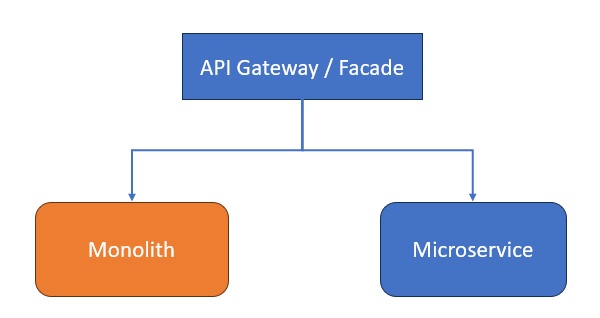
API Gateway forwards requests based on route mappings.
Requests for newer functionality go to microservices.
Legacy requests go to the monolith.
Real-World Use Case
Scenario: Legacy E-commerce Platform
Monolith Responsibilities
Product Catalog
Cart & Checkout
Payments
Order History
Migration Goal
Refactor into microservices
product-service
checkout-service
payment-service
Approach
Facade − Introduce Spring Cloud Gateway as the entry point.
Route old product-related endpoints to monolith.
Route new checkout/payment endpoints to new services.
Gradually migrate and remove old endpoints.
Step-by-Step Implementation Using Spring Boot
Introduce a Gateway (Strangling Point)
Use Spring Cloud Gateway −
pom.xml
<dependency>
   <groupId>org.springframework.cloud</groupId>
   <artifactId>spring-cloud-starter-gateway</artifactId>
</dependency>
application.yml
spring:
  application:
    name: api-gateway
  cloud:
    gateway:
      routes:
        - id: monolith-service
          uri: http://localhost:8080
          predicates:
            - Path=/products/**, /cart/**

        - id: checkout-service
          uri: http://localhost:8081
          predicates:
            - Path=/checkout/**

        - id: payment-service
          uri: http://localhost:8082
          predicates:
            - Path=/payment/**
Keep Monolith Intact (Initially)
No code changes in the monolith are needed immediately.
Develop Microservices (e.g., Checkout)
CheckoutController.java
@RestController
@RequestMapping("/checkout")
public class CheckoutController {
   @PostMapping("/")
   public String checkout(@RequestBody CheckoutRequest req) {
      return "Checked out cart ID: " + req.getCartId();
   }
}
application.yml (checkout-service)
server:
  port: 8081
spring:
  application:
    name: checkout-service
Gradual Migration
Redirect /checkout to new service
Extract logic for /cart next
Replace /products as last step
Each move is low risk
Advantages of the Strangler Pattern
| Sr.No. | Benefit | Description |
|---|---|---|
| 1 | Incremental Migration | Safely move piece-by-piece to microservices |
| 2 | Reduced Risk | Avoids "big bang" rewrites |
| 3 | Easier Debugging | Only part of the system changes at any time |
| 4 | Reuses Existing Features | Keeps old monolith alive until no longer needed |
| 5 | Supports Parallel Dev | Teams can build new modules while legacy still runs |
Challenges and Solutions
| Sr.No. | Challenge | Solution |
|---|---|---|
| 1 | Routing Complexity | Use Spring Cloud Gateway / Istio for traffic control |
| 2 | Inconsistent Data Models | Use event-driven sync or API composition |
| 3 | Monolith Coupling | Use facade to abstract internals; slowly decouple modules |
| 4 | Dual Maintenance Effort | Keep migration short-lived per module |
| 5 | Authentication Integration | Centralize with OAuth2 / JWT and shared identity provider |
Tools and Technologies for Strangler Pattern
| Sr.No. | Purpose | Tools |
|---|---|---|
| 1 | Routing / Gateway | Spring Cloud Gateway, Istio, NGINX |
| 2 | Service Discovery | Eureka, Consul |
| 3 | Asynchronous Events | Kafka, RabbitMQ |
| 4 | Observability | Sleuth, Zipkin, Prometheus |
| 5 | CI/CD | Jenkins, GitLab CI/CD |
Real-World Example: Amazon
Amazon moved from a monolithic system in the early 2000s to thousands of microservices by −
Introducing API gateways
Migrating single features at a time
Using service ownership by small autonomous teams
Strangler Pattern helped ensure uninterrupted service during their evolution.
When to Use the Strangler Pattern
Use When −
You want minimal risk migration
You must maintain availability
You don't have budget or time for rewrites
The monolith is too large for a full refactor
Avoid If −
The system is small and simple
Conclusion
The Strangler Pattern is a powerful and pragmatic approach to incrementally migrating legacy monolithic systems to modern microservice architectures.
By placing a routing layer between consumers and services, teams can −
Gradually introduce new microservices
Retire legacy components step-by-step
Minimize risk and maximize business continuity
This pattern reduces technical debt progressively and supports long-term modernization efforts, making it one of the most practical patterns in the microservices transition toolkit.
