
- Java Microservices Tutorial
- Java Microservices - Home
- Microservices - Introduction
- Microservices vs Monolith vs SOA
- Java Microservices - Environment Setup
- Java Microservices - Advantages of Spring Boot
- Java Microservices - Design Patterns
- Java Microservices - Domain Driven Design
- Java Microservices - Decomposition by Business Capability
- Java Microservices - Decomposition by Subdomain
- Java Microservices - Backend for Frontend
- Java Microservices - The Strangler Pattern
- Java Microservices - Synchronous Communication
- Java Microservices - Asynchronous Communication
- Java Microservices - Saga Pattern
- Java Microservices - Centralized Logging (ELK Stack)
- Java Microservices - Event Sourcing
- Java Microservices - CQRS Pattern
- Java Microservices - Sidecar Pattern
- Java Microservices - Service Mesh Pattern
- Java Microservices - Circuit Breaker Pattern
- Java Microservices - Distributed Tracing
- Java Microservices - Control Loop Pattern
- Java Microservices - Database Per Service
- Java Microservices - Bulkhead Pattern
- Java Microservices - Health Check API
- Java Microservices - Retry Pattern
- Java Microservices - Fallback Pattern
- Java Microservices Useful Resources
- Java Microservices Quick Guide
- Java Microservices Useful Resources
- Java Microservices Discussion
Java Microservices - Advantages of Using Spring Boot
Introduction
In the fast-paced world of software development, Microservices Architecture has emerged as a powerful alternative to monolithic applications. It promotes the idea of developing single-purpose, loosely coupled services that can be deployed independently. Spring Boot, a project from the Spring ecosystem, is one of the most popular frameworks used to build microservices due to its simplicity, speed, and strong community support.
This chapter explores the key advantages of using Spring Boot to develop microservices, including its features, architecture support, tooling, and real-world applicability.
What is Spring Boot?
Spring Boot is an extension of the Spring framework that simplifies the setup and development of Spring-based applications. It minimizes boilerplate code, automates configuration, and promotes convention over configuration.
Spring Boot makes it easy to create stand-alone, production-grade Spring-based applications. - Spring IO
Key Features
Auto-configuration
Embedded servers (Tomcat, Jetty, Undertow)
Production-ready metrics and health checks
Minimal XML configuration
Spring Initializr and CLI tools
How Spring Boot Supports Microservices
Spring Boot, along with Spring Cloud, offers built-in support to develop resilient, scalable, and cloud-ready microservices.
Microservices Architecture using Spring Boot
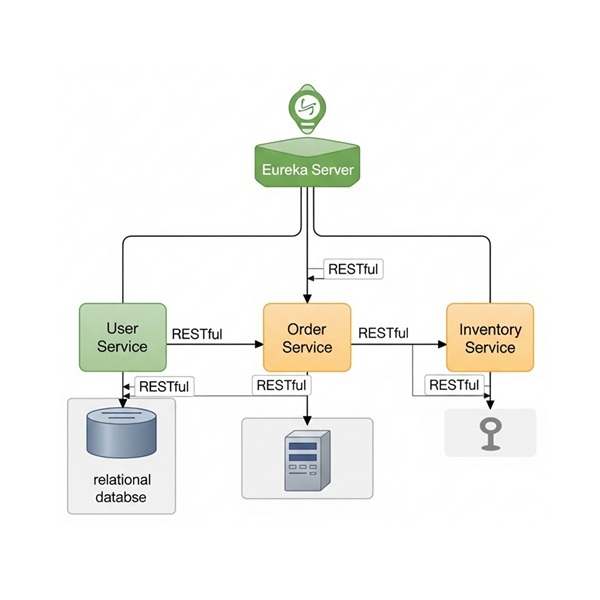
Advantages of Using Spring Boot in Microservices
Simplified Development
Spring Boot provides −
Pre-built templates and project structures (via Spring Initializr).
Auto-configuration based on classpath contents.
Minimal setup to get REST APIs running.
Example
With just a few annotations (@RestController, @SpringBootApplication), a microservice is ready.
@SpringBootApplication
public class InventoryServiceApplication {
   public static void main(String[] args) {
      SpringApplication.run(InventoryServiceApplication.class, args);
   }
}
Embedded Web Servers
Spring Boot embeds web servers like Tomcat or Jetty, eliminating the need for external server deployment. This makes each microservice −
Self-contained
Easier to deploy in Docker containers or cloud environments
Seamless Integration with Spring Cloud
Spring Cloud provides extensions to Spring Boot that facilitate −
Service discovery (Eureka)
API gateway (Spring Cloud Gateway)
Load balancing (Cloud Loadbalancer)
Circuit breakers (Resilience4j)
Config server (Spring Config Server)
All these integrations are minimal-code and declarative.
Rapid Bootstrapping with Spring Initializr
https://start.spring.io provides a UI and API to generate Spring Boot microservices with −Preselected dependencies (e.g., Web, JPA, Actuator)
Maven or Gradle configuration
Java/Kotlin/Groovy language support
This accelerates development and ensures consistency.
Built-in Monitoring with Spring Boot Actuator
Spring Boot Actuator offers endpoints like −
/health
/metrics
/info
These endpoints integrate well with Prometheus, Grafana, or ELK stack, providing real-time monitoring and health checks for microservices.
Easy Testing and Mocking
Spring Boot provides test annotations −
@SpringBootTest
@WebMvcTest
@DataJpaTest
It also supports −
MockMVC for REST controllers
Testcontainers for Docker-based integration tests
Docker & Cloud-Native Friendly
Spring Boot jars are −
Self-contained − Easily deployable in Docker.
Portable − Can be moved to Kubernetes clusters, AWS ECS, Azure Containers, etc.
Dockerfile Example −
FROM openjdk:17
ADD target/inventory-service.jar app.jar
ENTRYPOINT ["java", "-jar", "/app.jar"]
Spring Boot and DevOps Pipelines
Spring Boot integrates well with CI/CD tools −
Jenkins
GitHub Actions
GitLab CI/CD
Automated testing, packaging, and deployment are straightforward.
Case Study - E-Commerce Microservices
Services −
Product Service
Order Service
Payment Service
Notification Service
Using Spring Boot −
Each service uses REST or messaging (RabbitMQ/Kafka)
Configuration is centralized via Spring Cloud Config
Eureka handles service discovery
Gateway provides a unified API interface
