
- Java Microservices Tutorial
- Java Microservices - Home
- Microservices - Introduction
- Microservices vs Monolith vs SOA
- Java Microservices - Environment Setup
- Java Microservices - Advantages of Spring Boot
- Java Microservices - Design Patterns
- Java Microservices - Domain Driven Design
- Java Microservices - Decomposition by Business Capability
- Java Microservices - Decomposition by Subdomain
- Java Microservices - Backend for Frontend
- Java Microservices - The Strangler Pattern
- Java Microservices - Synchronous Communication
- Java Microservices - Asynchronous Communication
- Java Microservices - Saga Pattern
- Java Microservices - Centralized Logging (ELK Stack)
- Java Microservices - Event Sourcing
- Java Microservices - CQRS Pattern
- Java Microservices - Sidecar Pattern
- Java Microservices - Service Mesh Pattern
- Java Microservices - Circuit Breaker Pattern
- Java Microservices - Distributed Tracing
- Java Microservices - Control Loop Pattern
- Java Microservices - Database Per Service
- Java Microservices - Bulkhead Pattern
- Java Microservices - Health Check API
- Java Microservices - Retry Pattern
- Java Microservices - Fallback Pattern
- Java Microservices Useful Resources
- Java Microservices Quick Guide
- Java Microservices Useful Resources
- Java Microservices Discussion
Java Microservices - Asynchronous Communication
Introduction
As microservices become more complex, their need for effective communication grows. Traditionally, services interact synchronously-one service calls another and waits for a response. However, this model can lead to tight coupling, reduced resilience, and latency issues.
To address these challenges, modern systems often rely on Asynchronous Communication, especially via Event-Driven Architecture (EDA). In this model, services publish and subscribe to events, enabling loose coupling, scalability, and high performance.
This article explores the asynchronous communication model using RabbitMQ and Apache Kafka, and demonstrates practical implementations using Spring Boot.
What is Asynchronous Communication?
Definition
Asynchronous communication is a pattern where services interact without waiting for a direct response. Messages or events are sent and received independently, typically via message brokers or event buses.
Characteristics
Non-blocking communication
Services don't need to be online simultaneously
Interaction via queues, topics, or streams
Enables event-driven workflows
Why Use Asynchronous Communication in Microservices?
Advantages
Example
| Sr.No. | Feature | Benefit |
|---|---|---|
| 1 | Loose Coupling | Services don't directly depend on each other |
| 2 | Resilience | Failures in one service don't cascade |
| 3 | Scalability | Easily scale consumers independently |
| 4 | Performance | No waiting for slow downstream responses |
| 5 | Decoupled Development | Teams can build services independently |
Common Use Cases
Order processing
Email notifications
Event sourcing
Payment workflows
Audit and logging
Architecture of Event-Driven Microservices
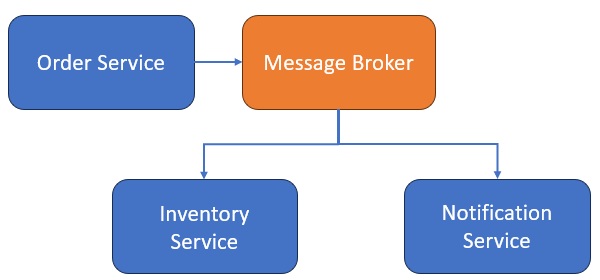
Key Components
| Sr.No. | Component | Role |
|---|---|---|
| 1 | Producer | Sends events (e.g., OrderPlaced) |
| 2 | Broker | Delivers events (RabbitMQ, Kafka, etc.) |
| 3 | Consumer | Subscribes to and processes events |
Diagram
Technologies for Asynchronous Communication
| Sr.No. | Tool | Description | Best Use Cases |
|---|---|---|---|
| 1 | RabbitMQ | Lightweight message broker using AMQP | Task queues, retry queues, real-time alerts |
| 2 | Kafka | Distributed event streaming platform | High-volume data, event sourcing, audit |
| 3 | ActiveMQ | Legacy support, JMS compatibility | Java-based systems |
| 4 | Amazon SNS/SQS | Managed messaging services | Cloud-native systems |
Asynchronous Communication with RabbitMQ and Spring Boot
Overview of RabbitMQ
RabbitMQ is a message queueing broker that supports multiple protocols, primarily AMQP. It uses exchanges, queues, and bindings.
Exchange − Routes messages
Queue − Stores messages until consumed
Binding − Connects exchanges to queues
Setup (Spring Boot)
Maven Dependencies−
<dependency>
   <groupId>org.springframework.boot</groupId>
   <artifactId>spring-boot-starter-amqp</artifactId>
</dependency>
Producer Example: Order Service
@Service
public class OrderProducer {

   @Autowired
   private RabbitTemplate rabbitTemplate;

   public void sendOrderEvent(Order order) {
      rabbitTemplate.convertAndSend("order.exchange", "order.routingKey", order);
   }
}
Configuration
@Configuration
public class RabbitMQConfig {

   @Bean
   public Queue orderQueue() {
      return new Queue("order.queue", true);
   }

   @Bean
   public DirectExchange exchange() {
      return new DirectExchange("order.exchange");
   }

   @Bean
   public Binding binding() {
      return BindingBuilder
         .bind(orderQueue())
         .to(exchange())
         .with("order.routingKey");
   }
}
Consumer Example: Inventory Service
@Service
public class InventoryConsumer {

   @RabbitListener(queues = "order.queue")
   public void handleOrder(Order order) {
      System.out.println("Processing inventory for order: " + order.getId());
   }
}
Asynchronous Communication with Apache Kafka
Overview of Kafka
Apache Kafka is a distributed, fault-tolerant event streaming platform.
Producer− Publishes messages to a topic
Consumer− Subscribes to topic(s)
Broker− Manages topics and partitions
Topic− Logical stream of events
Setup (Spring Boot)
Maven Dependencies −
<dependency>
   <groupId>org.springframework.kafka</groupId>
   <artifactId>spring-kafka</artifactId>
</dependency>
Producer Example: Order Service
@Service
public class KafkaOrderProducer {

   @Autowired
   private KafkaTemplate<String, Order> kafkaTemplate;

   public void sendOrder(Order order) {
      kafkaTemplate.send("order-topic", order);
   }
}
Kafka Configuration
spring:
  kafka:
    bootstrap-servers: localhost:9092
    producer:
      key-serializer: org.apache.kafka.common.serialization.StringSerializer
      value-serializer: org.springframework.kafka.support.serializer.JsonSerializer
    consumer:
      group-id: inventory-service
      key-deserializer: org.apache.kafka.common.serialization.StringDeserializer
      value-deserializer: org.springframework.kafka.support.serializer.JsonDeserializer
Consumer Example: Inventory Service
@Service
public class KafkaOrderConsumer {

   @KafkaListener(topics = "order-topic", groupId = "inventory-service")
   public void consume(Order order) {
      System.out.println("Inventory updated for Order: " + order.getId());
   }
}
Comparison: RabbitMQ vs Kafka
| Sr.No. | Feature | RabbitMQ | Apache Kafka |
|---|---|---|---|
| 1 | Model | Message Queue (Push) | Event Log (Pull) |
| 2 | Message Retention | Deletes after consumption | Retains for configured period |
| 3 | Use Case | Real-time messaging | Event streaming, audit, analytics |
| 4 | Performance | Good for low/medium volume | Excellent for high-throughput |
| 5 | Delivery Guarantees | At most once / at least once | Exactly once (with config) |
| 6 | Built-in Features | Dead-letter queues, priority | Stream replay, partitioning |
Best Practices
| Sr.No. | Practice | Description |
|---|---|---|
| 1 | Idempotency | Ensure consumers handle duplicate events safely |
| 2 | Dead-letter Queues (DLQs) | Handle failed messages without losing them |
| 3 | Retries and Backoff | Use exponential backoff for transient failures |
| 4 | Message Versioning | Support schema evolution |
| 5 | Monitoring & Tracing | Use Zipkin, Prometheus, Kafka UI for observability |
| 6 | Async Boundaries | Use command/event distinction (e.g., OrderPlaced vs OrderConfirmed) |
Real-World Use Cases
| Sr.No. | Company | Event-Driven Use Case |
|---|---|---|
| 1 | Uber | Geolocation updates, surge pricing via Kafka |
| 2 | Netflix | User activity tracking, recommendation pipelines with Kafka |
| 3 | Shopify | Order fulfillment via RabbitMQ |
| 4 | Built Kafka for internal use-event sourcing at scale |
When to Use Asynchronous Communication
Ideal For −
High-volume systems
Background task processing
Decoupled architectures
Event sourcing and audit trails
Retry-able workflows (notifications, billing, etc.)
Not Ideal When −
Immediate response is required
Simple request-response is sufficient
External system mandates synchronous calls (e.g., payment gateway)
Conclusion
Asynchronous communication is a key architectural pattern for building scalable, resilient, and event-driven microservices.
RabbitMQ is a great choice for lightweight message-based systems.
Apache Kafka shines in high-throughput, log-based systems.
By adopting this pattern, organizations gain the flexibility to −
Decouple services
Increase responsiveness
Handle complex workflows
Enable real-time data pipelines
When combined with proper tooling and best practices, asynchronous communication becomes a cornerstone of robust microservices systems.
