- Less - Nested Rules
- Less - Nested Directives and Bubbling
- Less - Operations
- Less - Escaping
- Less - Functions
- Less - Namespaces and Accessors
- Less - Scope
- Less - Comments
- Less - Importing
- Less - Variables
- Less - Extend
- Less - Mixins
- Less - Parametric Mixins
- Less - Mixins as Functions
- Less - Passing Rulesets to Mixins
- Less - Import Directives
- Less - Import Options
- Less - Mixin Guards
- Less - CSS Guards
- Less - Loops
- Less - Merge
- Less - Parent Selectors
- Functions
- Less - Misc Functions
- Less - String Functions
- Less - List Functions
- Less - Math Functions
- Less - Type Functions
- Less - Color Defination Functions
- Less - Color Channel Functions
- Less - Color Operation
- Less - Color Blending Functions
- Usage
- Less - Command Line Usage
- Using Less In The Browser
- Less - Browser support
- Less - Plugins
- Less - Programmatic Usage
- Less - Online Compilers
- Less - GUIs
- Less - Editors and Plugins
- Less - Third Party Compilers
- Less - Frameworks
- Less Useful Resources
- Less - Quick Guide
- Less - Cheatsheet
- Less - Useful Resources
- Less - Discussion
LESS - Import Statements
Description
An import statement can have a variable which holds a path. This is very useful when you are referring a common parent directory.
Example
The following example demonstrates the use of variables in the import statement −
<html>
   <head>
      <link rel = "stylesheet" href = "style.css" type = "text/css" />
      <title>LESS Variables in Import Statements</title>
   </head>

   <body>
      <div class = "myclass">
         <h2>Welcome to Tutorialspoint</h2>
         <p>LESS is a CSS pre-processor that enables customizable,
         manageable and reusable style sheet for web site.</p>
      </div>
   </body>
</html>
Next create the style.less file.
style.less
@path : "http://www.tutorialspoint.com/less";
@import "@{path}/external1.less";
.myclass {
   color : #A52A2A;
}
The following code will import the external.less file into style.less from the https://www.tutorialspoint.com/less/external1.less path −
external1.less
.myclass {
   background: #C0C0C0;
}
You can compile the style.less to style.css by using the following command −
lessc style.less style.css
Execute the above command; it will create the style.css file automatically with the following code −
style.css
body {
   background: #C0C0C0;
}

p {
   color: #A52A2A;
}
Output
Follow these steps to see how the above code works −
Save the above html code in the less_variables_interpolation_import.html file.
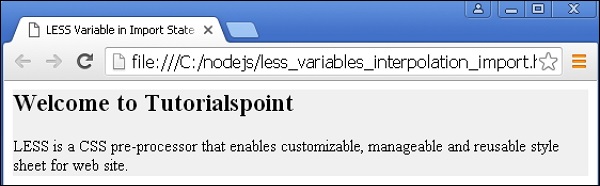
Open this HTML file in a browser, the following output will get displayed.