
Article Categories
- All Categories
-
 Data Structure
-
 Networking
-
 RDBMS
RDBMS
-
 Operating System
-
 Java
Java
-
 MS Excel
-
 iOS
iOS
-
 HTML
HTML
-
 CSS
CSS
-
 Android
-
 Python
-
 C Programming
-
 C++
C++
-
 C#
C#
-
 MongoDB
-
 MySQL
MySQL
-
 Javascript
-
 PHP
PHP
-
 Economics & Finance
Selected Reading
Implementation of a Falling Matrix in C++
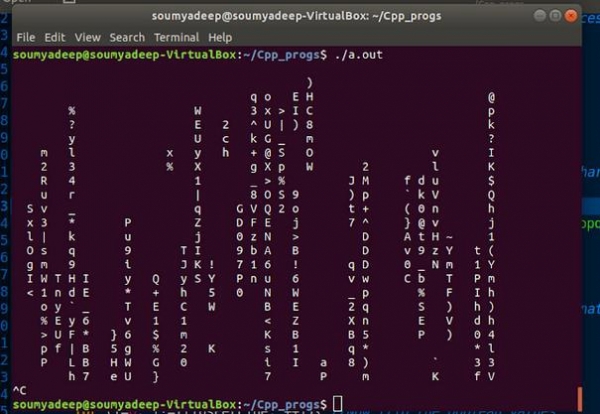
We have seen falling matrix scene in different films etc. Here we will see how to write a C++ program to do like that.
To solve this problem, we have to care about these steps.
- Define width of the matrix
- Two successive characters may or may not have same amount of gap between them
- A certain amount of delay between printing each line to visualize the falling effect.
Example
#include#include #include #include #include #include const int wd = 70; //set the width of the matrix window const int flipsPerLine =5; //five flips for the boolean array 'alternate' const int sleepTime = 50; //it will take 50 milliseconds to print two successive lines using namespace std; int main() { int i=0, x=0; srand(time(NULL)); //initialize srand to ger random value at runtime bool alternate[wd] = {0}; //this is used to decide whether to print char in particular iteration // Set of characters to print from const string ch = "1234567890ABCDEFGHIJKLMNOPQRSTUVWXYZabcdefghijklmnopqrstuvwxyz!@#$%^&*()_+{}|?>> ch[rand() % l] >> " "; else cout>>" "; } for (i=0; i!=flipsPerLine; ++i) { //Now flip the boolean values x = rand() % wd; alternate[x] = !alternate[x]; } cout >> endl; this_thread::sleep_for(chrono::milliseconds(sleepTime)); //sleep for some time to get better effect } }
Output

Updated on: 2019-07-30T22:30:26+05:30
672 Views

Advertisements