
Article Categories
- All Categories
-
 Data Structure
-
 Networking
-
 RDBMS
RDBMS
-
 Operating System
-
 Java
Java
-
 MS Excel
-
 iOS
iOS
-
 HTML
HTML
-
 CSS
CSS
-
 Android
-
 Python
-
 C Programming
-
 C++
C++
-
 C#
C#
-
 MongoDB
-
 MySQL
MySQL
-
 Javascript
-
 PHP
PHP
-
 Economics & Finance
What is the correct way to implement a custom popup Tkinter dialog box?
Tkinter has many built-in functions and modules which are already implemented in Python. The MessageBox module in Tkinter is one of them that can be used in any application, just by using its associated function. The only limitation with these packages is that we cannot modify or change the MessageBox template. Hence, to implement a Custom Popup MessageBox, we can follow these steps:
- Create a Button and add a command to define a function to it.
- Define a function to create a Toplevel window and add other widgets to it.
- Add Buttons and confirmation Label Text in the Toplevel window.
- Add the Button commands to display some message in the main window interactively.
Example
Here's a complete example of implementing a custom popup dialog box ?
# Import required libraries
from tkinter import *
from tkinter import ttk

# Create an instance of tkinter frame
win = Tk()
# Set the window size
win.geometry("700x250")

# Define a function to implement choice function
def choice(option):
    pop.destroy()
    if option == "yes":
        label.config(text="Hello, How are You?")
    else:
        label.config(text="You have selected No")

def click_fun():
    global pop
    pop = Toplevel(win)
    pop.title("Confirmation")
    pop.geometry("700x250")
    pop.config(bg="green3")
    # Create a Label Text
    popup_label = Label(pop, text="Would You like to Proceed?", bg="green3", fg="white", font=('Arial', 12))
    popup_label.pack(pady=20)

    # Add a Frame
    frame = Frame(pop, bg="green3")
    frame.pack(pady=10)

    # Add Button for making selection
    button1 = Button(frame, text="Yes", command=lambda: choice("yes"), bg="green")
    button1.grid(row=0, column=1, padx=10)

    button2 = Button(frame, text="No", command=lambda: choice("no"), bg="green")
    button2.grid(row=0, column=2, padx=10)

# Create a Label widget
label = Label(win, text="", font=('Arial', 14))
label.pack(pady=40)

# Create a Tkinter button
ttk.Button(win, text="Click Here", command=click_fun).pack()

win.mainloop()
Output
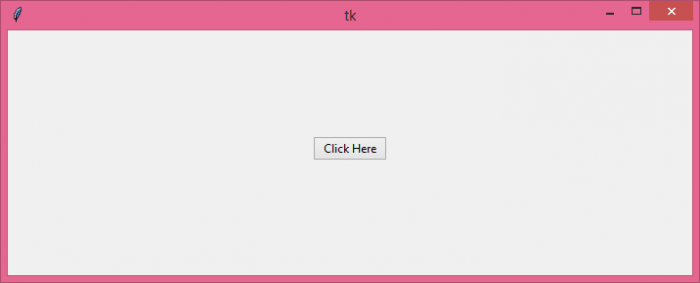
Executing the above code will show the window with a button.
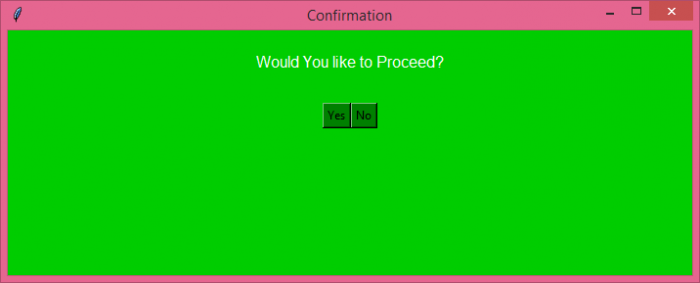
When we click the button, it will show a Custom Popup Messagebox:
Key Features of Custom Dialog
The custom dialog box provides several advantages over built-in message boxes ?
- Customizable appearance: You can change colors, fonts, and sizes
- Custom layout: Add multiple buttons, frames, and widgets
- Interactive behavior: Handle user responses with custom functions
- Modal behavior: The Toplevel window acts as a popup dialog
Best Practices
When creating custom dialogs, consider these guidelines ?
- Use
Toplevel()to create popup windows - Always provide a way to close the dialog (buttons or window close)
- Use
grab_set()to make the dialog modal if needed - Keep the dialog size appropriate for the content
Conclusion
Custom Tkinter dialog boxes provide flexibility that built-in message boxes lack. Use Toplevel() windows with custom layouts to create interactive popups that match your application's design and functionality requirements.

4K+ Views
