
- Quick Commerce - Home
- Quick Commerce - Overview
- The Last Mile Delivery
- Quick Commerce - Benefits
- Key Players in the Ecosystem
- The Current Landscape
- Quick Commerce vs. Traditional E-Commerce
- Logistics and Infrastructure
- The Payment Method
- Customer Acquisition Strategies
- Ethical and Social Considerations
- Challenges and Opportunities
- Quick Commerce - Global Trends
- Quick Commerce - Future
- Conclusion and key takeaways from
- Quick Commerce Useful Resources
- Quick Commerce - Quick Guide
- Quick Commerce - Resources
- Quick Commerce - Discussion
Quick Commerce - Quick Guide
Quick Commerce - Overview
In this tutorial, we will be entering the world of Quick Commerce. Ranging from what led to the birth of Quick Commerce to why it is important in today's business world. Quick Commerce is nothing but an extension of Electronic Commerce (E-Commerce), but it is today taking over many businesses.
Now we will start answering the basic questions that you will be having as soon as you read the topic "Quick Commerce," one by one, and then finally exiting this world as connoisseurs ready and excited to learn more and more advancements in this field.
What is Quick Commerce?
Quick Commerce, as the name suggests, is about getting your order quickly. Here, the customer is receiving their order within an hour of the order being placed. This has been in the food industry for years but has now entered other business domains. The main two customer factors that gave birth to Quick Commerce were convenience and efficiency. It is generally used for quick purchases or purchases of low-priced goods. For example, if you are cooking and you run out of some ingredients, you want them delivered to your doorstep within minutes to not disrupt your cooking, and this is what Quick Commerce is in simple terms.
What led to the birth of Quick Commerce?
Quick Commerce has been in the industry for years. It was used in the food industry and was a preferred mode of purchase for the elderly. However, the pandemic gave it the much-needed push, and now Quick Commerce is the way of life for people of every age and in most geographical locations. At the time of the pandemic, Quick Commerce gave customers safety and convenience as they could order the things that they needed at their doorstep without risking the deadly disease. Quick Commerce is also successful today because of rapid urbanization, a busy lifestyle, working partners, an aging population, and smaller households
What are the benefits of Quick Commerce?
Quick Commerce as a mode of business provides the following benefits −
Delightful customer experience − Quick Commerce gives utmost priority to its customers and their experience. Quick Commerce as a model is known for speed, convenience, 24*7 accessibility, and safety. With Quick Commerce, customers can get the goods delivered to their doorstep within minutes, and they will rely on the brand and the product that it has to offer.
Edge over the competition − companies - With Quick Commerce as a medium will be able to target more customers and will also be able to deliver a greater customer experience.
A unique selling proposition for the business − There are many companies today coming up that offer nothing but the Quick Commerce facility. Having the resources to develop and maintain Quick Commerce facilities is another benefit that companies can leverage.
Greater margins for businesses − Smaller companies without the facility and resources to install Quick Commerce would depend on these businesses. The companies can also charge fees to customers for fast delivery, and hence there is a lot of profit-making space for a company in the Quick Commerce world.
Some renowned businesses have adopted the Quick Commerce strategy
In India, we can see many big companies entering the Quick Commerce market with nothing but the ability to deploy the many resources that can provide customers with a delightful Quick Commerce experience. To name some of them, they would be −
Blinkit from Zomato
Swiggy Instamart form Swiggy
Jio Mart from Reliance
DMart Ready from Dmart
Nature's Basket from Spencers
Dunzo Daily from Zepto
Amazon fresh from Amazon
Flipkart Supermart from Walmart
Big basket from Tata and others.
Quick Commerce - The Last Mile Delivery
Quick Commerce was born out of e-commerce. E-commerce meant providing customers with a platform on which they could view different products, compare the products of different brands, and then order what they wanted from the web. The major benefits that e-commerce offered to customers were convenience, 24-hour accessibility, and options. Customers can easily lie down on their couch at 11 p.m. in the comfort of their pajamas and do grocery shopping for the week. Quick Commerce, on the other hand, is the advanced version of e-commerce.
With Quick Commerce as a medium of business, not only will the customer get all the benefits of e-commerce, but on top of that, they will get the added benefit of speed. Whatever a customer orders, it could be anything from a mobile phone to a packet of lays to munch upon, and it will be delivered to your doorstep within 15 or 30 minutes. The general delivery time for Quick Commerce business is less than an hour. Quick Commerce is also known as an on-demand delivery service, e-groceries, or the third generation of commerce.
What is the focus of Quick Commerce?
Currently, as the market is working, the focus of the Quick Commerce industry is to provide customers with goods that are daily necessities and low-priced goods. For example, simple everyday groceries in smaller quantities E-commerce was ordering groceries online for an entire week or month, and Quick Commerce is ordering groceries needed immediately or on a daily basis. However, the feel of the market is that Quick Commerce is soon going to enter other non-complicated domains as well. For example, the retail industry of clothes, the cell phone distribution industries, and others The horizon of Quick Commerce's expansion totally depends upon the resources that the company has and the network that the business owner has.
What gave Quick Commerce the required boost?
Quick Commerce was there in the industry, but what gave Quick Commerce the required push was the pandemic. With the pandemic, people were afraid to leave the safety of their houses, and hence they wanted things to be delivered to their doorstep, sometimes really fast.
Quick Commerce - Market segmentation
The Quick Commerce market can be segmented into the following categories for a better understanding.
By application
E-commerce application
Restaurant delivery application
Merchandised servicing application
Food servicing application
Product delivery application
By product type
Fruits and Vegetables
Electronic items
Electrical and appliance
Repairs and servicing - automotive
Clothing and Merchandise
Daily necessities sector
By regional classification
Asia Pacific region
Middle East and Gulf region
Africa region
North American region
European region
Latin America and Caribbean region
By technology focus type
Application-based operations
Website-based operations
Hybrid operations
Quick Commerce - Benefits
Benefits that Quick Commerce offers to its customers
Customers can plan better and shop with ease − With Quick Commerce, customers can easily shop for the goods that they only need on a daily basis. This helps the customer not feel the hefty load of monthly shopping. Along with this, customers can search for the product, compare different brands, place the final order, and also receive it in 10 minutes, ensuring ease of shopping.
Real-time delivery of goods - The differentiating point of Quick Commerce is that it provides the customer with speed. Customers can order anything they need, and the goods will be at their doorstep in less than an hour. The general time that Quick Commerce companies take is around 10 to 20 minutes.
Assortment and variety of goods for shoppers − Quick Commerce websites offer the company a different assortment of goods. It is not just on brand, but products of different brands are available on the same website or screen. Customers can easily compare and make decisions. Retail outlets or brick-and-mortar stores provided customers with limited choices, but now the sky's the limit for them. We also see brands coupling up products together or in smaller quantities for the customer's ease, which is an added benefit for the customer
24*7 accessibility for customers − Customers can access the service of the application 24*7 and 365 days a year. There is no day or night when it comes to order delivery for Quick Commerce; hence, customers enjoy greater accessibility to the brand.
A personalized shopping experience that comes with the AI of Quick Commerce − Customers definitely have a better shopping experience. They are not only providing speed, ease, variety, convenience, and 24*7 accessibility but also algorithms and personalized chat support to enhance the customer experience or user journey on the application and the website. Customers are at the highest level of satisfaction. There are algorithms in which the application will record the previous purchase order, and customers can repeat the order or see recommended products for a better and easier experience, which is missing in brick-and-mortar stores or big shopping malls.
Quick Commerce offers the following benefits to business owners
An edge over the competitors − Companies can get a greater advantage over the brick-and-mortar stores, which lack the variety of goods, and the big shopping houses, which lack such a personalized shopping experience, 24*7 accessibility, ease, and speed. Quick Commerce is like getting the benefits of all the world clubbed together for the customer. This helps the company get super-normal profits from the market and fuels it to fight competitive rivalries.
A new unique selling proposition − the companies are leveraging their financial resources and networking capabilities to enter the Quick Commerce business world and are succeeding as well. NBrand, like Swiggy, Instamart, and Blinkit, only has the proposition of quick delivery to the customers.
More profits for the company − Since the company is going out of its way to provide customers with speed, customers will be ready to pay a price for the same. Blinkit is a brand in India that started with no delivery fees and discounts on the product. Once it had the customers in its grasp, it added the minimum order free delivery rule, and after that, we always see a surcharge in rush hour. Since the customers are people with a busy lifestyle and in urban areas, the company is able to take more money from the customer, and since the company has large warehouses in different places, it is able to load or store huge quantities of goods, hence getting a bulk discount from the brand.
Satisfied and loyal customers − Since the company is offering its customers speed, ease, variety, convenience, 24*7 accessibility, and an AI-developed shopping experience, they now have a satisfied or delighted customer base who will be loyal to the brand. The company here will be building relationships with its customers
Quick Commerce - Key Players in the Ecosystem
Key Players in the Indian Ecosystem
In the Indian landscape, we are seeing the major players in the ecosystem come up with their Quick Commerce companies. Customers are not expected to shift to the traditional method of shopping anytime soon. The major players of Quick Commerce in the Indian landscape are −
Blinkit from Zomato
Swiggy Instamart form Swiggy
Jio Mart from Reliance
DMart Ready from Dmart
Nature's Basket from Spencers
Dunzo Daily from Zepto
Amazon fresh from Amazon
Flipkart Supermart from Walmart
Big basket from Tata and others.
Market share of each of the key players in the Quick Commerce industry in the Indian ecosystem
All the brands are huge players in their respective fields and have a lot of resources to invest and get the ball rolling. As per the current data for the Indian market, we see that −
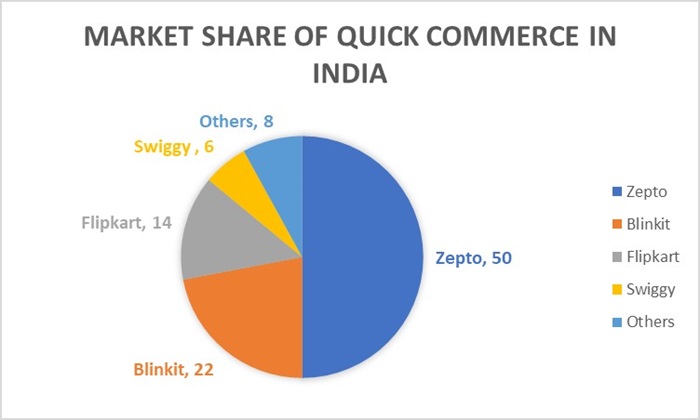
Zepto has the highest share, which is around 50%
Blinkit has the second-highest share, at around 22%.
Flipkart has the third-highest share, which is around 14%.
Swiggy has the fourth-highest share, which is around 6%.
And the rest, 8%, are with other players in the market.
Key players in the global quick commerce industry
When we cross the geographical boundaries, we see that some of the major players in the Quick Commerce industry are −
Gorillas
Weezy
FridgeNoMore
Jokr
Zepto
Swiggy's Instamart
Dunzo Daily
Blinkit
Quick Commerce - The Current Landscape
Quick Commerce - Indian Market Share
The total revenue of the Quick Commerce industry in the Indian market is projected to reach a figure of US $1408 million by 2023. The Quick Commerce industry is experiencing an annual growth rate (compound annual growth rate) of around 45.13% in the Indian market. This means the potential to grow is not only large but humongous for the business owners. Though the only difference that Quick Commerce brings to the market is last-mile delivery or fast delivery, with more and more customers and resources, companies will be able to provide larger varieties, more discounts, and more convenience to their customers.
Quick Commerce - Market Penetration Rat
The main business of the quick commerce industry is done in urban or semi-urban areas. The reason for this is that consumers here have the income to spare, are too busy to go out to shop for their needs, and are always on the run. Most are young consumers who have fewer responsibilities and more disposable income. The current penetration rate of the Quick Commerce industry in 2023 will be around 0.9% and is supposed to reach 3.5% by 2027 in the Indian market. The current global penetration rate of the Quick Commerce industry will be around 6.7% in 2023.
Quick Commerce - Average Revenue Per User (ARPU)
With 0.9% of the penetrated market, the Quick Commerce industry is currently seeing an average revenue of US 105.10 dollars. The ARPU is calculated as the total revenue of the company divided by the total number of users. This helps the company determine how much revenue each user brings to the table for the company. The average revenue per user is also expected to grow in the coming years. The table for the same looks like this, as per Statista.com −
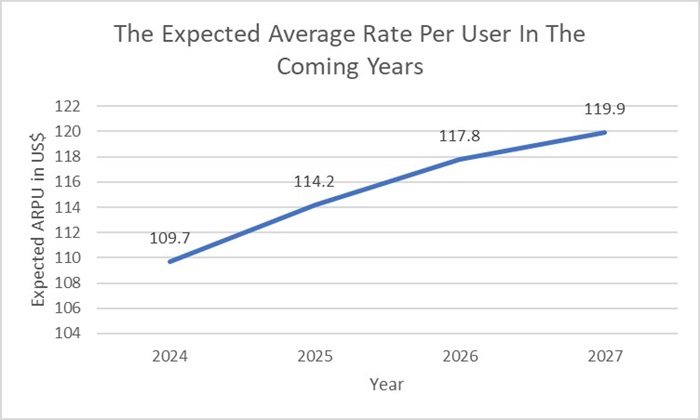
2024 the expected ARPU could be 109.7 US dollars
2025 the expected ARPU could be 114.2 US dollars
2026 the expected ARPU could be 117.8 US dollars
2027 the expected ARPU could be 119.9 US dollars
Quick Commerce - Mckinsey Report
As per the McKinsey report, we have found out some interesting facts about the Indian quick commerce industry. The total worth of the Quick Commerce companies was around 0.3 billion dollars in 2022, and it is expected to grow to more than 5 billion dollars by 2025. However, another interesting fact that Mckinsey's report showed was that the EBITA (earnings before income and tax) of the Quick Commerce companies was on the negative scale, while the brick-and-mortar companies in India showed an EBITA of around 5 to 8%. Profitability and market penetration have been a keen challenge for the Quick Commerce companies. Less profitability for the companies is because of high cash burn, more and more resources for last-mile delivery, and big warehouses or tie-ups with store owners to be available near the customer segment.
Quick Commerce - Growth History
In 2017, the revenue generated by the Quick Commerce companies was a very negligible amount. This was because of the factors of mistrust in the online world, fear of online payment, and the customer's preference to be physically present in the shop at the time of purchase. We see, however, a growth curve for Quick Commerce companies.
Following were the revenues generated by the companies in the past year and the expected revenue that they could generate, as per Statista.com −
2018 - Negligible
2019 - 6.9 million US dollars
2020 - 46.87 million US dollars
2021 - 188.10 million US dollars
2022 - 543.9 million US dollars
2023 - 1408.00 million US dollars
2024 - 2878.00 million US dollars
2025 - 4482.00 million US dollars
2026 - 5630.00 million US dollars
2027 - 6247 million US dollars
Though "quick commerce" has been the buzzword and the third generation of commerce, we do not see a lot of difference between quick commerce and e-commerce. With market penetration and more customer acquisition, the current landscape of the Quick Commerce industry is surely going to improve, but until then, companies have to sit tight and let the magic of speed unfold for them.
Quick Commerce vs. Traditional E-Commerce
To clear the air, we would like to start by laying out the point that there are no major points of distinction between quick commerce and e-commerce. The only distinction that both of these business models have is that Quick Commerce enables the users or customers to get products delivered to their doorstep faster, or rather, in minutes. This change in the delivery system, or on-time delivery system, has changed the way that business operates. We would like to highlight the following points −
More resources to build the warehouse − In the e-commerce system, the company does not have to build dark storage spaces. These spaces are basically warehouses located near crowded civilizations. The distance between two storage units is less, and this is what gives the company efficiency in fast delivery.
More human resources and delivery vehicles are required − The company has to onboard more and more delivery people. Since the company is delivering goods within minutes, they have to have large human resources available for work.
Less order value − Along with this, the order amount for Quick Commerce companies by each customer is less than the e-commerce companies. This is because Quick Commerce stands for getting urgent goods delivered to your doorstep. This means that the company has more orders from most customers but not bulk orders. The value for each order is low, and the business model is currently also working with fast-moving consumer goods or goods of low value or price.
Mode of transportation for delivery − E-commerce businesses use large vehicles or trucks for delivering orders. This is one of the reasons why e-commerce companies take 3 to 4 days to deliver the order. On the other hand, Quick Commerce uses two-wheelers as their primary mode of transportation for delivery purposes. Two-wheelers are possible because the order value and quantity are lower and the company is not delivering heavy products.
Warehouse location − in the case of e-commerce companies, warehouses are located on the outskirts to have a larger area at a lower cost, but in the case of Quick Commerce, warehouses are located in densely populated areas to make fast delivery possible. This in turn increases the operation costs of the Quick Commerce companies.
Difference in the customer demographics − In the case of e-commerce companies, we are seeing that young customers are the primary focus, but we have customers from the middle ages and older levels as well. In the case of Quick Commerce, we generally see young customers who are keen on trying out new products or services.
Payment method − Another point of distinction that will be discussed in detail later in the tutorial is the payment method. Quick Commerce is a more secure and faster form of payment as compared to e-commerce.
Quick Commerce is doing wonders and, in a way, has taken up a lot of share of the e-commerce market and has a lot of potentials to offer to both customers and business owners, but for that to happen, companies have to make sure that there is market and custom penetration and they start to ride on the positive scale of profits.
Quick Commerce - Logistics and Infrastructure
Getting goods delivered to your doorstep within minutes requires a very strong and reliable logistical infrastructure. Here we will try to explain the operational part of Quick Commerce companies in simple terms. There are three things that are mandated for any Quick Commerce establishment, and those are −
Dark warehouses − These are basically storehouses or warehouses set up by the company in densely populated areas. These warehouses will be the storehouse for all the goods produced by the company and will not be used as retail outlets or serve walk-in customers. While having a word with the delivery partners, we found out that their area of operation is within a range of 5 kilometers. This means that in the distance of every 5 kilometers for the Zepto company, you will find a dark house. Also, the average delivery time for the delivery partners was 10 minutes, and the average distance traveled for each order was 1.8 km.
This varies from company to company. Instead of installing the warehouse, companies can also chain up with local distributors. In this way, the company would not have to maintain a large inventory but would also not be able to deliver variety to its customers. Hence, an amalgamation of both the dark house and the partnership with retail distributors is preferred.
Technology-driven inventory management system − For Quick Commerce to be successful, it is crucial for companies to keep a tab on their inventory. These systems will order the required items when the stock falls below the minimum order level and are continuously doing so day and night. Along with this, a bar code is assigned to each item to keep tabs on all the inventory and the sales being made.
Zepto's delivery partner told us that it takes Zepto around 60 seconds to collect all the items of the order, and it is the responsibility of the delivery partner to check the quantity and the date of expiration of the product. Without a well-working and established inventory management system, Quick Commerce companies cannot work.
Customer-driven stocking of goods − companies should use AI to understand what a particular geographical location is asking for and stock goods accordingly. For example, if we have a dark store near the official area, we would want the store to have more and more stationery items, corporate or small gifts, and food munchies rather than Indian spices, oil, or ghee. This logical stocking of goods as per the number of orders by the customer and their sentiment will help the company have a higher turnover of stock and better profitability. The company gets a sense of the type of goods that customers in that particular area order and then stocks them accordingly in their warehouses.

Availability of delivery partners − Another thing that a company has to take care of is the availability of delivery partners and their two wheels for the order to get placed. Companies sometimes have to bear the loss of having labor sit for the maximum number of hours. An incentive-based mode of salary is a more economical and logical step for the company. The company, however, should be ready to bear some blows.
If setting up the logistics of a Quick Commerce company may seem too tiresome or costly, then companies can also tie up with the already established big Quick Commerce companies to sell their products. This will help them focus on the more important issue of the production of goods as well as the marketing of goods rather than the distribution of goods.
Quick Commerce - The Payment Method
The entire focus of the quick commerce industry is on customer convenience and speed. If you remove these two factors, Quick Commerce is not any better than the e-commerce industry. Here, the companies understood that to ensure large sales or fast purchase decisions by the customer, they had to reduce all the frictional points during the purchase decision-making process. In Quick Commerce, customers are influenced to make online payments, and you will see that most of the Quick Commerce companies will provide you with an extra discount for online payments.
This not only reduces the delivery time for the company but also helps it get digital benefits. On Quick Commerce websites, you will see that they accept payment using every mode, like Gpay, Paytm, phone pay, cards, and others. This is done to ensure that the customer can make the payment through the mode with which he is most comfortable and, hence, reduce the amount of time spent thinking about the purchase.
Quick Commerce also uses the Software Development Kit (SDK), which is a safer method for online payment and also a faster method. The SDK allows users to add information regarding their payment on the entry screen instead of adding the payment information using a square reader, dip, or swipe for payment options. This SKD method is followed by the Quick Commerce companies and has yet to be widely adopted in the e-commerce industries.
Quick Commerce - Customer Acquisition Strategies
Quick Commerce, as a business model, acquires its customers by providing them with the following benefits or the customer acquisition strategies of the industry −
Provide customers with comfort − The major selling point of the Quick Commerce industry is that it provides its customers with comfort and benefits. Quick Commerce understood that in urban and semi-urban areas, customers have a very busy lifestyle. They are working professionals and have a lot of personal commitments to fulfill, and in that time of need, they need someone to do certain tasks for them. Getting groceries to the doorstep is one such task. Quick Commerce provides customers with comfort, and since they are earning some decent income, they do not mind paying that extra charge for the goods or services.
Provide customers with an amazing shopping experience − Quick Commerce, along with its speed, also offers its customers an AI-related shopping experience. With the Quick Commerce application, companies can collect data, store it, and then use that data to enhance the customer experience. Product recommendations, the storage of inventory in the dark houses that are frequently purchased by the customers, and also use this data to extrapolate the future needs and demands of the customers.
Many companies have also added chat support and personalized salespeople to help customers get the feel of an offline shopping experience even in online mode. Companies have to focus a lot on this parameter because we see new competitors entering the market day and night and trying to attract customers through referrals and discounts; hence, the shopping experience is what will bind the customer with the company.
Provide customers with discounts and referrals that they cannot deny − To gain market share or get the customer into the habit of the product and the Quick Commerce applications, companies started their program by targeting or overwhelming customers with discounts, referrals, and extra benefits. When the Blinkit brand by Zomato entered the Quick Commerce industry, it provided its customers with free delivery on every order for months. Along with this, you will see more discounts on FMCG as well as other products on this application, which they are able to sustain because of the high turnover of goods and bulk purchases of goods from the companies or producers. Understand your customers better to serve them better.
Understanding Quick Commerce customers
Customers are generally working professionals.
Customers have a very busy lifestyle.
Customers are in the age group of 15 to 40.
Customers generally belong to high-income households.
Customers reside in Tier 1 cities.
Customers have the psychological trait that they prefer comfort over price.
Customers are tech-savvy.
Customers are comfortable with online payment methods.
Quick Commerce - Ethical and Social Considerations
Though quick commerce as an industry is trying to enhance the customer experience and provide them ease, we see a lot of social and ethical considerations for the company that they can take a look at and provide solutions to. The considerations are as follows −
Cartel or hoarding of goods by the Quick Commerce companies − operations of the Quick Commerce companies are possible because of the birth of dark houses, many delivery partners using two-wheelers, and the AI-driven inventory management system. However, this inventory management is creating social and ethical issues for the company. Since the Quick Commerce companies have to maintain stock in huge quantities in all their dark store outlets, they can make bulk purchases as one entity, thereby wiping off the entire market of goods. They form a cartel and make the survival of retailers impossible. They hoard goods in larger quantities so that companies with limited resources cannot purchase those items, and hence the customer has no option but to depend on the Quick Commerce companies.
Promotion of impulsive buying − Since the entire decision-making process works on speed, this results in the impulsive buying of goods and services. Because of so much convenience, customers become blinded, and this results in their own loss. Companies might find impulsive buying profitable, but this is not necessarily good for the community as a whole. Companies cannot forget their duty towards nature and mankind just because they are running behind on profits. The government of Mexico has entirely banned the promotion of fast food to children on television because of the increasing number of obese people. This came as a huge blow to the companies, and hence, for long-term profitability, companies should care for their customers and the community they are in.
A cause for rising inflation and consumption − It is difficult to keep tabs on the frequent small purchases that an individual makes, resulting in more spending than the earlier quota of customers. Previously, customers used to order the ration for a month in one go and try their best to survive in those limited circumstances, but now, with convenience, consumption has increased and so has spending. More spending and less savings are resulting in inflation in the economy.
More road fatalities and accidents − There is a chance that delivery partners become reckless because of the limited time they get to deliver the products and hence compromise road safety, leading to more trouble than there was previously.
Companies should care about society and fulfill their social and ethical obligations because growing with people is the only growth that matters.
Quick Commerce - Challenges and Opportunities
We will be discussing the various challenges that Quick Commerce might face in the coming years and some of the pointers through which companies can armor themselves.
Flexible commerce − With AI and the increased importance of customers, businesses have to understand one thing: change is the only constant. Companies cannot invest all their money in the current and hope that it sustains them for the coming years. They have to continuously adopt new technology and new trends to stay abreast of the market and gain a competitive edge. Companies should build a culture of iterating and testing.
Recommerce − Another new trend coming up is the "recommerce" thing. In this way, the brand is not only selling the products to the customers but also providing them with a platform on which they can sell their used products. It is the market for pre-owned or resold goods. Recommerce is trending because customers are becoming more environmentally friendly and thinking about sustainability. The carbon footprint of companies and individuals is a regular topic of discussion.
In-store experience − Another thing that was found out is that customers want a shopping experience. This experience went missing with the birth of e-commerce, but with AI, companies are getting back to it. So if your business does not provide customers with a positive experience, the brand switching rate will be high.

Retain your customers − Brand switching is a very important challenge that quick commerce companies are facing today. Customers are getting blinded by the discounts and referrals and, hence, using other applications. Companies, in turn, have understood that acquiring a customer is costlier than retaining a customer; hence, companies should keep a tab on customer retention metrics. Some of the calculations for the company that will help them understand the picture are the repeat purchase rate over one year, the average time between two purchases, and customer lifetime value over three years.
Keep a tab on the inventory management resources and the delivery partners − Companies have to understand that these are the primal entities that keep the Quick Commerce business successful, and the competitor's companies will be targeting these to hamper the company's progress. Having delivery partners that are satisfied with work and remuneration and backup for the inventory management system is a must.
Augmented reality − companies will witness that, with time, Quick Commerce will step into industries like clothes, accessories, glasses, and others. When Quick Commerce comes into this industry to enhance the customer's experience, it has to use augmented reality. Augmented reality will not only improve the shopping experience for customers, but it will also give the company a competitive advantage.
Social commerce − Along with technology and updates, companies should put an emphasis on social commerce. In many studies, it was found that customers are willing to pay more for companies and their products that are invested in the social welfare of the community.
Quick Commerce - Global Trends
The quick commerce industry is expected to grow 10 to 15 times its current size. This means that the industry has enormous potential. These potentials are not limited to one geographical location but have existed globally. Customers globally are preferring Quick Commerce as their mode of delivery, and that is why it has become important for businesses to understand global trends.
Some of the sentiments and expectations of the global quick commerce industry are
Global revenue growth − The total revenue generated by the Quick Commerce industry globally is expected to account for somewhere close to 113.8 billion US dollars.
Global growth rate of the Quick Commerce industry − The total revenue of the Quick Commerce industry is expected to grow (compound annual growth rate from 2023 to 2027) by 12.95% globally.
Market share of the countries in the Quick Commerce industry − The top 5 countries that are going to witness the largest Quick Commerce growth in the coming years or are experiencing it now, in order of their total contribution to Quick Commerce revenue, are −
China
United States
Japan
South Korea
United Kingdom
The largest player in the Quick Commerce industry − in global comparison, China is going to be the hub of the Quick Commerce industry. Currently, even China has the highest revenue contribution to the global quick commerce industry, which is somewhere near 601300 million US dollars.
Penetration rate of the Quick Commerce industry − The penetration rate, or the number of consumers that are getting affiliated with the Quick Commerce industry or the Quick Commerce services, is also going to increase year by year. Currently, the global consumer penetration rate of the Quick Commerce industry is 6.7% by the year 2023, and it is expected to grow or hit the 9.9% global consumer penetration rate by the year 2027.
Number of users in the Quick Commerce industry − The number of users in the Quick Commerce industry is expected to amount to 789.10 million consumers.
The ARPU of the Quick Commerce Industry − The average revenue per user (ARPU) generated by the Quick Commerce industry globally amounts to 222.3 US dollars, and it is expected to grow over the years.
Growing companies in the Quick Commerce Industry − In India, we are now going to have to go to BBnow, which is going to be the Quick Commerce version of Big Basket E-commerce by Tata. BBnow is going to provide customers with choices of more than 3000 products, and the products are going to range from frozen treats and fresh groceries to daily necessities. We have also seen similar developments in other nations, like Nigeria's Jumia Food Mart, Veppy.com, the United Arab Emirates' first Quick Commerce company, and others.
Hyper-local and the Quick Commerce industry − The Quick Commerce industry is following the hyper-local business working strategy. This was something that was followed years ago, but then we switched to standardized and mass distributions of goods across geographical areas, which in turn shows that as a world we are running in a cycle. What is trendy now is going to become obsolete and trendy again with the passage of time.
To sum up the entire Quick Commerce industry globally, we can see that sentiments are positive and there are large potentials for the market as well as businesses to grow with Quick Commerce. However, there are a lot of things that companies have to take into consideration and also improvise upon. Companies cannot stay stagnant in this volatile, uncertain, complex, and ambiguous (VUCA) world, and deeper in the tutorial we will be covering the same.
Quick Commerce - Future
It is impossible to predict the future accurately, but we can go to certain lengths to prepare ourselves for future demands and requirements. Certain points of consideration are −
The leader is going to emerge − Currently, in the quick commerce industry, we see that there are many players. These players are all funded or started by the big names in the industry and are competing fiercely with one another. We also see a lot of potential in the other players entering the market because of customer preference and today's market demand, but in all this haywire as well, we will see a lot of mergers. There is going to be one player, and that person is going to be the leader of the market.
Another reason for this merger would be the fact that the companies require a lot of funds to open dark stores in heavily populated areas; they have to maintain huge stocks with them, and along with that, they have to maintain delivery partners with them. Hence, companies are going to merge or acquire each other to use their existing resources.
Quick Commerce is going to be the preferred and most sought-after mode of business − Quick Commerce is going to be the amalgamation of hyperlocal stores and the digital benefits of the customers. If we take a look back or even in the near future, many brick-and-mortar stores or grocery stores have delivery partners with them who do the delivery in the nearby area. Hence, with Quick Commerce, customers are getting the benefit of both a local store, a personalized shopping experience, and digital choices at discount stores. Companies have to make a point that they also enter the Quick Commerce industry by setting up their own channel or listing their products in well-established channels. There is a lot to lose if the company cannot catch up with Quick Commerce.
Inventory and demand forecasting − Another issue is that the company has to make sure that they have software and applications installed and that they are working fine and providing the company with data. If the company is understocked or overstocked, then there will be a problem with the survival of Quick Commerce companies, as they should also know the sentiments of customers around them and store goods accordingly. Failure in each one is going to make Quick Commerce turn into a loss-making firm.
Customer's expectations − Customers are mostly only getting groceries and food delivery items, but their expectations will increase with time. They will expect companies to store more variety and provide more discounts. Every new brand that enters this industry is going to use attractive sales promotions and discounting techniques to acquire buyers. Hence, the smart option is to make the customers loyal by meeting, or at least trying to meet their expectations.
Companies can also engage in social commerce, re-commerce, and sustainable approaches to make themselves more attractive than their competitors. The future is bright and sunny; companies just have to be cautious and on their toes to make the most out of the situation.
Quick Commerce - Conclusion and key takeaways from
The quick commerce industry is more than just fast deliveries. If we had to define the entire process of the Quick Commerce industry or the entire business model of the Quick Commerce businesses, we could use the following pointers −
Currently, Quick Commerce businesses offer a small selection of goods or limited varieties.
The delivery partners in the Quick Commerce industry use two-wheeler vehicles as their mode of transportation or for the delivery of goods.
Delivery time for Quick Commerce businesses is less than 60 minutes.
The order value in the Quick Commerce businesses is generally low.
The total number of orders that a Quick Commerce business receives is very high when compared to e-commerce businesses.
Quick Commerce uses the SDK mode of payment, which is a safer and faster method of payment.
The Quick Commerce industry will soon enter other business domains like beauty products, cosmetics, clothes, accessories, and others.
Quick Commerce has been in the market before, but the pandemic has given the much-needed push to customers to accept and appreciate the beauty of Quick Commerce and the services the business model is offering to its customers.
There are many dark outlets or dark warehouses for the Quick Commerce businesses. Quick Commerce businesses can also tie up with local retailers.
The major customer segments of the Quick Commerce industry are single households, tech-savvy customers, and young customers between the ages of 15 and 30.
Quick Commerce has a lot of potential and opportunities that businesses can capture. It is also known as third-generation commerce. Quick Commerce is the buzzword around which businesses will revolve for the time being.
