
- Go - Home
- Go - Overview
- Go - Environment Setup
- Go - Program Structure
- Go - Basic Syntax
- Go - Data Types
- Go - Variables
- Go - Constants
- Go - Identifiers
- Go - Keywords
- Go Operators
- Go - Operators
- Go - Arithmetic Operators
- Go - Assignment Operators
- Go - Relational Operators
- Go - Logical Operators
- Go - Bitwise Operators
- Go - Miscellaneous Operators
- Go - Operators Precedence
- Go Decision Making
- Go - Decision Making
- Go - If Statement
- Go - If Else Statement
- Go - Nested If Statements
- Go - Switch Statement
- Go - Select Statement
- Go Control Flow Statements
- Go - For Loop
- Go - Nested for Loops
- Go - Break Statement
- Go - Continue Statement
- Go - Goto Statement
- Go Functions
- Go - Functions
- Go - Call by Value
- Go - Call by Reference
- Go - Functions as Values
- Go - Function Closure
- Go - Function Method
- Go - Anonymous function
- Go Strings
- Go - Strings
- Go - String Length
- Go - String Concatenation
- Go - Compare Strings
- Go - Split String
- Go - Substring Extraction
- Go - String Replacement
- Go - String Interpolation
- Go - Parse Date Strings
- Go - Pointers
- Go - Pointers
- Go - Array of pointers
- Go - Pointer to pointer
- Go - Passing pointers to functions
- Go Advanced Control Structures
- Go - Scope Rules
- Go - Dereferencing Pointer
- Go - Structures
- Go - Slice
- Go - Slice of Slices
- Go - Range
- Go - Maps
- Go - Recursion
- Go - Type Casting
- Go - Interfaces
- Go - Type Assertion
- Go - Error Handling
- Go - Concurrency
- Go - Regular Expression
- Go - Inheritance
- Go - Packages
- Go - Templates
- Go - Reflection
- Go - Generics
- Go File Handling
- Go - Read File By Word
- Go - Read File By Line
- Go - Read CSV Files
- Go - Delete File
- Go - Rename & Move File
- Go - Truncate a File
- Go - File Read-Write Mode W/O Truncation
- Go Miscellaneous
- Go - defer Keyword
- Go - Fmt Package
- Go - Zero Value
- Go - Import
- Go Useful Resources
- Go - Questions and Answers
- Go - Cheatsheet
- Go - Quick Guide
- Go - Useful Resources
- Go - Discussion
- Go - Online Compilers
Job Search Skills - Goal Setting
Once there is self-realization, the next step is to set your goal. We will discuss in this chapter the importance of setting achievable goals.
What is a Goal?
A goal is your ultimate wish, desire, dream, and source of happiness that you want to attain. Goal can be decided only after thorough self-introspection. Remember, dont keep any confusion at this point, and dont make any error because all your activities will be solely goal oriented. Any mistake can cause a big problem for you.

What is an Ideal Goal?
Before you set a goal, you need to pay attention to the following points. It will help you to choose a right and achievable goal −
Specific − Your goal has to be specific. No confusion should remain in your mind. Once you set this, make a resolution to achieve it at any cost. For example, if your goal is to work for the Apple Company or be a CIA agent, stick with it.
Measurable and Achievable − Your goal should not be abstract; it must be decided only after an analysis of your wish, skill sets, your education, and immediate circumstances. So that you can visualize your goal and can make the right strategy to achieve that. For example, you are a very good management student, but also like basketball; you have very good knowledge of basketball game, but you never played. In such a situation, do not get confused, basketball is your likeness, but your expertise lies in management area.
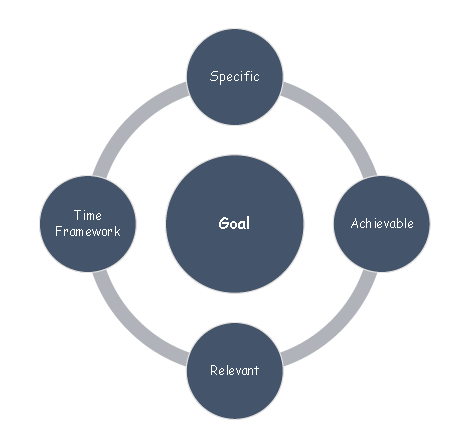
Relevant − Some goals are of such kind that it is fascinating for certain period of time, but later on loses its relevancy. For example, generally an athlete girl cannot pursue her goal for a long time; future circumstances post marriage might create many problems in her personal as well as professional life.
Time Framework − You have to fix a time period to attain your goal.
