
Article Categories
- All Categories
-
 Data Structure
-
 Networking
-
 RDBMS
RDBMS
-
 Operating System
-
 Java
Java
-
 MS Excel
-
 iOS
iOS
-
 HTML
HTML
-
 CSS
CSS
-
 Android
-
 Python
-
 C Programming
-
 C++
C++
-
 C#
C#
-
 MongoDB
-
 MySQL
MySQL
-
 Javascript
-
 PHP
PHP
-
 Economics & Finance
How to detect humans in an image in OpenCV Python?
To detect humans in an image and draw bounding boxes around them, you can use OpenCV's built-in HOG (Histogram of Oriented Gradients) descriptor with a pre-trained SVM classifier. This approach is effective for detecting pedestrians in upright positions.
Steps for Human Detection
Import the required library. In all the following examples, the required Python library is OpenCV. Make sure you have already installed it.
Read the input image using cv2.imread(). Specify the full image path.
Initialize a HOG descriptor object hog = cv2.HOGDescriptor() and set the SVM detector using hog.setSVMDetector() with the default people detector.
Detect humans in the input image using hog.detectMultiScale(). It returns the coordinates of detected humans in (x,y,w,h) format.
Loop over all detected humans in the image and draw the bounding rectangles around the detected humans using cv2.rectangle().
Display the image with the drawn bounding rectangles around the humans.
Let's have a look at the example below for more clear understanding.
We will use this image as the Input File for the following example
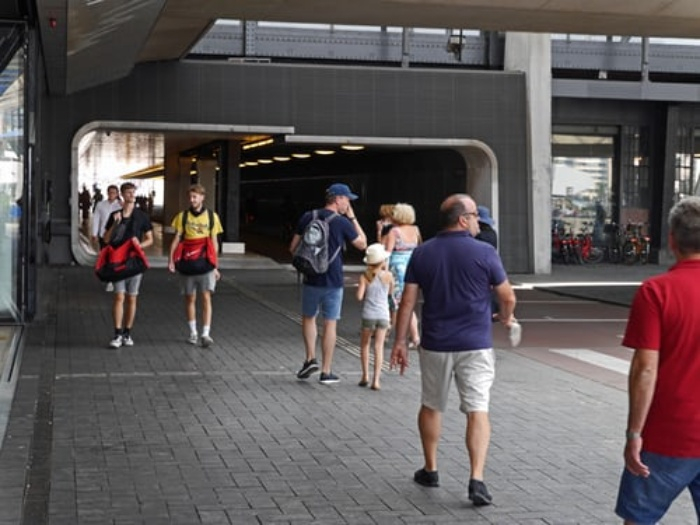
Example
In this example, we detect humans in the input image using the HOG descriptor ?
# import required libraries
import cv2

# Reading the Image
image = cv2.imread('people1.jpg')

# initialize the HOG descriptor
hog = cv2.HOGDescriptor()
hog.setSVMDetector(cv2.HOGDescriptor_getDefaultPeopleDetector())

# detect humans in input image
(humans, _) = hog.detectMultiScale(image, winStride=(10, 10),
                                   padding=(32, 32), scale=1.1)

# getting no. of human detected
print('Human Detected : ', len(humans))

# loop over all detected humans
for (x, y, w, h) in humans:
    pad_w, pad_h = int(0.15 * w), int(0.01 * h)
    cv2.rectangle(image, (x + pad_w, y + pad_h),
                  (x + w - pad_w, y + h - pad_h), (0, 255, 0), 2)

# display the output image
cv2.imshow("Image", image)
cv2.waitKey(0)
cv2.destroyAllWindows()
Output
When you run the above Python program, it will produce the following output
Human Detected: 4
And we get the following output window
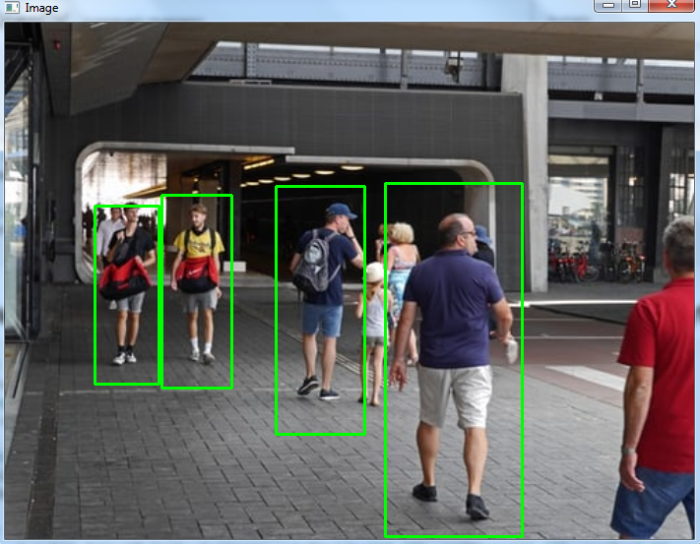
The bounding boxes around the detected humans are drawn with green color.
Key Parameters
The detectMultiScale() method accepts several important parameters ?
winStride Step size for the sliding window (smaller values = more thorough detection)
padding Number of pixels to pad around each detection window
scale Detection window scale factor between layers of the image pyramid
Conclusion
OpenCV's HOG descriptor with the default people detector provides an effective way to detect humans in images. The method works best for upright pedestrians and can be fine-tuned using the detectMultiScale parameters for better accuracy.

16K+ Views
