
Article Categories
- All Categories
-
 Data Structure
-
 Networking
-
 RDBMS
RDBMS
-
 Operating System
-
 Java
Java
-
 MS Excel
-
 iOS
iOS
-
 HTML
HTML
-
 CSS
CSS
-
 Android
-
 Python
-
 C Programming
-
 C++
C++
-
 C#
C#
-
 MongoDB
-
 MySQL
MySQL
-
 Javascript
-
 PHP
PHP
-
 Economics & Finance
Selected Reading
How to create a step histogram using ggplot2 in R?
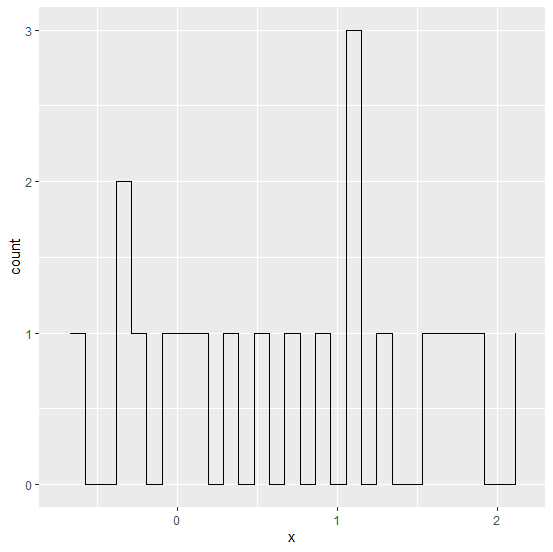
To create a step histogram using ggplot2, we can use geom="step" argument inside stat_bin function. For example, if we have a data frame that contains a single column then the step histogram can be created using the command − ggplot(df,aes(x))+stat_bin(geom="step",bins=30)
Example
library(ggplot2)
ggplot(df,aes(x))+stat_bin(geom="step",bins=30)
Output

Updated on: 2026-03-11T23:22:53+05:30
505 Views

Advertisements