
Article Categories
- All Categories
-
 Data Structure
-
 Networking
-
 RDBMS
RDBMS
-
 Operating System
-
 Java
Java
-
 MS Excel
-
 iOS
iOS
-
 HTML
HTML
-
 CSS
CSS
-
 Android
-
 Python
-
 C Programming
-
 C++
C++
-
 C#
C#
-
 MongoDB
-
 MySQL
MySQL
-
 Javascript
-
 PHP
PHP
-
 Economics & Finance
Wide Area Network (WAN)
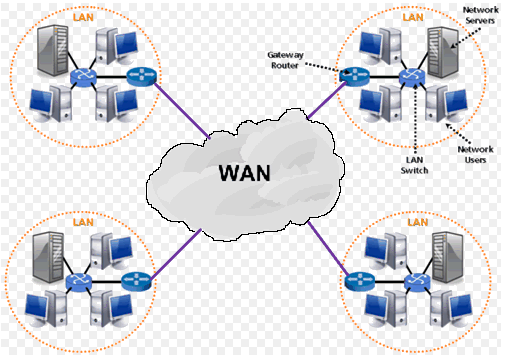
A Wide Area Network (WAN) is a computer network that covers a large geographical area comprising a region, a country, a continent, or even the whole world. WAN includes the technologies to transmit data, image, audio, and video information over long distances and among different LANs and MANs.
The Internet is the largest and most well-known example of a WAN. Organizations use WANs to connect their branch offices, data centers, and cloud services spread across different cities or countries.
Distinguishing Features of WAN
-
Large capacity and scalability − WANs connect a large number of computers over a vast area and are inherently scalable to accommodate growing networks.
-
Regional resource sharing − They facilitate the sharing of regional resources such as centralized databases, cloud storage, and enterprise applications across geographically distributed locations.
-
Uplink capability − They provide uplinks for connecting LANs and MANs to the Internet.
-
Public carrier links − Communication links are provided by public carriers like telephone networks, network providers, cable systems, satellites, and undersea fiber optic cables.
-
Lower speed − Typically, WANs have lower data transfer rates and higher propagation delay compared to LANs, resulting in slower communication speed.
-
Higher error rate − They generally have a higher bit error rate due to the long distances and multiple intermediate devices involved in data transmission.
How WAN Works
A WAN connects multiple LANs and MANs through long-distance communication links. Data travels from a local network through routers, across carrier networks (such as leased lines, MPLS, or satellite links), and arrives at the destination network. WAN protocols like PPP (Point-to-Point Protocol) and Frame Relay manage data transmission across these links.
Examples of WAN
-
The Internet − The largest WAN in existence, connecting billions of devices across the globe.
-
4G/5G Mobile Broadband − Cellular networks that provide wide-area wireless connectivity for mobile devices across countries.
-
Bank ATM Networks − A network of bank cash dispensers (ATMs) spread across cities and countries, allowing customers to access accounts from any location.
WAN vs LAN vs MAN
| Feature | LAN | MAN | WAN |
|---|---|---|---|
| Coverage | Building / Campus | City (5-50 km) | Country / Global |
| Speed | 100 Mbps - 10 Gbps | 100 Mbps - 1 Gbps | 10 Mbps - 100 Mbps |
| Ownership | Single organization | ISP or user group | Multiple ISPs / Telecom |
| Latency | Low | Moderate | High |
| Error Rate | Low | Moderate | Higher |
| Example | Office network | Cable TV, WiMAX | Internet, ATM network |
Conclusion
A Wide Area Network spans large geographical areas, connecting LANs and MANs across cities, countries, and continents using public carrier links. While WANs offer unmatched reach and scalability, they come with higher latency and error rates compared to smaller networks. The Internet, mobile broadband, and bank ATM networks are everyday examples of WAN technology in action.

28K+ Views
