
Article Categories
- All Categories
-
 Data Structure
-
 Networking
-
 RDBMS
RDBMS
-
 Operating System
-
 Java
Java
-
 MS Excel
-
 iOS
iOS
-
 HTML
HTML
-
 CSS
CSS
-
 Android
-
 Python
-
 C Programming
-
 C++
C++
-
 C#
C#
-
 MongoDB
-
 MySQL
MySQL
-
 Javascript
-
 PHP
PHP
-
 Economics & Finance
Metropolitan Area Networks (MAN)
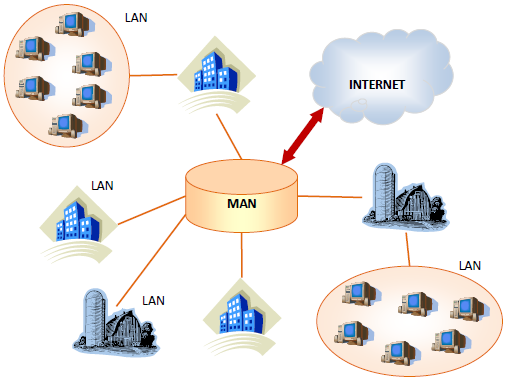
A Metropolitan Area Network (MAN) is a network with a size greater than a LAN but smaller than a WAN. It normally comprises networked interconnections within a city that also offers a connection to the Internet. A MAN typically covers a geographical area ranging from 5 to 50 kilometers, making it ideal for connecting multiple offices, campuses, or buildings across a city.
Distinguishing Features of MAN
-
Network size − Generally ranges from 5 to 50 km. It may be as small as a group of buildings in a campus to as large as covering an entire city.
-
Data rates − Data transfer rates are moderate to high, typically ranging from 100 Mbps to 1 Gbps depending on the technology used.
-
Ownership − A MAN is either owned by a user group or by a network provider who sells service to users, rather than a single organization as in a LAN.
-
Resource sharing − It facilitates sharing of regional resources such as databases, servers, and internet access across the metropolitan area.
-
Uplink capability − MANs provide uplinks for connecting LANs to WANs and the Internet, acting as a bridge between local and wide-area connectivity.
How MAN Works
A MAN connects multiple LANs within a city or metropolitan region using high-capacity backbone links such as fiber optic cables. Each LAN connects to the MAN backbone through routers or switches, and the MAN backbone in turn connects to a WAN or the Internet through a gateway.
Examples of MAN
-
Cable TV network − Cable television infrastructure often spans an entire city and is commonly used to deliver both TV and internet services.
-
Telephone networks − Telephone networks providing high-speed DSL lines across a metropolitan area.
-
IEEE 802.16 (WiMAX) − A wireless standard that provides high-speed broadband access with Internet connectivity to customer premises across a city-wide area.
MAN vs LAN vs WAN
| Feature | LAN | MAN | WAN |
|---|---|---|---|
| Coverage | Building / Campus | City / Metro area (5-50 km) | Country / Global |
| Speed | 100 Mbps - 1 Gbps | 100 Mbps - 1 Gbps | 10 Mbps - 100 Mbps |
| Ownership | Single organization | User group or ISP | Multiple ISPs / Telecom |
| Example | Office network | Cable TV, WiMAX | Internet |
| Latency | Low | Moderate | High |
Conclusion
A Metropolitan Area Network bridges the gap between LANs and WANs by connecting multiple local networks across a city or campus. It is commonly implemented using cable TV infrastructure, DSL lines, or WiMAX technology, and plays a key role in enabling regional resource sharing and Internet connectivity for organizations spread across a metropolitan area.

8K+ Views
