
Article Categories
- All Categories
-
 Data Structure
-
 Networking
-
 RDBMS
RDBMS
-
 Operating System
-
 Java
Java
-
 MS Excel
-
 iOS
iOS
-
 HTML
HTML
-
 CSS
CSS
-
 Android
-
 Python
-
 C Programming
-
 C++
C++
-
 C#
C#
-
 MongoDB
-
 MySQL
MySQL
-
 Javascript
-
 PHP
PHP
-
 Economics & Finance
Selected Reading
How to create stacked bar chart using ggvis in R?
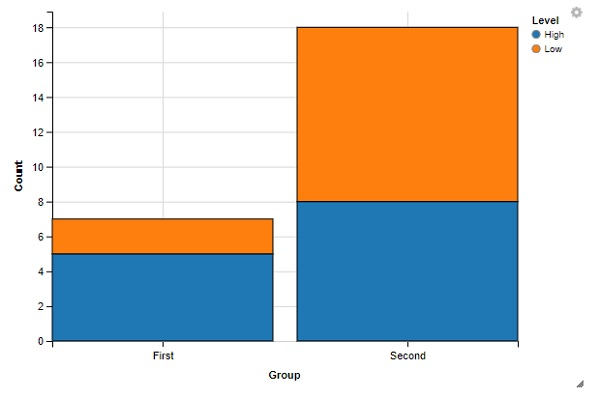
To create stacked bar chart using ggvis, we can follow the below steps −
- First of all, create a data frame.
- Create the stacked bar chart with layer_bars function of ggvis package.
Create the data frame
Let's create a data frame as shown below −
Group<-c("First","Second","First","Second")
Level<-c("Low","Low","High","High")
Count<-c(2,10,5,8)
df<-data.frame(Group,Level,Count)
df
On executing, the above script generates the below output(this output will vary on your system due to randomization) −
   Group Level Count
1  First  Low    2
2  Second Low   10
3  First  High   5
4  Second High   8
Create the stacked bar chart with ggvis
Use layer_bars function of ggvis package to create the stacked bar chart for the data given in data frame df −
Group<-c("First","Second","First","Second")
Level<-c("Low","Low","High","High")
Count<-c(2,10,5,8)
df<-data.frame(Group,Level,Count)
library(ggvis)
df %>% ggvis(x=~Group, y=~Count, fill=~Level) %>% group_by(Level) %>%
layer_bars()
Output

Updated on: 2026-03-11T22:50:58+05:30
329 Views

Advertisements