
Article Categories
- All Categories
-
 Data Structure
-
 Networking
-
 RDBMS
RDBMS
-
 Operating System
-
 Java
Java
-
 MS Excel
-
 iOS
iOS
-
 HTML
HTML
-
 CSS
CSS
-
 Android
-
 Python
-
 C Programming
-
 C++
C++
-
 C#
C#
-
 MongoDB
-
 MySQL
MySQL
-
 Javascript
-
 PHP
PHP
-
 Economics & Finance
How Autoencoders works?
Autoencoders are a powerful category of neural networks used for unsupervised learning and dimensionality reduction. They learn compact representations of input data by encoding it into a lower-dimensional latent space and then decoding it back to reconstruct the original input. This article explores how autoencoders work in Python using Keras.
What are Autoencoders?
Autoencoders are neural networks designed to reconstruct input data through two main components:
Encoder: Compresses input data into a lower-dimensional latent representation
Decoder: Reconstructs the original input from the compressed representation
The network is trained to minimize reconstruction error, forcing it to learn meaningful patterns and features in the data. Common applications include dimensionality reduction, anomaly detection, denoising, and generative modeling.
How Autoencoders Work
Autoencoders learn by minimizing the difference between input and reconstructed output. The encoder compresses data into essential features, while the decoder reconstructs the original from this compressed representation. This process forces the network to learn meaningful data patterns.
Implementation Example
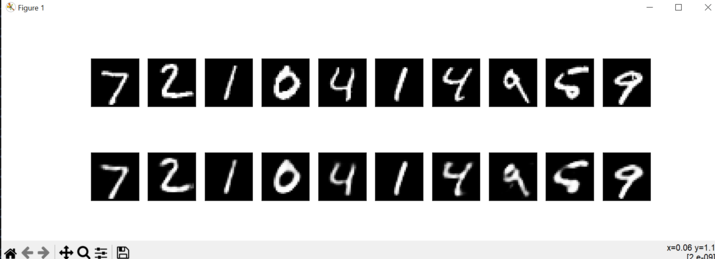
Let's build an autoencoder using the MNIST dataset to demonstrate how it works ?
import numpy as np
import matplotlib.pyplot as plt
from keras.datasets import mnist
from keras.layers import Input, Dense
from keras.models import Model

# Load and preprocess the MNIST dataset
(x_train_m, _), (x_test_m, _) = mnist.load_data()

# Normalize pixel values between 0 and 1
x_train_m = x_train_m.astype('float32') / 255.
x_test_m = x_test_m.astype('float32') / 255.

# Reshape the input images to flatten them
x_train = x_train_m.reshape((len(x_train_m), np.prod(x_train_m.shape[1:])))
x_test = x_test_m.reshape((len(x_test_m), np.prod(x_test_m.shape[1:])))

# Define the size of the latent space
latent_dim = 32

# Define the input layer
input_img = Input(shape=(784,))

# Define the encoder layers
encoded1 = Dense(128, activation='relu')(input_img)
encoded2 = Dense(latent_dim, activation='relu')(encoded1)

# Define the decoder layers
decoded1 = Dense(128, activation='relu')(encoded2)
decoded2 = Dense(784, activation='sigmoid')(decoded1)

# Create the autoencoder model
autoencoder = Model(input_img, decoded2)

# Create separate encoder and decoder models
encoder = Model(input_img, encoded2)

# Define the decoder input
latent_input = Input(shape=(latent_dim,))
decoder_layer = autoencoder.layers[-2](latent_input)
decoder_layer = autoencoder.layers[-1](decoder_layer)
decoder = Model(latent_input, decoder_layer)

# Compile the autoencoder
autoencoder.compile(optimizer='adam', loss='binary_crossentropy')

# Train the autoencoder
autoencoder.fit(x_train, x_train,
                epochs=50,
                batch_size=256,
                shuffle=True,
                validation_data=(x_test, x_test))

# Encode and decode the test data
encoded_imgs = encoder.predict(x_test)
decoded_imgs = decoder.predict(encoded_imgs)

# Display original and reconstructed images
n = 10
plt.figure(figsize=(20, 4))
for i in range(n):
    # Original image
    ax = plt.subplot(2, n, i+1)
    plt.imshow(x_test[i].reshape(28, 28))
    plt.gray()
    ax.get_xaxis().set_visible(False)
    ax.get_yaxis().set_visible(False)

    # Reconstructed image
    ax = plt.subplot(2, n, i+n+1)
    plt.imshow(decoded_imgs[i].reshape(28, 28))
    plt.gray()
    ax.get_xaxis().set_visible(False)
    ax.get_yaxis().set_visible(False)
plt.show()
Output
Key Components Explained
| Component | Input Size | Output Size | Purpose |
|---|---|---|---|
| Input Layer | 784 | 784 | Flattened 28×28 images |
| Encoder Layer 1 | 784 | 128 | First compression |
| Latent Space | 128 | 32 | Compressed representation |
| Decoder Layer 1 | 32 | 128 | Begin reconstruction |
| Output Layer | 128 | 784 | Reconstructed image |
Conclusion
Autoencoders provide a powerful framework for learning compressed data representations through encoder-decoder architecture. They effectively capture important features and patterns, making them valuable for dimensionality reduction, anomaly detection, and generative modeling tasks.
---
620 Views
