
Article Categories
- All Categories
-
 Data Structure
-
 Networking
-
 RDBMS
RDBMS
-
 Operating System
-
 Java
Java
-
 MS Excel
-
 iOS
iOS
-
 HTML
HTML
-
 CSS
CSS
-
 Android
-
 Python
-
 C Programming
-
 C++
C++
-
 C#
C#
-
 MongoDB
-
 MySQL
MySQL
-
 Javascript
-
 PHP
PHP
Homomorphism
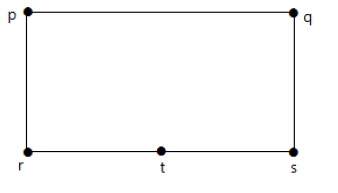
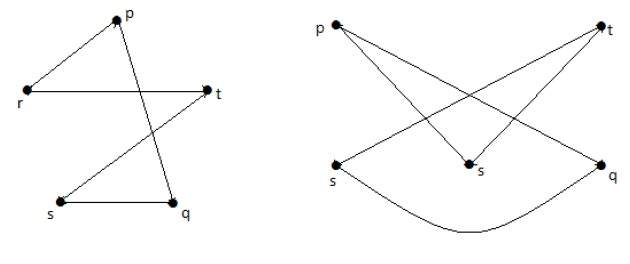
Two graphs G1 and G2 are said to be homomorphic, if each of these graphs can be obtained from the same graph 'G' by dividing some edges of G with more vertices. Take a look at the following example −
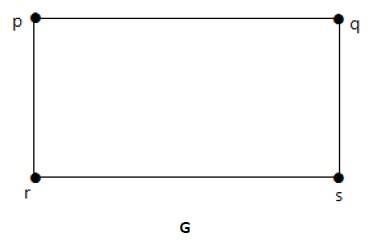
Divide the edge 'rs' into two edges by adding one vertex.
The graphs shown below are homomorphic to the first graph.
If G1 is isomorphic to G2, then G is homeomorphic to G2 but the converse need not be true.
Any graph with 4 or less vertices is planar.
Any graph with 8 or less edges is planar.
A complete graph Kn is planar if and only if n ≤ 4.
The complete bipartite graph Km, n is planar if and only if m ≤ 2 or n ≤ 2.
A simple non-planar graph with minimum number of vertices is the complete graph K5.
The simple non-planar graph with minimum number of edges is K3, 3.
Polyhedral graph
A simple connected planar graph is called a polyhedral graph if the degree of each vertex is ≥ 3, i.e., deg(V) ≥ 3 ∀ V ? G.
- 3|V| ≤ 2|E|
- 3|R| ≤ 2|E|

2K+ Views
