
Article Categories
- All Categories
-
 Data Structure
-
 Networking
-
 RDBMS
RDBMS
-
 Operating System
-
 Java
Java
-
 MS Excel
-
 iOS
iOS
-
 HTML
HTML
-
 CSS
CSS
-
 Android
-
 Python
-
 C Programming
-
 C++
C++
-
 C#
C#
-
 MongoDB
-
 MySQL
MySQL
-
 Javascript
-
 PHP
PHP
-
 Economics & Finance
Selected Reading
C Program to construct a DFA which accepts L = {aN | N ≥ 1}
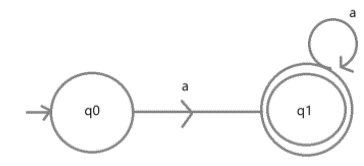
Let us take a string S of size N, we have to design a Deterministic Finite Automata (DFA) for accepting the language L = {aN | N ≥ 1}.
The string accepting the language L is {a, aa, aaa, aaaaaaa…, }.
Now the user has to enter a string, if that string is present in the given language, then print “entered string is Accepted”. Otherwise, print “entered string is not Accepted”.
DFA transition diagram for the given language is −
Example
Following is the C program to construct DFA which accepts the language L = {aN | N ≥ 1} −
#include<stdio.h>
int main() {
   char S[30];
   int l,i;
   int count = 0;
   printf("To implement DFA of language {aN | N ≥ 1} <br> enter input string:");
   scanf("%s",S);
   l=strlen(S);
   for (i=0;i<l;i++) {
      if(S[i]!='a') {
         printf("entered string is NOT ACCEPTED");
         getch();
         exit(0);
      }
      if (S[i] == 'a')
         count++;
      else
         printf("invalid input");
   }
   if (count == l && count != 0) {
      printf("entered string is accepted");
   }
   return 0;
}
Output
You will get the following output −
Run 1:
To implement DFA of language {aN | N >= 1}
enter input string:aaaa
entered string is accepted
Run 2:
To implement DFA of language {aN | N >= 1}
enter input string:badsaa
entered string is NOT ACCEPTED 
Updated on: 2021-06-14T15:19:30+05:30
1K+ Views

Advertisements