
Article Categories
- All Categories
-
 Data Structure
-
 Networking
-
 RDBMS
RDBMS
-
 Operating System
-
 Java
Java
-
 MS Excel
-
 iOS
iOS
-
 HTML
HTML
-
 CSS
CSS
-
 Android
-
 Python
-
 C Programming
-
 C++
C++
-
 C#
C#
-
 MongoDB
-
 MySQL
MySQL
-
 Javascript
-
 PHP
PHP
-
 Economics & Finance
Selected Reading
Transitive closure of a Graph
Transitive Closure it the reachability matrix to reach from vertex u to vertex v of a graph. One graph is given, we have to find a vertex v which is reachable from another vertex u, for all vertex pairs (u, v).
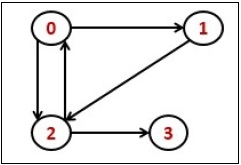
The final matrix is the Boolean type. When there is a value 1 for vertex u to vertex v, it means that there is at least one path from u to v.
Input and Output
Input:
1 1 0 1
0 1 1 0
0 0 1 1
0 0 0 1

Output:
The matrix of transitive closure
1 1 1 1
0 1 1 1
0 0 1 1
0 0 0 1
Algorithm
transColsure(graph)
Input: The given graph.
Output: Transitive Closure matrix.
Begin
   copy the adjacency matrix into another matrix named transMat
   for any vertex k in the graph, do
      for each vertex i in the graph, do
         for each vertex j in the graph, do
            transMat[i, j] := transMat[i, j] OR (transMat[i, k]) AND transMat[k, j])
         done
      done
   done
   Display the transMat
End
Example
#include#include #define NODE 4 using namespace std; /* int graph[NODE][NODE] = { {0, 1, 1, 0}, {0, 0, 1, 0}, {1, 0, 0, 1}, {0, 0, 0, 0} }; */ int graph[NODE][NODE] = { {1, 1, 0, 1}, {0, 1, 1, 0}, {0, 0, 1, 1}, {0, 0, 0, 1} }; int result[NODE][NODE]; void transClosure() { for(int i = 0; i Output
1 1 1 1 0 1 1 1 0 0 1 1 0 0 0 1

Updated on: 2020-06-16T13:54:00+05:30
21K+ Views

Advertisements