
Article Categories
- All Categories
-
 Data Structure
-
 Networking
-
 RDBMS
RDBMS
-
 Operating System
-
 Java
Java
-
 MS Excel
-
 iOS
iOS
-
 HTML
HTML
-
 CSS
CSS
-
 Android
-
 Python
-
 C Programming
-
 C++
C++
-
 C#
C#
-
 MongoDB
-
 MySQL
MySQL
-
 Javascript
-
 PHP
PHP
-
 Economics & Finance
Perfect Competition Defining Features
Perfect competition represents an idealized market structure where numerous buyers and sellers trade homogeneous products under conditions of complete information and free market entry. In this theoretical framework, no single participant can influence market prices, which are determined purely by the forces of supply and demand.
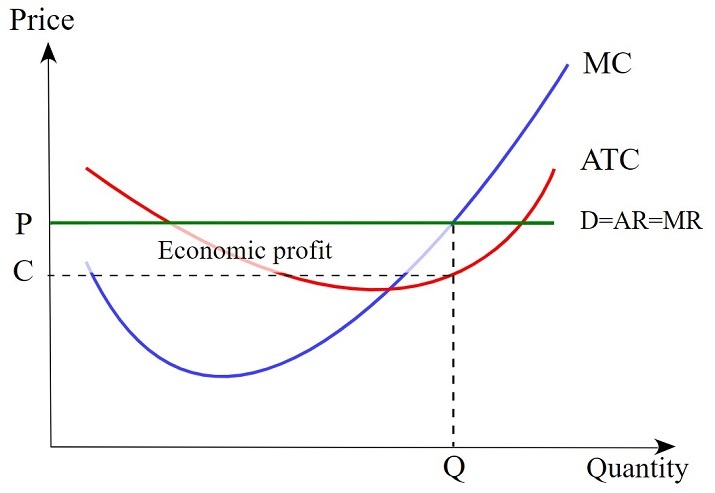
Key Features of Perfect Competition
Large Number of Buyers and Sellers
Perfect competition requires numerous participants on both sides of the market. No single firm can monopolize or significantly influence market conditions. This abundance ensures continuous market activity with balanced demand and supply forces. The presence of many buyers prevents any seller from having excessive pricing power, while multiple sellers ensure competitive pricing and product availability.
Free Market Entry and Exit
There are no barriers preventing new firms from entering the market or existing firms from leaving. This free movement ensures that economic profits attract new entrants, while losses encourage exits, maintaining market equilibrium. In reality, most markets have some barriers like licensing requirements, capital investments, or regulatory hurdles, making perfect competition largely theoretical.
Homogeneous Products
All firms sell identical products that are perfect substitutes for each other. Product differentiation through branding, quality variations, or unique features does not exist. This uniformity ensures that buyers make purchasing decisions based solely on price, as no seller can claim product superiority to justify premium pricing.
Perfect Information
Both buyers and sellers possess complete knowledge about market conditions, including current prices, product quality, and availability. This transparency prevents information asymmetries that could lead to market inefficiencies. Sellers cannot exploit uninformed buyers, and buyers can make optimal purchasing decisions.
No Transaction Costs
Trading occurs without additional costs such as transportation, taxes, or intermediary fees. The price paid by buyers equals the price received by sellers. This assumption simplifies market analysis but is unrealistic in practice, where various costs accompany most transactions.
Example of Near-Perfect Competition
Agricultural commodity markets, such as wheat trading, approximate perfect competition. Consider a wheat market where:
- Many farmers thousands of wheat producers
- Homogeneous product wheat of the same grade is identical
- Price transparency commodity exchanges publish current prices
- Low entry barriers farmers can switch crops relatively easily
Price Determination in Perfect Competition
In perfect competition, market price is determined by the intersection of aggregate supply and demand curves. Individual firms are price-takers, accepting the market price as given. The equilibrium condition can be expressed as:
$$\mathrm{P = MC = MR = AR}$$
- P Market price
- MC Marginal cost
- MR Marginal revenue
- AR Average revenue
Real-World Applications
While perfect competition rarely exists in pure form, understanding its principles helps analyze:
- Commodity markets agricultural products, metals, and energy resources
- Stock exchanges standardized securities with transparent pricing
- Foreign exchange currency trading with minimal differentiation
- Policy analysis benchmark for evaluating market efficiency and regulation
Comparison with Other Market Structures
| Feature | Perfect Competition | Monopolistic Competition | Oligopoly | Monopoly |
|---|---|---|---|---|
| Number of Firms | Many | Many | Few | One |
| Product Type | Homogeneous | Differentiated | Homogeneous/Differentiated | Unique |
| Entry Barriers | None | Low | High | Very High |
| Price Control | None | Limited | Considerable | Complete |
Advantages and Limitations
Advantages: Perfect competition promotes maximum economic efficiency, consumer welfare through lowest possible prices, and optimal resource allocation. It serves as an important theoretical benchmark for policy analysis.
Limitations: The model is highly unrealistic as it ignores product innovation, economies of scale, and real-world market imperfections. Most actual markets deviate significantly from perfect competition conditions.
Conclusion
Perfect competition remains a valuable theoretical concept despite its impractical nature in real markets. It provides insights into efficient market functioning and serves as a benchmark for evaluating actual market performance and regulatory policies.
FAQs
Q1. What are the four main features of perfect competition?
The four main features are: (1) Large number of buyers and sellers, (2) Homogeneous products, (3) Free entry and exit, and (4) Perfect information about prices and products.
Q2. Can companies determine prices in perfect competition?
No. In perfect competition, individual firms are price-takers and must accept the market price determined by overall supply and demand forces.
Q3. Do perfectly competitive markets exist in reality?
Pure perfect competition is largely theoretical. However, some markets like agricultural commodities and stock exchanges approximate perfectly competitive conditions.
Q4. Why is perfect information important in perfect competition?
Perfect information ensures that all market participants make optimal decisions based on complete knowledge, preventing any party from exploiting information advantages and maintaining market efficiency.
Q5. How does perfect competition benefit consumers?
Perfect competition leads to the lowest possible prices, maximum product choice within the category, and efficient resource allocation, ultimately maximizing consumer welfare.

309 Views
