
Article Categories
- All Categories
-
 Data Structure
-
 Networking
-
 RDBMS
RDBMS
-
 Operating System
-
 Java
Java
-
 MS Excel
-
 iOS
iOS
-
 HTML
HTML
-
 CSS
CSS
-
 Android
-
 Python
-
 C Programming
-
 C++
C++
-
 C#
C#
-
 MongoDB
-
 MySQL
MySQL
-
 Javascript
-
 PHP
PHP
-
 Economics & Finance
What is Polar Encoding?
Polar encoding is a digital encoding scheme that uses two voltage levels ? one positive and one negative ? to represent binary data. Unlike unipolar encoding which uses only one polarity, polar encoding eliminates the DC component by using both positive and negative voltages, resulting in better signal transmission characteristics.
In polar encoding, the average voltage is reduced to zero over time because positive and negative voltages cancel each other out. This makes it superior to unipolar schemes for long-distance communication as it reduces power consumption and improves signal integrity.
Types of Polar Encoding
Polar encoding is divided into two main categories: NRZ (Non-Return to Zero) and RZ (Return to Zero) schemes, each with specific variants designed for different communication requirements.
NRZ (Non-Return to Zero) Encoding
In NRZ encoding, the signal level remains constant during the entire bit duration. There are three main approaches in NRZ encoding:
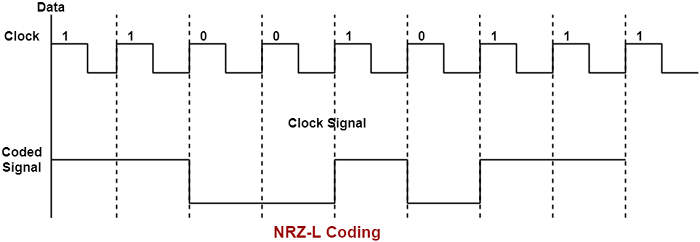
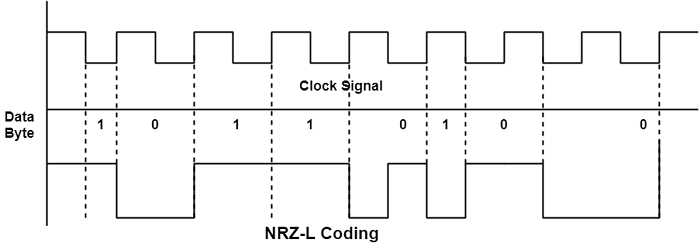
Non-Return to Zero Level (NRZ-L)
In NRZ-L, each bit is represented by a specific voltage level that remains constant throughout the bit duration. Typically, binary '1' is represented by a positive voltage and binary '0' by a negative voltage.
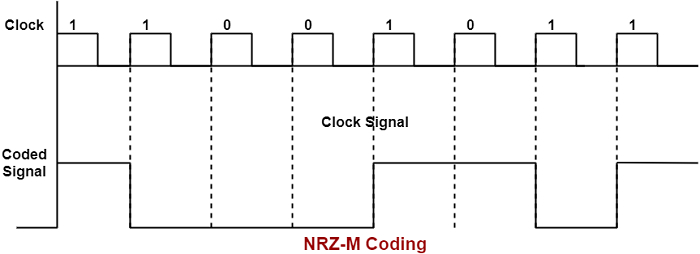
Non-Return to Zero Mark (NRZ-M)
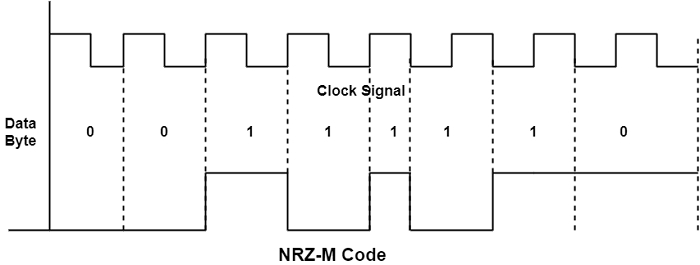
NRZ-M uses signal transitions to represent data. A transition occurs for binary '1' (mark), while binary '0' (space) maintains the previous signal level. This differential encoding helps in clock recovery.
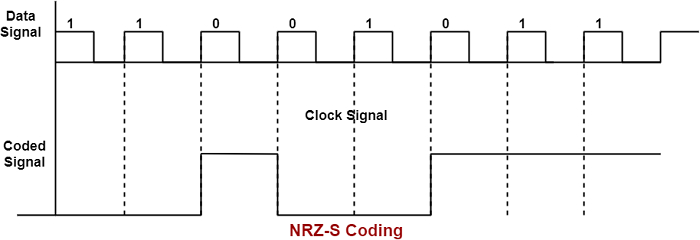
Non-Return to Zero Space (NRZ-S)
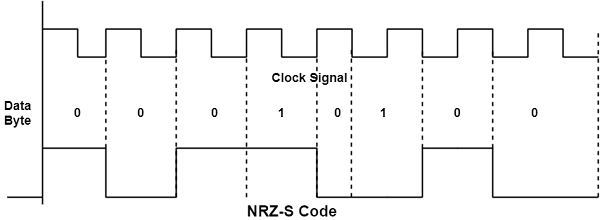
NRZ-S is similar to NRZ-M but with inverted logic. The signal changes only for binary '0' (space) and remains constant for binary '1' (mark). This provides an alternative differential encoding approach.
RZ (Return to Zero) Encoding
RZ encoding addresses the clock recovery limitation of NRZ by ensuring signal transitions within each bit period. The signal returns to zero voltage during part of the bit duration, enabling better synchronization.
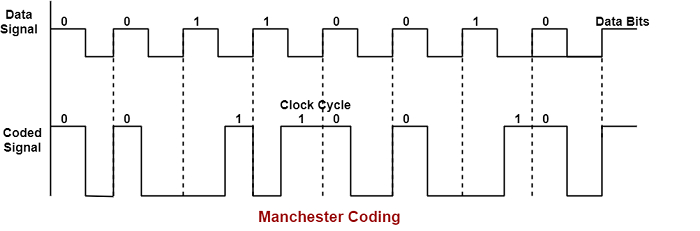
Manchester Code
Manchester encoding uses mid-bit transitions to represent data: a negative-to-positive transition represents binary '1', while a positive-to-negative transition represents binary '0'. This guarantees at least one transition per bit, making clock recovery reliable.
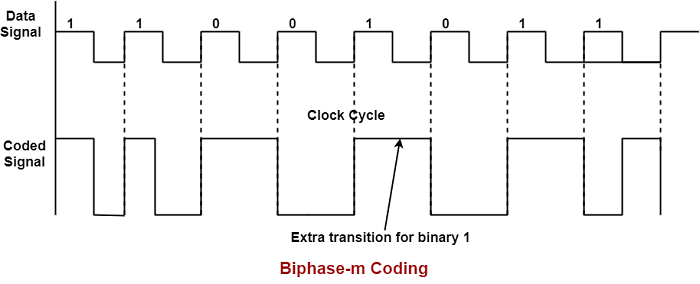
Biphase-M Code
Biphase-M always has a transition at the beginning of each bit interval. Binary '1' (mark) includes an additional transition in the middle of the bit period, while binary '0' has no mid-bit transition.
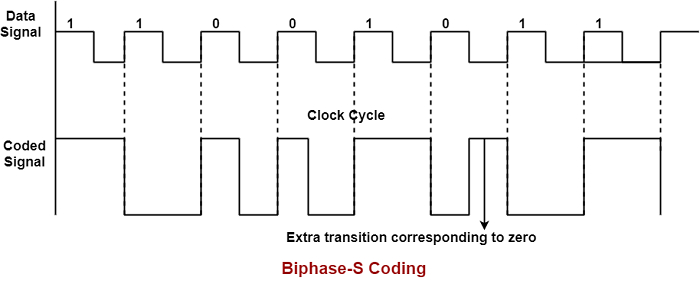
Biphase-S Code
Biphase-S is similar to Biphase-M but with inverted logic. It has a transition at each bit boundary, with binary '0' (space) having an additional mid-bit transition instead of binary '1'.
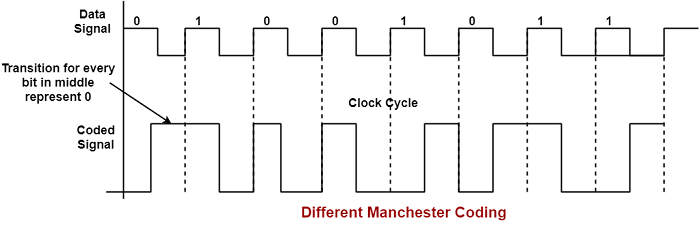
Differential Manchester Code
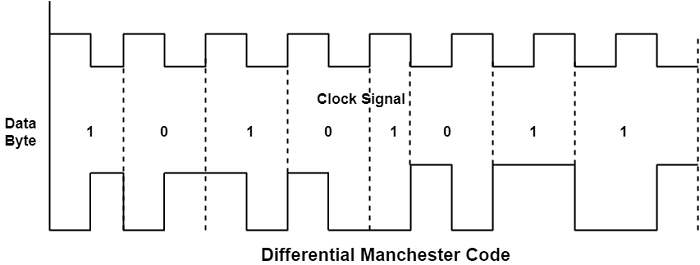
Differential Manchester combines the benefits of Manchester encoding with differential signaling. It always has a mid-bit transition, with binary '0' having an additional transition at the bit boundary.
Comparison of Polar Encoding Schemes
| Encoding Type | Clock Recovery | Bandwidth Efficiency | Common Applications |
|---|---|---|---|
| NRZ-L | Poor | High | Short-distance communication |
| Manchester | Excellent | Medium | Ethernet LANs |
| Differential Manchester | Excellent | Medium | Token Ring networks |
Examples
Example 1: NRZ-L Code for Data Byte 10110100
Example 2: NRZ-S Code for Data Byte 00010100
Example 3: NRZ-M Code for Data Byte 00111110
Example 4: Differential Manchester Coding for Data Bytes 10101011
Conclusion
Polar encoding schemes use both positive and negative voltages to eliminate DC components and improve signal transmission. While NRZ variants offer bandwidth efficiency, RZ schemes like Manchester encoding provide superior clock recovery capabilities, making them ideal for network communications where synchronization is critical.

6K+ Views
