
Article Categories
- All Categories
-
 Data Structure
-
 Networking
-
 RDBMS
RDBMS
-
 Operating System
-
 Java
Java
-
 MS Excel
-
 iOS
iOS
-
 HTML
HTML
-
 CSS
CSS
-
 Android
-
 Python
-
 C Programming
-
 C++
C++
-
 C#
C#
-
 MongoDB
-
 MySQL
MySQL
-
 Javascript
-
 PHP
PHP
-
 Economics & Finance
SEBI: Objectives and Functions
The Securities and Exchange Board of India (SEBI) is the regulatory body that manages and oversees the securities market in India. Established on April 12, 1988, as an autonomous statutory body under the Securities and Exchange Board of India Act, 1992, SEBI serves as the watchdog of India's capital markets. Its primary mission is to protect investors, promote fair trading practices, and foster the development of a transparent and efficient securities market.
Structure of SEBI
The Securities and Exchange Board of India follows a well-defined organizational structure designed to effectively regulate the securities market.
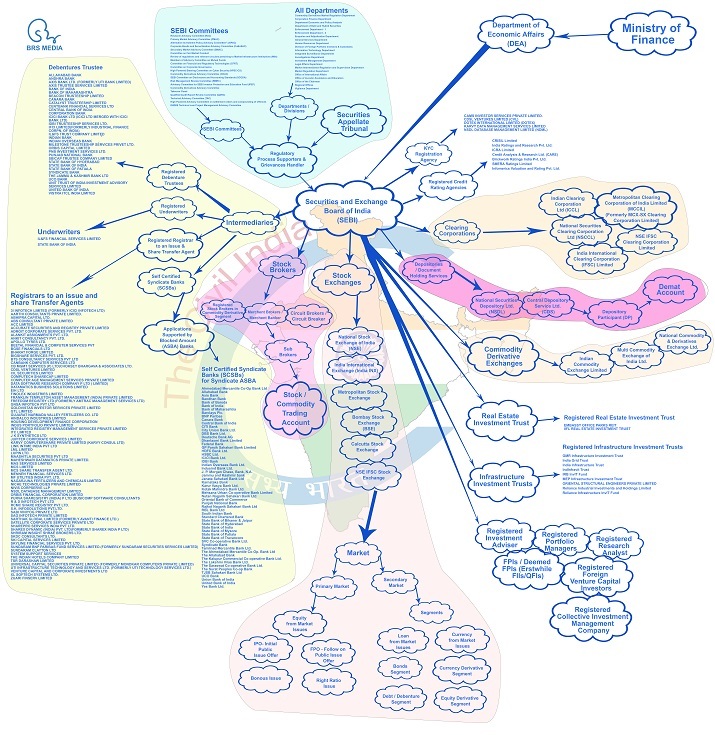
Here is an overview of its structure
Chairman Appointed by the Government of India, the Chairman heads SEBI and provides strategic direction and leadership to the organization.
Board of Directors Consists of representatives from the Government of India, Reserve Bank of India (RBI), and independent members. The Board makes regulatory decisions, formulates policies, and oversees SEBI's functioning.
-
Departments SEBI operates through specialized departments handling different regulatory functions:
Legal Affairs Department Handles legal matters and assists in formulating regulations
Enforcement Department Investigates violations and initiates enforcement actions
Market Intermediaries Regulation Department Regulates stockbrokers, sub-brokers, and depositories
Corporation Finance Department Oversees listed companies and corporate governance
Investment Management Department Regulates mutual funds and asset management companies
Market Regulation Department Monitors stock exchanges and trading activities
Investor Education and Protection Department Focuses on investor awareness and grievance redressal
Regional Offices Located in major cities across India, these offices serve as local centers for inspections, operations, and investor services.
Committees and Panels SEBI forms various advisory committees comprising officials, industry experts, and stakeholders to propose regulatory changes and provide expert opinions.
Key Functions of SEBI
SEBI performs multiple regulatory and supervisory functions to maintain market integrity:
Registration and Regulation Registers and regulates market participants including stockbrokers, investment advisors, and mutual funds
Market Oversight Regulates stock exchanges and other market intermediaries
Fair Practice Promotion Prevents unfair and fraudulent trade practices
Insider Trading Prevention Prohibits insider trading and regulates company takeovers
Investigation and Inspection Ensures compliance with securities laws through regular monitoring
Mutual Fund Regulation Oversees collective investment schemes
Investor Education Educates investors about their rights and responsibilities
Corporate Governance Sets disclosure requirements and listing obligations for companies
Primary Objectives of SEBI
Investor Protection
SEBI creates a fair and transparent market environment where investors can make informed decisions with confidence in market integrity.
Market Development and Regulation
SEBI develops and regulates the securities market by formulating rules and guidelines for market participants, ensuring orderly market functioning.
Fraud Prevention and Fair Practices
SEBI prevents insider trading, market manipulation, and fraudulent schemes that could harm investors or undermine market confidence.
Market Efficiency and Transparency
SEBI promotes disclosure requirements and corporate governance standards, encouraging timely and accurate information dissemination.
Intermediary Regulation
SEBI regulates stockbrokers, merchant bankers, investment advisors, and credit rating agencies through registration requirements and compliance monitoring.
Investor Education and Awareness
SEBI conducts investor education programs to enhance financial literacy and empower informed investment decisions.
Real-World Applications
SEBI's regulatory framework impacts various stakeholders:
Individual Investors Benefit from investor protection measures and transparent market practices
Companies Must comply with listing requirements, disclosure norms, and corporate governance standards
Market Intermediaries Operate under SEBI registration and follow prescribed conduct rules
Mutual Fund Industry Functions under SEBI regulations ensuring investor protection and fair practices
Conclusion
SEBI plays a crucial role in maintaining investor confidence, promoting market integrity, and facilitating the growth of India's securities market. As the primary regulator, SEBI ensures fair, transparent, and efficient capital markets, making it indispensable for India's financial ecosystem and economic development.
FAQs
Q1. What is SEBI and when was it established?
The Securities and Exchange Board of India (SEBI) is the regulatory body responsible for overseeing India's securities market. It was established on April 12, 1988, as an autonomous statutory body under the Securities and Exchange Board of India Act, 1992.
Q2. What are the main objectives of SEBI?
SEBI's main objectives include investor protection, regulation and development of securities markets, preventing fraudulent practices, promoting market transparency, and educating investors.
Q3. Which institution regulates stockbrokers and mutual funds in India?
SEBI regulates and registers all securities market participants including stockbrokers, sub-brokers, investment advisors, and mutual funds in India.

1K+ Views
