
Article Categories
- All Categories
-
 Data Structure
-
 Networking
-
 RDBMS
RDBMS
-
 Operating System
-
 Java
Java
-
 MS Excel
-
 iOS
iOS
-
 HTML
HTML
-
 CSS
CSS
-
 Android
-
 Python
-
 C Programming
-
 C++
C++
-
 C#
C#
-
 MongoDB
-
 MySQL
MySQL
-
 Javascript
-
 PHP
PHP
-
 Economics & Finance
How to list files from SD card with runtime permission in android?
This example demonstrates How to list files from SD card with runtime permission in android.
Step 1 − Create a new project in Android Studio, go to File ⇒ New Project and fill all required details to create a new project.
Step 2 − Add the following code to res/layout/activity_main.xml.
<?xml version = "1.0" encoding = "utf-8"?>
<LinearLayout xmlns:android = "http://schemas.android.com/apk/res/android"
   xmlns:tools = "http://schemas.android.com/tools"
   android:layout_width = "match_parent"
   android:layout_height = "match_parent"
   tools:context = ".MainActivity"
   android:orientation = "vertical">
   <Button
      android:id = "@+id/read"
      android:text = "read"
      android:layout_width = "wrap_content"
      android:layout_height = "wrap_content" />
   <ListView
      android:id = "@+id/list"
      android:layout_width = "match_parent"
      android:layout_height = "wrap_content"></ListView>
</LinearLayout>
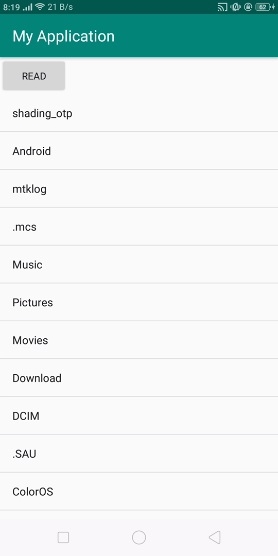
In the above code, we have taken list view and button. When user click on button, it will take data from external storage and append the data to list view.
Step 3 − Add the following code to src/MainActivity.java
package com.example.andy.myapplication;

import android.content.pm.PackageManager;
import android.os.Build;
import android.os.Bundle;
import android.os.Environment;
import android.support.v4.app.ActivityCompat;
import android.support.v4.content.ContextCompat;
import android.support.v7.app.AppCompatActivity;
import android.util.Log;
import android.view.View;
import android.widget.ArrayAdapter;
import android.widget.Button;
import android.widget.ListView;
import android.widget.Toast;

import java.io.File;
import java.util.ArrayList;

public class MainActivity extends AppCompatActivity {
   private static final int PERMISSION_REQUEST_CODE = 100;
   Button read;
   ArrayList<String> myList;
   ListView listview;
   @Override
   protected void onCreate(Bundle savedInstanceState) {
      super.onCreate(savedInstanceState);
      setContentView(R.layout.activity_main);
      listview = findViewById(R.id.list);
      read = findViewById(R.id.read);
      myList = new ArrayList<>();
      read.setOnClickListener(new View.OnClickListener() {
         @Override
         public void onClick(View v) {
            String state = Environment.getExternalStorageState();
            if (Environment.MEDIA_MOUNTED.equals(state)) {
               if (Build.VERSION.SDK_INT > = 23) {
                  if (checkPermission()) {
                     File dir = new File(Environment.getExternalStorageDirectory().getAbsolutePath() + "/");
                     if (dir.exists()) {
                        Log.d("path", dir.toString());
                        File list[] = dir.listFiles();
                        for (int i = 0; i < list.length; i++) {
                           myList.add(list[i].getName());
                        }
                        ArrayAdapter arrayAdapter = new ArrayAdapter(MainActivity.this, android.R.layout.simple_list_item_1, myList);
                        listview.setAdapter(arrayAdapter);
                     }
                  } else {
                     requestPermission(); // Code for permission
                  }
               } else {
                  File dir = new File(Environment.getExternalStorageDirectory().getAbsolutePath() + "/");
                  if (dir.exists()) {
                     Log.d("path", dir.toString());
                     File list[] = dir.listFiles();
                     for (int i = 0; i < list.length; i++) {
                        myList.add(list[i].getName());
                     }
                     ArrayAdapter arrayAdapter = new ArrayAdapter(MainActivity.this, android.R.layout.simple_list_item_1, myList);
                     listview.setAdapter(arrayAdapter);
                  }
               }
            }
         }
      });
   }
   private boolean checkPermission() {
      int result = ContextCompat.checkSelfPermission(MainActivity.this,          android.Manifest.permission.READ_EXTERNAL_STORAGE);
      if (result = = PackageManager.PERMISSION_GRANTED) {
         return true;
      } else {
         return false;
      }
   }
   private void requestPermission() {
      if (ActivityCompat.shouldShowRequestPermissionRationale(MainActivity.this,  android.Manifest.permission.READ_EXTERNAL_STORAGE)) {
         Toast.makeText(MainActivity.this, "Write External Storage permission allows us to read  files.
            Please allow this permission in App Settings.", Toast.LENGTH_LONG).show();
      } else {
         ActivityCompat.requestPermissions(MainActivity.this, new String[]
            {android.Manifest.permission.READ_EXTERNAL_STORAGE}, PERMISSION_REQUEST_CODE);
      }
   }
   @Override
   public void onRequestPermissionsResult(int requestCode, String permissions[], int[] grantResults) {
      switch (requestCode) {
         case PERMISSION_REQUEST_CODE:
         if (grantResults.length > 0 && grantResults[0] = = PackageManager.PERMISSION_GRANTED) {
            Log.e("value", "Permission Granted, Now you can use local drive .");
         } else {
            Log.e("value", "Permission Denied, You cannot use local drive .");
         }
         break;
      }
   }
}
Step 4 − Add the following code to manifest.xml
<?xml version = "1.0" encoding = "utf-8"?>
<manifest xmlns:android = "http://schemas.android.com/apk/res/android"
   package = "com.example.andy.myapplication">
   <uses-permission android:name = "android.permission.WRITE_EXTERNAL_STORAGE"/>
   <uses-permission android:name = "android.permission.READ_EXTERNAL_STORAGE"/>
   <application
      android:allowBackup = "true"
      android:icon = "@mipmap/ic_launcher"
      android:label = "@string/app_name"
      android:roundIcon = "@mipmap/ic_launcher_round"
      android:supportsRtl = "true"
      android:theme = "@style/AppTheme">
      <activity android:name = ".MainActivity">
         <intent-filter>
            <action android:name = "android.intent.action.MAIN" />
            <category android:name = "android.intent.category.LAUNCHER" />
         </intent-filter>
      </activity>
   </application>
</manifest>
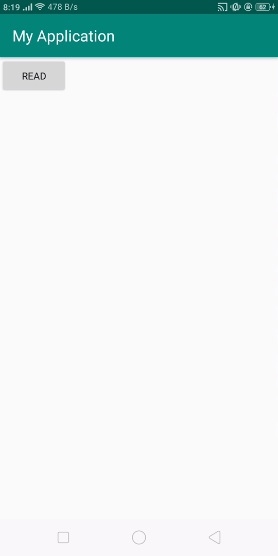
Let's try to run your application. I assume you have connected your actual Android Mobile device with your computer. To run the app from android studio, open one of your project's activity files and click Run play.jpg icon from the toolbar. Select your mobile device as an option and then check your mobile device which will display your default screen −
In the above result, click on read button to show list of external storage directory files as shown below –
Click here to download the project code

2K+ Views
