
Article Categories
- All Categories
-
 Data Structure
-
 Networking
-
 RDBMS
RDBMS
-
 Operating System
-
 Java
Java
-
 MS Excel
-
 iOS
iOS
-
 HTML
HTML
-
 CSS
CSS
-
 Android
-
 Python
-
 C Programming
-
 C++
C++
-
 C#
C#
-
 MongoDB
-
 MySQL
MySQL
-
 Javascript
-
 PHP
PHP
-
 Economics & Finance
Selected Reading
Golang program to define a binary tree
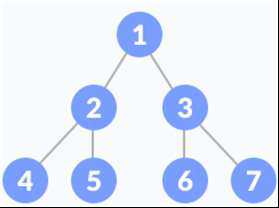
Example − In the given tree, the root node is 1, the root of its left sub tree is 2, and the root of its right sub tree is 3, ... so on.
Preorder Tree Traversal Output: 1, 2, 4, 5, 3, 6, 7.
Approach to solve this problem
Step 1 − First, we’ll define the node structure.
Step 2 − In the main method, we would create the above tree.
Step 3 − Finally, we will perform the Preorder Tree Traversal.
Example
package main
import "fmt"
type Node struct {
   data int
   left *Node
   right *Node
}
func (root *Node)PreOrderTraversal(){
   if root !=nil{
      fmt.Printf("%d ", root.data)
      root.left.PreOrderTraversal()
      root.right.PreOrderTraversal()
   }
   return
}
func main(){
   root := Node{1, nil, nil}
   root.left = &Node{2, nil, nil}
   root.right = &Node{3, nil, nil}
   root.left.left = &Node{4, nil, nil}
   root.left.right = &Node{5, nil, nil}
   root.right.left = &Node{6, nil, nil}
   root.right.right = &Node{7, nil, nil}
   fmt.Printf("Pre Order Traversal of the given tree is: ")
   root.PreOrderTraversal()
}
Output
Pre Order Traversal of the given tree is − 1 2 4 5 3 6 7

Updated on: 2026-03-11T22:50:56+05:30
809 Views

Advertisements