
Article Categories
- All Categories
-
 Data Structure
-
 Networking
-
 RDBMS
RDBMS
-
 Operating System
-
 Java
Java
-
 MS Excel
-
 iOS
iOS
-
 HTML
HTML
-
 CSS
CSS
-
 Android
-
 Python
-
 C Programming
-
 C++
C++
-
 C#
C#
-
 MongoDB
-
 MySQL
MySQL
-
 Javascript
-
 PHP
PHP
-
 Economics & Finance
Selected Reading
Golang program to calculate the absolute and scale of a vertex.
Example
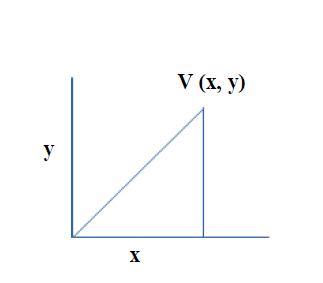
Abs(x, y) => √(x)2+(y)2
Scale(f) => (x*f, y*f)
Approach
Define a vertex as a struct.
Initialize the vertex with some x and value.
Define a method to calculate absolute(x, y).
Define a method to calculate scale(x*f, y*f).
Example
package main
import (
   "fmt"
   "math"
)
type Vertex struct {
   X, Y float64
}
func Abs(v Vertex) float64{
   return math.Sqrt(v.X*v.X + v.Y*v.Y)
}
func Scale(v *Vertex, f float64) {
   v.X = v.X * f
   v.Y = v.Y * f
}
func main() {
   v := Vertex{3, 4}
   fmt.Println("Given vertex is: ", v)
   fmt.Println("Absolute value of given vertex is: ", Abs(v))
   f := 10.0
   fmt.Printf("After scaling by %0.1f new vertex is: ", f)
   Scale(&v, f)
   fmt.Println(v)
   fmt.Println("Absolute value of given vertex is: ", Abs(v))
}
Output
Given vertex is: {3 4}
Absolute value of given vertex is: 5
After scaling by 10.0 new vertex is: {30 40}
Absolute value of given vertex is: 50 
Updated on: 2026-03-11T22:50:56+05:30
392 Views

Advertisements