
Article Categories
- All Categories
-
 Data Structure
-
 Networking
-
 RDBMS
RDBMS
-
 Operating System
-
 Java
Java
-
 MS Excel
-
 iOS
iOS
-
 HTML
HTML
-
 CSS
CSS
-
 Android
-
 Python
-
 C Programming
-
 C++
C++
-
 C#
C#
-
 MongoDB
-
 MySQL
MySQL
-
 Javascript
-
 PHP
PHP
-
 Economics & Finance
Selected Reading
Find Simple Closed Path for a given set of points in C++
Consider we have a set of points. We have to find a simple closed path covering all points. Suppose the points are like below, and the next image is making a closed path on those points.
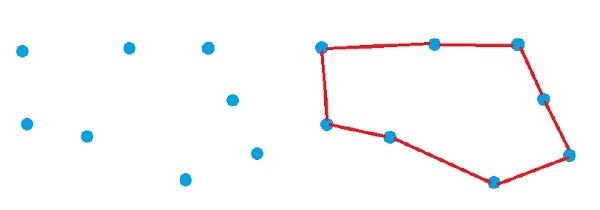
To get the path, we have to follow these steps −
Find the bottom left point as P
Sort other n – 1 point based on the polar angle counterclockwise around P, if polar angle of two points are same, then put them as the distance is shortest
Traverse the sorted list of points, then make the path
Example
#include <bits/stdc++.h>
using namespace std;
class Point {
   public:
   int x, y;
};
Point p0;
int euclid_dist(Point p1, Point p2) {
   return (p1.x - p2.x)*(p1.x - p2.x) + (p1.y - p2.y)*(p1.y - p2.y);
}
int orientation(Point p1, Point p2, Point p3) {
   int val = (p2.y - p1.y) * (p3.x - p2.x) - (p2.x - p1.x) * (p3.y - p2.y);
   if (val == 0) return 0; // colinear
   return (val > 0)? 1: 2; // clockwise or counterclock wise
}
int compare(const void *vp1, const void *vp2) {
   Point *p1 = (Point *)vp1;
   Point *p2 = (Point *)vp2;
   int o = orientation(p0, *p1, *p2);
   if (o == 0)
   return (euclid_dist(p0, *p2) >= euclid_dist(p0, *p1))? -1 : 1;
   return (o == 2)? -1: 1;
}
void findClosedPath(Point points[], int n) {
   int y_min = points[0].y, min = 0;
   for (int i = 1; i < n; i++) {
      int y = points[i].y;
      if ((y < y_min) || (y_min == y && points[i].x < points[min].x))
      y_min = points[i].y, min = i;
   }
   swap(points[0], points[min]);
   p0 = points[0];
   qsort(&points[1], n-1, sizeof(Point), compare); //sort on polar angle
   for (int i=0; i<n; i++)
   cout << "(" << points[i].x << ", "<< points[i].y <<"), ";
}
int main() {
   Point points[] = {{0, 3}, {1, 1}, {2, 2}, {4, 4},{0, 0}, {1, 2}, {3, 1}, {3, 3}};
   int n = sizeof(points)/sizeof(points[0]);
   findClosedPath(points, n);
}
Output
(0, 0), (3, 1), (1, 1), (2, 2), (3, 3), (4, 4), (1, 2), (0, 3),

Updated on: 2026-03-11T22:50:45+05:30
527 Views

Advertisements